

Drukhari Coven:The Pain Engine and the Industrialisation of Torture
I. The Pain Engine as a Civilisational Solution
Cruelty is not a choice for the Drukhari. They attack as if their lives depend on the violence that they unleash. They are not sustained by a single, grand atrocity but by the repeating cycle, with a culture that is engineered to make the cycle feel normal.
The Drukhari are the descendants of a civilisation that closed the circle of pleasure and pain, and paid for it with an eternal predator. Their souls are being diminished, drawn out by a hunger that never sleeps. Slaanesh waits behind every movement they make, she is the reason that brutality has turned to maintenance.
The culture on Commorragh has rituals that turn harm into tradition, hierarchies that give status to those who show that capacity to extract suffering, and a language that says pain is necessary to give life. In a world like this, harm feels continuous, routine, and necessary. And necessity always produces its own technologies.
The pain engines are a symbol of what the Drukhari have become: perpetrators of violence, yes, but more gifted engineers of pain. These constructs are monstrous weapons, designed to make suffering reliable, built to turn something volatile and personal into something repeatable and controllable. They embody the moment cruelty becomes technical.
Human cruelty can still carry traces of hesitation, improvisation, even remorse. A system does not. A system refines. A system iterates. A system improves its output. The pain engine represents a civilisation that has crossed the threshold from violence as expression to violence as method.
A tool can amplify what a single villain cannot: take something unspeakable and distribute it into roles. Torture becomes craftsmanship. Captives become inventory. Pain becomes a resource that can be collected, stored, refined, and traded. Where a person can be guilty; a system can be necessary. A person can be condemned; a system can be defended.
With this in mind, we can look at the Drukhari to see how easily a civilisation can learn to speak of cruelty as though it were simply the cost of staying intact.
The Drukhari offer us an allegory of what happens when harm becomes reliable, and reliability becomes virtue. If we want to understand the pain engine, we first need to understand the world that made it feel like an improvement.
II. How the Cycle Works
The Drukhari do not conquer worlds. They harvest them. They arrive with speed, overwhelm with precision, and vanish before resistance can reorganise itself. A raid is not a frenzy of violence. It is an extraction event. They do not need territory. The Drukhari take what they need and leave an open wound. They do not only seek bodies, but chase after the experience.
In Drukhari lore, a pain engine is the face of coven craft: a construct that displays the Haemonculi's obsession onto the battlefield. The Drukhari do not build engines like this because they need heavy armour in a conventional sense. They build them because their relationship with violence is not limited to killing. They require proximity. They require control. They require bodies that can be processed, not merely destroyed.
Drukhari souls are under constant threat, diminished by a hunger they cannot bargain away, and so their civilisation becomes dependent on intense sensation as a means of renewal, most often the suffering of others. The covens treat torment as craft, building survival technologies. They study how a body breaks, how it can be kept from breaking too soon, and how pain can extracted reliably and often.
Pain engines are the covens’ answer to the problem of scale. A civilisation that depends on suffering cannot afford to rely on variables found on the battlefield.
In the lore, the engines exist to make the covens’ method portable. The engines are operators, built for brutality: blades, injectors, limbs that function like a moving theatre of surgery. Built for close combat, they impose helplessness, emphasising dominion over a living body.
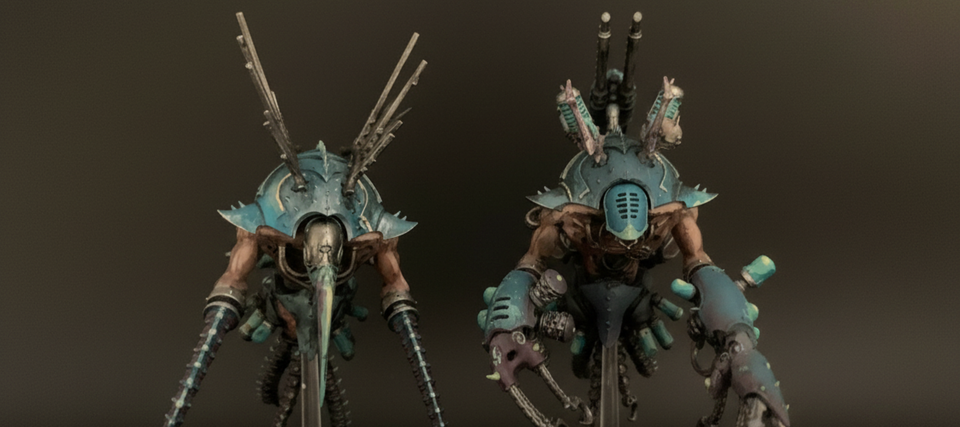
A Talos[1] is a semi-sentient coven construct prized by the Haemonculi as both guardian and mobile torture chamber. On the battlefield it fights with a cold movement. As it harvests flesh it seems to gain vigour while its weapons rake through enemy ranks. The cycle of capture, and extraction repeats, and when the Talos finally returns to the coven’s oubliettes, the remnants inside its shell are drawn out and repurposed into potions and elixirs.
A Cronos[2] is a Haemonculi pain-engine that projects a field of malignant feedback, siphoning life-force from those caught within it, leaving victims to wither in moments. Its trailing tentacles, half-metal and half-nerve, do the same work at close range. The engine of pain shares the harvest with Drukhari, who become stronger and more vital, which is why it is bought, hired and kept close. Used in drawn out conflicts to replenish those in battle, or by overlords on Commorragh as punishment as executioner.
Although they are weapons, they are also a symbol of torture turned into practice, perfection of pain built into engineering. They show the Drukhari have moved from the love of a craft, into the mass production of it. The engines of pain are what you build when cruelty is no longer an impulse but a tradition, when torment is no longer merely desired but required, and when survival itself has been made dependent on a craft that cannot be allowed to fail.
III. Gilles Deleuze: From Enclosures to Control
Deleuze’s “Postscript on the Societies of Control”[3] is a small text with an outsized afterlife. He begins with Michel Foucault’s account of disciplinary society: schools, factories, prisons, hospitals; institutions that shape subjects through confinement and training. Deleuze accepts that picture, but he suggests that a new form is arriving. This new form governs by moving through us, tracking us, reorganising access, adjusting conditions.
“Enclosures are molds, distinct castings, but controls are a modulation, like a self-deforming cast that will continuously change from one moment to the other, or like a sieve whose mesh will transmute from point to point.”
A mold fixes a form. A modulation continuously reshapes the form as it moves. Control is not about locking into a specific situation; it can insist compliance and direction by changing what you are allowed to have access to, where you can go, what you can see, and it costs you to refuse.
While we consider “control” as political, it has also become economic and managerial. Control has shifted boundaries, as our institutions have changed. A factory was once a single body - a set of rules, a box of allocated work hours. But as things moved to corporations, nature of control has impacted other domains.
“We are taught that corporations have a soul, which is the most terrifying news in the world.”
A corporation-as-soul suggests an entity that can move across boundaries, persist beyond individuals, and reproduce itself through mechanisms that don’t resemble older sovereign command.
Deleuze’s “control” is therefore not just coercion. It is an arrangement of flows: circulation of people, money, permissions, identities, and numbers. The language of control is numerical and variable, no longer simple laws to follow, but adjustable code that applies differently in different situations. Control is a conceptual position, where power is under continuous management, shaping behaviour in real time by altering the environment.
He is careful not to claim that the new world is complete. His text is a warning: an attempt to describe how governance shifts when the walls of the old institutions are replaced by moving machines.
IV. Achille Mbembe: Necropolitics and Death-Worlds
Mbembe’s “Necropolitics”[4] rises from the field shaped by colonial domination, slavery, racialised governance, apartheid, and occupation. He writes about a type of politics that is more dire than management of life, in that some structural powers use exposure of death as a form of control.
“The ultimate expression of sovereignty resides, to a large degree, in the power and the capacity to dictate who may live and who must die.”
The aspect of sovereignty exposed here is assessing who has that ability to decide mortality: who is killable, who is protected, who is valued and who is disposable. But necropolitics is not only about the act of killing. It is more-so about the conditions: who has the ability to keep populations in a state of forced proximity to death via injury, exhaustion or precarity.
“... weapons are deployed in the interest of maximum destruction of persons and the creation of death-worlds, new and unique forms of social existence in which vast populations are subjected to conditions of life conferring upon them the status of living dead.”
A “death-world” is a social form, a reality in which life is lived under a governance of mortal threat. A place where the line between life and death is constantly managed, and where suffering, debility, or exposure are not accidents but outcomes of power.
Mbembe insists that modern states treat violence as constitutive, rather than pretending that is an exception. Necropolotics names the ways power uses death as a tool or creating order and control.
Mbembe’s tone is diagnostic, not sensational, and not metaphorical. He writes as if describing the machine as it should be exposed, showing that some political arrangements can be built so that some people are forced to inhabit a world where death is not a single moment, but something that is looming on every horizon. The point is less the spectacle of killing than the reproducibility of exposure: a form of power that can be carried, installed, and maintained.
V. The Pain Engine as Method: When Control Meets the Death-World
Deleuze names control as modulation: power reshapes it’s access, movement and possibility without relying on a single form. Mbembe names necropolitics as the production of death-worlds: social constructs where populations are managed under managed exposure. With both of these views, we can see that death can be used as a form of control, or applied philosophy.
An engine of pain exists as this form of control.
A pain engine appears as an object of war, dropped upon the horizon of the battlefield, yet it doesn’t behave as a conventional weapon. While on the field of war the looming possibility of near death brings fear, the enemy know what awaits them if they engage these and fail. Once on the field, it changes the local reality: the actions of the enemy are changed due to its presence. It does not merely kill, but changes the environment around it.
This is done in a way that aligns with Mbembe’s emphasis on exposure. The pain engine is not a device of clear-cut finality. It is a tool designed to prolong the state in which bodies can be dominated, pushed to the edge without crossing too quickly. In this state, the body is kept in a state of usefulness, and the true source of what needs to be extracted can be.
The Drukhari do not hide this behind some kind of moral language. Their civilisation embraces the repeatability of pain and death. It is maintenance. The pain engine is the refinement of maintenance becoming engineering; When a tool of suffering becomes so stable that it can be iterated, refined and improved, to create tools that make cruelty dependable and consistent.
A lone blade can be condemned as it hs one agent. A machine, on the other hand, removes agency, and distributes it across design and procedure. The horror of the pain engine is symbolised in what it does, but it masks the chain of thought behind it - behind the machine, someone decided that this should be reproducible; someone found the most reliable way; someone designed the process to run again and again.
Deleuze shows us that control becomes the continuous shaping of conditions. Mbembe shows us that necropolitics becomes the continuous production of exposure. The pain engine shows us a single weapon that carries both at once. A mechanism that modulates the battlefield, and a machine that lives between living and dying, between agency and helplessness, between resistance and processing.
The Drukhari, in their own lore, have imagined a world where harm is not merely committed but systematised. The most frightening development is not cruelty as passion, but cruelty as method.
And once harm becomes method, it can be perfected.
Original Link: Talos Pain Engine: Role
Snapshot: Internet Archive ↩︎Original Link: Cronos Parasite Engine: Role
Snapshot: Internet Archive ↩︎Original Link: Postscript on the Societies of Control
Snapshot: Internet Archive ↩︎Mbembe, Achille. Necropolitics. United Kingdom: Duke University Press, 2019. ↩︎