

Drukhari Coven: Wracks and the Voluntary Collapse of the Self
What happens to a self when a society only recognises you as real once you become useful?
I. The Category That Shouldn’t Exist
Torture is an act committed against someone. It has perpetrators and victims. Moments of cruelty and moments of aftermath. For the Drukhari, torture does not follow these patterns. They have built a civilisation where their survival depends on cruelty, and that cruelty makes roles. Harm is not a deviation from social order, but a means by which social order is maintained.
In such a world, it is not the sadists that are the most unsettling figures, it is the ones who don’t flinch when cruel acts are demanded. The question is no longer what is done to a person, but what a system can make a person become. This is where we begin to look toward the Wrack.
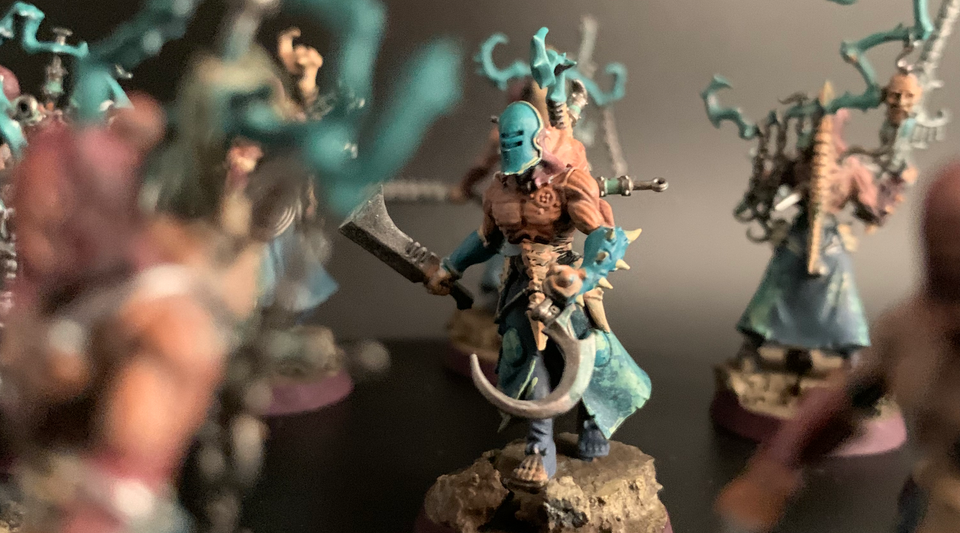
The Wracks are engineered. Tools built by the Haemonculi as assistants and bodyguards. Loyal to their fleshcrafting masters, their existence suggests that flesh and bone can be edited until their identity becomes a tool that the body wears. A Wrack carries the mark of coven authorship, and that mark makes certain assumptions settle in the mind before a word is spoken. The body has been edited into a role that Commorragh understands.
What happens to a self when a society only recognises you as real once you become useful?
The Wrack, in the streets of Commorragh, raises the question of identity as something made between forces: what a person wants, what an institution can author, and what a society will recognise. And if a role can be made stable enough that someone can “know” you at a glance then the boundary between coercion and consent becomes difficult to find.
II. The Coven Workshop: How a Self Becomes a Function
Wracks are created. Born of pain, fleshcraft, and terror, they are subserviant to the Haemonculi that altered their form into the perfected instrument of torture. A member of the Haemonculi Covens, their bodies have been fashioned into something that is designed for a specific purpose.
An Haemonculus is an entity with a god-like mania, composing and altering bodies the same way a sculptor alters stone, except the stone is still awake. Their workshops are place where suffering becomes method, where the boundary between healing and pain is erased.
Wracks are refashioned beings. Cut. Rebuilt. Fitted into new shapes until they become instruments of pain. Their bodies are crafted into tools, shaped for a task, set for the desires of the Haemonculus that grafts, implements and modifies them, until they can fulfill what is aksed of them.
They are built for a task, but they also raise their hands to be formed, choosing a life of servitude to an Haemonculus as a way to rise to the top of the coven, hoping one day to be a lord. This ambition causes them to choose a life of pain and servitude in the hopes of rising above, showing that violence doesn’t only destroy identity in Commorragh, it also produces it.
Many Wracks makes this decision after many long years of boredom on Commorragh, seeking new experiences and debaucheries to savour, they hand themselves over to the Haemonculi as a wager against ennui. Some seek the covens out of devotion, others out of exhaustion, their bodies an escape hatch from their daily experience. When they emerge from the coven workshops they have been retrofitted with the experience they seek, as tools that are needed, built for purpose. Recognised as the very things to give them purpose.
III. Judith Butler: Identity as Performance, Repetition, and Social Production
Judith Butler’s Gender Trouble[1] is often read through its arguments about gender, but the tool we need here is more general: her account of how a “self” becomes socially real.
Butler’s claim is not that identity is an illusion. It is that identity is made; produced through repeated acts that become legible within a field of norms. In her most quoted formulation:
“There is no gender identity behind the expressions of gender; that identity is performatively constituted by the very ‘expressions’ that are said to be its results.”
Taken seriously, this is less a provocation than a method. It shifts attention away from hidden essence and toward the conditions under which a person is recognised. Repetition stabilises the self because repetition stabilises what others can read. An act becomes habit, habit becomes expectation, expectation becomes what feels “natural.”
What follows is a subtle but heavy pressure. If the subject must repeat what a world can recognise in order to be intelligible, then identity is never entirely private. It is formed at the boundary between a body and the norms that decide what counts as a life. The self is not sovereign in the abstract; it is negotiated; shaped by what is rewarded, punished, or simply allowed to appear without challenge.
IV. Frantz Fanon: Objecthood, the Imposed Self, and Being Made “for Others”
Frantz Fanon, in Black Skin, White Masks[2], writes from lived experience. The external gaze turns him into an object before he is seen as a person. In a chapters about the lived experience of a black man, it opens with an exclamation: “Look! A Negro!” It is not the phrase along that matters, but what it creates in that statement. It turns him as a person into an object, a category, something that carries the weight of other people’s stories.
Fanon is direct: “I am given no chance. I am overdetermined from without.”
The self is not merely misunderstood, it is assigned from observation alone. And once assigned, the expectation is that it must live inside that assignment. Reacting, resisting, internalising, all from observation.
Fanon’s writing shows that this is not only political, but it is psychological, bodily, and an everyday pressure of felt experience. The identity, imposed via observation, becomes the way the experience is lived, how a person feels, determines how they are watched. The world demands a performance that is not freely chosen, and that demand saturates how a person feels about themselves. The result is a forced double life: trying to be a person while being treated as an ideal.
Fanon’s work is not just about oppression as a felt-experience, something that is lived in, but about what happens when the oppression installs itself inside the person as a constant negotiation with imposed meaning.
V. Recognition Purchased at a Cost
The value in using these philosophers is that they offer a language for how our social world makes an individual exist in that society. Ways in which identities are produced, fixed, rewarded and constrained through recognition. We are not trying to equate the direct translation of gender theory or racial domination into some kind of fictional plastic horror, they are used to help us to place a different meaning to the life experienced as a Wrack.
If we look at Butler’s emphasis on repetition and intelligibility, the Wrack is not altered once. Being a Wrack is a role that is maintained; the mask, the implements, the engagement in coven work, are not aesthetic. They are signal repeated until the Wrack becomes socially understandable. Their identity establishes because the role is performed, again and again until it becomes the natural thing that is expected.
Fanon helps us see the establishment of what begins with a “name”. The interpreted identity arrives before a person has arrived. After the transformation by the Haemonculus the shape will precede the individual. Others will not ask who the Wrack is, they will respond to what the Wrack is for. Wrackhood illustrates what it means to be an idea from without. To have one’s meaning fixed in society as an idea. To have one’s interior life overlooked because it is not needed to understand what role the Wrack fulfills. The role becomes the primary reality.
Many Wracks step toward the coven. Some do it from ambition: accepting servitude as a path to status. Others do it as an escape: seeking new intensity, a new category, a new way to feel alive in a city where experience can go stale. In exchange for either of these choices, the body is written into function. Life belongs to someone else, and social understanding comes from another’s authoring.
The Wrack becomes a meeting point of three recognitions: the individual seeking a life that “counts” in Commorragh; the Haemonculus authoring a body that is useful and reliable; and the city receiving that body as a familiar type. Identity is created in the overlap; between desire for meaning, institutional design, and social readability
If identity is held between these three points, then the role doesn’t just describe the self. It replaces it. And once a society can do that reliably, the line between coercion and consent becomes a tool.
VI. The Shape of the Question
A society, like the city of Commorragh, recognises people through repeated patterns. They produce beings that can be recognised, and then treat that recognition as reality. Over time, roles become the thing that is “true”, because the role is what others respond to. A Wrack in Commorragh does not need to declare what it is. The city declares it for them.
The Wrack is what happens when a self becomes a social surface. They move through the world without explanation, because explanation is no longer required. Their reformed flesh tells everyone else how to behave. It tells the coven what has been made. It tells the individual what is expected. Recognition has been traded: it grants the Wrack a place, but it asks for the self as payment.
It is with this that we see that identity such a heavy philosophy because it is social. It is produced through repetition, fixed by recognition, and reinforced through the daily responses of others. It is also in the gaze that reads the skin, in the norms that decide what counts, and in the institutions that benefit from people being easy to recognise.
The Wrack is a being whose reality is shown through usefulness: to the Haemonculus who authored them, to the coven that employs them, to the city that understands what they are for. The “self” is stretched across those recognitions until it becomes difficult to say where the person ends and the role begins.
If the role can be manufactured, then consent can be manufactured too.
The question that remains is the one we began with: what happens to a self when a society only recognises you as real once you become useful? In Commorragh, the answer is simple and terrible. The self learns to resemble the role, until the role becomes the only self the city can see.