

Perfection, Paralysis, and the Models I Don’t Paint
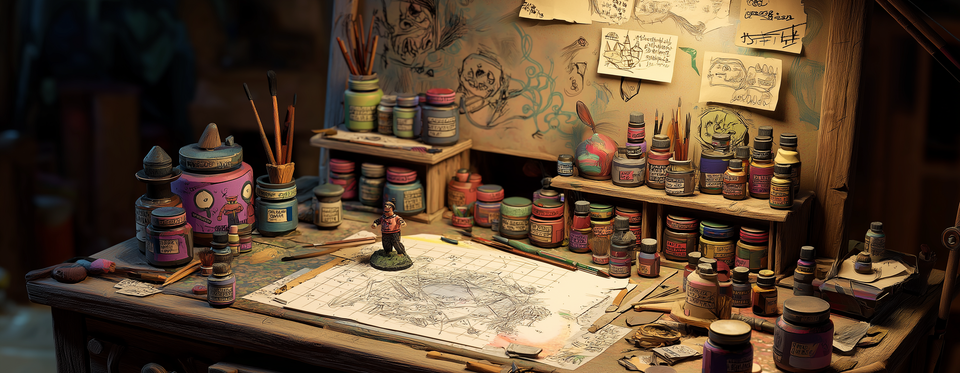
I. The Model in the Box
There’s a model I’ve had for months. Still in its box. I know exactly how I want it to look. I have the palette planned, the base imagined, the final pose in my mind. But I haven’t touched it.
I’ve built it in my head a dozen times over. Each time, more perfect. And that’s the problem. The imagined version has become so complete, so pristine, that any real attempt would feel like a compromise. I hesitate out of a kind of reverence, as though starting would desecrate the thoughts I have of it..
This is not procrastination in the usual sense. It’s something closer to fear. The fear that the moment I put brush to plastic, the dream will begin to die. That the gap between intention and execution will reveal itself. Wide. Unbridgeable. Mine.
And so I wait. Because as long as it’s unpainted, it’s still perfect.
“I hesitate, not because I don’t care — but because I care so much that I’d rather protect the idea than risk the failure.”
II. The Ideal Before the Hand
Every unpainted model is a perfect idea. It sits, sealed in plastic, uncut, unprimed. Because it’s untouched, it’s unspoiled. In my mind, I’ve already painted it a dozen times. I know the highlight on the knee plate. The drybrush on the base. The final placement of the basing terrain.
But none of them exist. They are shadows of a Form, based on an ideal that lives in my mind.
Plato wrote that everything we touch, build, or see is only a copy of a copy. A pale reflection of an ideal. What he called the Form, it exists beyond our world. In his allegory of the cave[1], the prisoner who escapes the shadows and sees the sun believes he’s discovered truth. But when he returns to the cave to share it, the others laugh. They trust the wall more than the world.
Painting, in a strange way, feels like this reversal.
My mind escapes the cave easily. I picture the model in radiant detail: the edge highlights, color harmonies, and the basing that grounds it all with quiet authority. It is a complete vision, as close to a Form as I can imagine. And having seen that sunlit shape in my mind, I return to the desk, to the box, and to the plastic.
I hesitate.
I know the moment I begin, I lose the vision. The Form vanishes. All that remains is pigment and plastic. A copy, and a copy of that. The ideal collapses into effort. Every brushstroke feels like a dimming.
So perhaps I keep the box closed not out of fear, but out of reverence. Because I know: to make the thing real is to admit that it will never be what I imagined.
The mind adores perfect things. But the hand ruins them.
III. Acedia and the Weight of Intention
I thought at first it was laziness. The kind of casual procrastination you shake off with a coffee. But it’s not that. It’s something heavier. There are models I build without thinking, but this one has weight. This one carries intention. And it’s that intention that slows me.
And when something matters the start becomes heavier than it should be. Every brushstroke feels like a question: Are you good enough to meet your own standard?
The monks had a word for this: acedia.
In the fourth century, it described more than boredom[2]. More than sloth[3]. It was a kind of spiritual fatigue[4]. A turning away from what one ought to do, not out of defiance, but because it felt meaningless, or too meaningful to bear. It struck in the midday hour, when the sun was high and the soul sagged. When the monk would stare at the scriptures, knowing their purpose, and still feel nothing. Or too much.
Acedia isn’t always loud. It doesn’t always look like despair. Sometimes, it sounds like: I’ll start tomorrow. Sometimes, it feels like a model untouched for weeks.
That’s the paradox: I don’t avoid the brush because I don’t care. I avoid it because I care too much, and I fear what the result will tell me about my ability to live up to it.
This isn’t depression. It’s not refusal. It’s reverence, curdled. Acedia is what happens when we know the work is meaningful, and still can’t move.
IV. When the Idea Has to Die
If I ever do begin, I will fail. That’s not self-doubt. That’s the fabric of the universe.
There is no path from imagination to execution that does not pass through imperfection. The moment the brush touches the model, the idea begins to die. The clean, complete, perfect vision I’ve carried in my mind starts to collapse under the weight of choices.
And maybe that’s the part I haven’t accepted. That painting the model means killing the idea. But opposite, the death of the idea is the only way it can live.
V. Wabi-Sabi and the Honest Mark
In Japanese aesthetics, there’s a quiet philosophy called wabi-sabi[5]. It doesn’t celebrate imperfection in a cheap or romantic way. It acknowledges that impermanence, incompleteness[6], and imperfection are not flaws to be corrected, but features of being itself.
A crack in the glaze. A fading line of ink. The accidental wobble of a hand-carved bowl. These are not errors. They are fingerprints of time. Proof that something passed through the world, and left a mark.
So perhaps I’m wrong to mourn the gap between my vision and what will be painted. Perhaps the gap is the work.
Maybe the model isn’t meant to match the idea. It’s meant to record the moment the idea entered the world and changed in doing so.
VI. The Model Does Not Improve in the Box
The weight does not come from the model. It comes from the idea of the model. The version that exists before the first cut. The image is so complete in my mind that it begins to hum with expectation. But that expectation has no body. It is a Form, and like all Forms, it recoils from becoming real. To touch it is to lose it.
Acedia shows in those between spaces. The way the act matters, and still finds no breath to begin. It is the soul, stalled. Not by confusion, but by clarity. The more I believe this model should be meaningful, the more impossible it becomes to act. The brush does not weigh grams. It weighs years, my intentions, pride and my self-image tied to the not-yet finished model. I feel all of it when I pick it up. The stakes rise not because the model is important, but because I made it important.
When I finish thinking of acedia, all that remains is wabi-sabi, waiting without apology. To create is not to preserve an idea, but to alter it forever. That what I make will never be what I imagined. The first stroke is a crack. And every mark after it is a drift. The finished piece, if it ever arrives, will not be the dream. It will be the scar where the dream was turned into something mortal. Something human. Something flawed. And something honest.
That is the goal, though. To model.
To find that quiet rhythm where time recedes and focus sharpens. To settle into the act so fully that the separation between self and stroke begins to dissolve. Where there is peace in the movement of pigment across plastic, where the hand gives shape to thought, and the miniature becomes more than a thought. Turning into something enduring, something spiritual.
But it will never become that if I wait.
There is no clarity that arrives through hesitation. No miracle of technique that descends in the absence of effort. If I sit back and wait for the perfect to emerge from the skills I have not yet earned, I will wait forever. The model does not improve in the box. The image in my mind only grows more radiant the longer I avoid it, untouched by reality, immune to failure.
And so I stall. I think about the other kits I could build. The other armies I could begin. The endless miniatures I might one day finish. I tell stories about them because they haven’t disappointed me yet. The imagined version of myself who paints them is always better, more skilled, more precise, more ready than I feel now. It is easier to remain in the future, in the infinite library of plans, than to confront the quiet demand of this one, single model.
VII. Momentum, Not Perfection
In reflecting on this, I’ve come to sit with the idea of wabi-sabi. The Japanese aesthetic that embraces imperfection as truth. There is something quietly radical in this. Something deeply human. It tells me that beauty is not found in symmetry or polish, but in the visible record of process. The miniature will be imperfect. It must be. But it will also bear witness to my time, my effort, and the small changes in who I am as I paint it.
When I finish this miniature, I will have more than a painted model. I will have the memory of time spent. The silent moments of concentration. The mistakes I noticed too late. The things I quietly got right. This figure will become a point in a timeline that stretches beyond it. A small instance in a long journey. A step, not a statement. It will carry my present limitations, yes, but also the path through them.
There is no final miniature. No perfect moment of arrival. Each one teaches. Each one wounds a little. Each one gives something back. And so this model, the one I’ve avoided, is not a test I must pass. It is a step I must take. Because if I do not paint this one, I cannot paint the next. And if I do not face the imperfections here, I will never earn the ones to come. The scars I leave in this paint will become part of how I learn to move forward.
The end, if there is one, is not a final piece that outshines all others. The end is momentum. The ability to keep painting, to stay in motion, to grow without waiting for permission from some imagined future self. In this light, the miniature is the path. It is the means by which that ability is built. In the scale of a lifetime, it is nothing. But without it, nothing can begin.
Gill, N.S. The Allegory of the Cave From the Republic of Plato. ThoughtCo.
Snapshot: Internet Archive ↩︎Original Link: Acedia: the lost name for the emotion we’re all feeling right now
Snapshot: Internet Archive ↩︎Original Link: What Is Acedia? How a Medieval Stigma Remains With Us Today
Snapshot: Internet Archive ↩︎Original Link: Acedia: The Overlooked Vice
Snapshot: Internet Archive ↩︎Original Link: Why Wabi-Sabi Is the Best Philosophy of Life
Snapshot: Internet Archive ↩︎Original Link: What is wabi‑sabi? Will this Japanese philosophy make me happy?
Snapshot: Internet Archive ↩︎