

A Limited Edition Christmas: The Goblin That Means Christmas
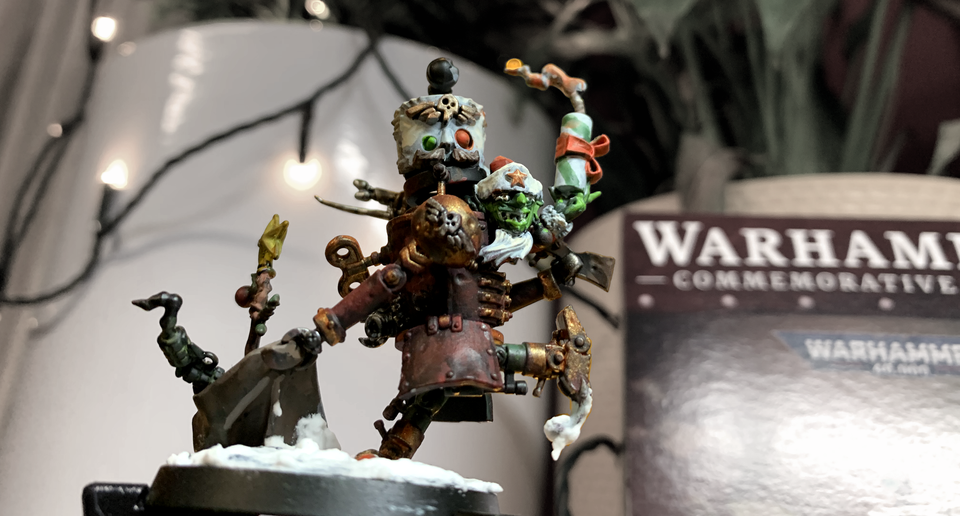
I. The Goblin That Means Christmas
The Christmas goblin doesn’t come as a surprise. Deviant, a little wacky, but always expected. A joke that has gone on for so long now that it has stopped being funny and has become a yearly ritual, like decorating the tree or getting socks from the in-laws. Every year a new Christmas Gobbo, every year a new sculpture with some comedic pose, more ork than any other release. Before we realise it, amidst the end-of-year chaos, there is another small green idiot model to paint. We bring this upon ourselves, yet it is difficult to set it aside for the pile of shame.
Our festive rituals are usually remembered to be something different from everyday life: opening presents or hanging decorations, the same kind of things we do year on year, things that make it feel like Christmas. Our recent essay series we looked at how the machines now starts these rituals instead of us, and the way playlists and gifting suggestions bring the season before we decide to join in. The world we live in has things in plce to bring the festive season around.
Come October we can expect the announcement for the Gobbo[1], it doesn’t arrive with the fanfare of a new Space Marines release, but the announcement arrives and sets the expectation for the pre-order. The community post shows up, we wait for the pre-order, and hit the purchase button on the release date. This is the ritual now; this is something that happens at this time of year.
First we buy it as a joke model; there is something cute about it, and we have a little extra money spare. The second time, it's a callback, another entertaining model to match along with the last. By the third or fourth year we hardly notice that we have pre-ordered the new gobbo. There is an expectation for a Christmas model; we know it will be absurd, but the new model is going to join the collection that no-one officially named. We tell ourselves that we could skip a year, but if we did that line would be broken and some part of the festive season would feel empty.
It would be nice to say that this is all fun and games, but there is a subtle undercurrent running through this release schedule: the knowledge that what feels like tradition is also a predictable spike in a Q4 chart, in an office somewhere. This small plastic is sculpted nostalgia that sits at the crossroads of limbic capitalism and tradition. This is not some kind of special algorithm that is used to predict our purchases, no complicated manipulation; it is something more basic: the fact that we can’t help but make meaning out of repetition. The model comes back because the season comes back. And we buy it again, because what is repeated becomes ritual. A small joke became a way to count the years, a new decoration in the box, and a new silly proof that we survived another season.
II. Industrialised Festivity & Limbic Capitalism
Companies use data to lure us, to connect with us, and to sell to us. Systems are in place that organise themselves around the areas of the human nervous system: where we crave, repeat and remember. We believe we can tune these signals out, but the companies exploiting our limbic systems know exactly how to control us all. This is evident in the festive cups at the coffee shop, the unnecessary decorations placed in the checkout lanes, and this small green goblin dressed in festive gear and grenades: each a play on a hidden part of our choice systems, built to entice and entertain.
The systems we exist inside record our movements, understand what we do, and build them around our behaviour. The calendars in their hands are not sacred seasons but spreadsheets of peaks and troughs, algorithms built to interpret our input and give us what they want us to be looking for. This goblin is a minor character, a footnote in a much larger balance sheet, but it does what it needs to do. It is festive but not serious, cheap enough to feel like a treat, and timed to be released when we are looking for something to add to the table. It comes wrapped as a joke, as if Games Workshop is sharing in a private joke with us about the absurdity of the whole season. The joke disarms us, but the truth is enough of us buy it every year for the company to release a new model.
Games Workshop is not pre-programming Christmas for us, but they have learnt to run in the slipstream of patterns we leave for them. The Christmas Gobbo returns every year because we are built for ritual, and they are offering the very thing we have come to expect.
Limbic capitalism[2] doesn’t want to only sell us things; it wants us to respond from the nature of our being, through the cravings and the half-thoughts, to join in the buying of things that have been influenced beneath our understanding. After a long year, the seasonal item, whether it is a coffee mug, a jumper, or a limited-edition miniature, doesn’t have to be good; it only needs to make us feel a part of a season. It should provide us with a quick way to celebrate, mark the year, and carry on the long-standing tradition of embracing the Gobbo.
While the season is sold to us as one of abundance and being present, it is now just a series of rare items, limited edition models, and deals that are available for a short time. Each of these pulls on the internal circuitry that, in the past, brought us to family, rest, and remembrance; now it pulls us to the things that companies are looking to sell. We laugh at the festive drop and how easily we are tempted by it, but we know we are being played.
The Christmas Gobbo isn’t the worst example of this; there are worse, more predatory forms of holiday shopping, but this one is enough to show us how easy we are to manipulate. It is a small, useless and stupid model that shows up when our defences are at their lowest, perfectly tied to this time of year, as we are waiting for the pre-order to become available.
III. Vulnerable Because We Care: Exploitation & Attachment
We click purchase each year. We feel bad about being manipulated, but it is so easy to pick up the next drop because the system knows how to pull on our human instincts. Limbic capitalism[^3] works because there are places within ourselves that are able to be enticed, things passed down from our ancestors that existed long before the graphs.
That same thing that opens the door for us to be influenced by the festive spike is the same thing that connects us to loved ones; it doesn’t let us forget songs and creates strange habits that make living together possible. The Gobbo gets into our festive season because of our internal wiring, something passed down in human nature that connects us together. If we could choose to kill that response, to make the choice to not have the Gobbo exist, it would stop us from finding our tribe and stop us from returning to our families each year.
We can see the pathway of history with each new Gobbo. Initially he is nothing more than a curiosity, an excuse to paint an orc in a festive suit. The second year, the model is a recognition of something from the previous year. By the third or fourth year it becomes a way to track time. You remember which one was being painted when things went wrong that year. This one here was half-finished and in a rush to complete before going back to work. The business can only see this figure as a string of sales, but there is no database category for “the year my father was sick” or “the December I wish I could forget”. This same yearly festive idiot stitches time together, no longer a product, just a witness who has been through the years with you.
The companies who target Christmas look at the bottom line, but they don’t evaluate the sense of escape that these festive rituals can give us each year. And, in this way, the Christmas Gobbo is a great example of a larger pattern we have revealed in these essays: how systems and machines are getting in the way of our memory, generosity, and the desire to return to our rituals that make the season worth celebrating. That same feeling we felt when the Christmas decorations came out each year is the same softness we have for the yearly Christmas Gobbo.
There is no easy way to tell the difference between good and bad. The goblin is a sign of a predatory economy and a way for people to connect with each other. While the machine can put a price on the moment we press the Add to Cart button, it can’t put a price on the feeling we get 10 years from now when we pull a worn-out model from a messy box of decorations and, for a second, get a sense of recognition and comfort. That feeling is not nothing, as all our old rituals try to hold onto that same thread.
IV. Reclaiming the Goblin: Meaning After the Sale
The miniature arrives, the transaction ends. Graphs update, the quarter ticks closer to target. For the company, that is almost the whole story. The goblin completed the task, pressed into the limbic system, and converted into revenue, marked as “units sold” and into a prediction model for next year. If we stopped here, the story would be bleak: the softer parts of our humanity were extorted for gain from a large company. End of scene.
The sale is the least interesting part of this story. Once the miniature arrives, it is no longer part of the system it created; it drops into ordinary life. Half built on the workbench one year, half painted the next until motivation strikes at 11pm to get it completed; knocked over by the cat; rescued from the bin at by someone who mistakes it for another toy. In this particular second life of the model there are no sales metrics attached. No one is monitoring your feelings. It is in this life that the miniature slips from the target of the creator and into the dirty life, the ebb and flow of time, that makes it ours.
The exploitation doesn’t vanish. Our soft parts are still nudged by machines that know how we think and how we purchase. We buy a tree, decorate it for a few weeks and drag its shedding body to the rubbish. We cook more food than everyone can eat. The season is marked by decadence and excess, and the goblin sits somewhere in this confusing mess. He is a luxury that pretends to be a joke, and still there are hours put into the painting that show he is more serious to us. These hours we could have spent on something more productive or virtuous.
Time heals all wounds; time also forgets transactions, but it doesn’t forget the residue that remains from years of repeating the same rituals. The receipt will be somewhere, but what really remains are the memories: the night you stayed up later to finish the textures of the Santa hat; the year painting with your firstborn being rocked to sleep; the failed December where he only got the base coats. These memories do not excuse the system producing limited edition models that catch our mood swings; they do show that the system never fully understands the impact. The purchase that bleeds into care, satisfaction bleeding into sadness, and the lasting impact that these trinkets hold on our soul longer than the toy says they should.
This is all we can hope for, that we go on remembering the models for what they do to us, rather than the graphs that predicted our purchases. This seasonal model will never be innocent, born of a mould cut in the shape of our weaknesses, his release timed for us when we are weakest. But, for us, he can be a marker for the years that we have survived. When we dig him out each year, we don’t think of shareholder value; we think about the memories attached to him, and in that moment the model takes back a small amount of ground for ourselves.
V. A Limited Edition That Refuses to End
It is difficult to tell when the marketing campaign ends and the season begins. The Gobbo appears in stores and welcomes us into the season. Grotmas is as expected as any Saint’s Day now, a way to keep us coming back, a bright mark on our calendars and a priming of our limbic systems for the coming year. It is important that we see the trap in this, to see that we are being led through a narrow corridor where every turn has been designed for us in advance. The release cycle is not innocent; it is tuned into our systems, attuned to our decisions, and primed to engage us when our shields are low. Each December we are called by a miniature that has the hallmarks of a joke, but is at the same time an invoice for our longing.
This time of year our festive feelings make us malleable. We buy a tree that lasts a few weeks, buy lights that tangle into unmanageable knots, and gifts that lose their shine. We do these things knowing that it is not strictly rational. The point was never sanity, but that these things leave waypoints in our lives, and markers in our years. The dead tree, the lights and the stupid goblin miniature become waypoints that we leave in the ground.
The systems around us lean on these impulses, but our impulse preceded them. Our inbuilt mechanisms draw us together, allow us to remember and also to create memories that last a long time. On one hand, this little goblin is a lure, a cheap trick in place to draw us back every year, but on the other, he is something that the system can’t process, something that extends beyond algorithms and Q4 charts. Each time he appears, he drags our persistence along with him; those yearly markers we can’t help but attach meaning to something small and diabolical.
The yearly Christmas Gobbo serves as a reminder that we are shaped by forces that wish us harm, yet we continue to put meaning into the gaps between their intentions. A spark we have chosen to be marked by the same silly rituals, year upon year. A stubborn insistence that we will build meaning, create connections, and return to the ache of being included in a tribe. The system is dependent on our weakness, and that weakness ends up betraying us and defining us at the same time.
Original Link: Wreck the halls – Da Red Gobbo is back with a festive robotic contraption
Snapshot: Internet Archive ↩︎Original Link: The Deep Mechanics and Consequences of Limbic Capitalism: A System of Exploitation
Snapshot: Internet Archive ↩︎