

Drukhari Coven: Immortality Without Redemption
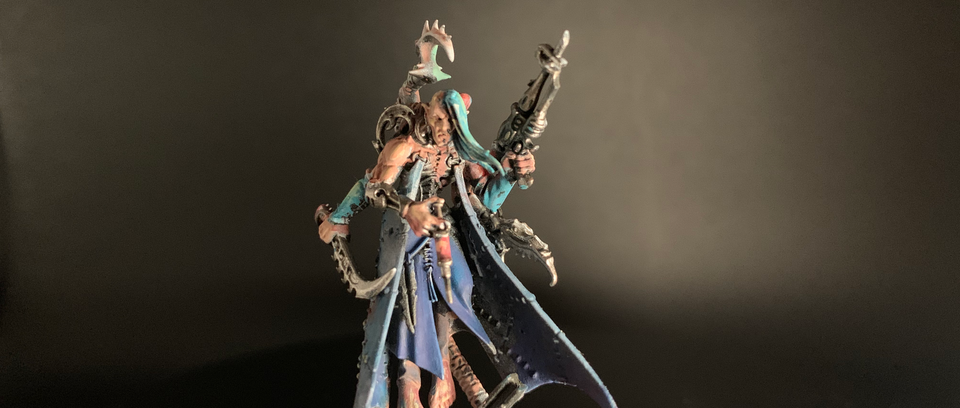
What becomes of meaning when death is negotiable?
The Problem of Endings
The Drukhari do not dream of immortality the way other civilisations do. There is no imagination of peace in it. They are not seeking to extend scholarly work, or to expand an empire. In their world, immortality is an operational advantage. No redemption. No cleansing. No reconciliation. Just continuation.
In Commorragh, immortality is not an abstract hope, it is a mechanism. Death is common, but endings are negotiable. Controlled mainly by the Haemonculus, a lone figure that can bring back life from the end. But if a single figure is in control, the immortality is a relationship. A service. A debt. A form of ownership.
If death is not an ending then meaning doesn’t expand, it can collapse. Life can become repetition without resolution. But the greater problem is not boredom, it is the authority being held by someone else. If the terms of continuation are granted by someone else, the shape of that life is not chosen by the one living it.
This is not to focus on immortality, or to find if it is desirable. We are asking what becomes of meaning when death is delayed without transformation? What happens when the delay of death is controlled by another intelligence? Particularly one that treats flesh as craft, and immortality as leverage.
In such a world, what restrains appetite? What ends a cycle? What allows forgiveness to mean anything—when even the ending of a life is no longer guaranteed to belong to the one who lived it?
II. The Haemonculus in Commorragh
The Haemonculi, the Drukhari’s so-called “Lords of Pain,” are flesh artisans who work from the depths of Commorragh. They are connoisseurs of suffering and specialists in bodily revision. Able to graft, reshape, and redesign their subjects with obscene precision. Even other Drukhari fear them, because their craft is not limited to enhancement. It can also become punishment: a reminder that in Commorragh, the body is never fully your own.
Organised into covens, the Haemonculi are leaders of self-governing factions spread across the Dark City. Each Haemonculus is closer to a sovereign craftsman, surrounded by a retinue of creations and acolytes, treating his domain like a private laboratory and his rivals like colleagues in a citywide arms race. In Commorragh, information is power, violence is currency, and fear is a stabiliser. The Haemonculus holds rare kind of power, the ability to re-enter life after it should have ended.
Among the services provided to the rest of the Drukhari society, the Haemonculi offer biological enhancements, grotesque military technologies, and the ability to restore those who would otherwise be lost.
“The strange science of the Haemonculi allows them to regenerate a fallen "client" from even the most ruined remains, essentially bringing him back to life in exchange for a portion of his soul.” [1]
But they are not a benevolent restorer, their craft is inseparable from domination. They speak through the body, altering, correcting, weaponising, preserving, or rewriting it. Their workshops produce the Wracks, Grotesques, and the drifting pain engines such as Talos and Cronos.
The Haemonculus finds itself in a position of control within the social structure of Commorragh, a force that cannot rule openly, but can ruin it privately. Their influence is threaded through dependency, favours owed, restorations granted, enhancements purchased. If you cross them, the consequence is greater than death. Death is one of the smaller outcomes available to someone who treats the body as a canvas for horrors.
The Haemonculus’ true place in Commorragh is a figure who turns mortality from a fact into a variable. One who can make continuation less like survival, and more like obligation. In a world already haunted by the slow pressure of soul-drain and the need for replenishment, the covens offer a brutal reassurance: you can be restored—provided you can pay, and provided the one who restores you decides what you will be when you return.
“As masters of regenerative techniques, they hold the power of life and death over their Commorrite kin, handing out a sham immortality to those who court their favour. The strange science of the Haemonculi allows them to regenerate a fallen "client" from even the most ruined remains, essentially bringing him back to life in exchange for a portion of his soul.” [2]
Bernard Williams: Immortality and the Tedium of Continuation
Bernard Williams, in “The Makropulos Case[3]”, reverses the usual beginning to talking about immortality by stating very stark: “Immortality, or a state without death, would be meaningless… so, in a sense, death gives the meaning to life.”
This rephrasing of the regular discussion moves the pressure back to the time we have allotted, refusing the romantic assumption that “more time” automatically means “more value.” Williams shows this by the figure of Elina Makropulos (Emilia Marty), whose extended life has reached a condition of boredom and indifference. We get to see what a life can look like when continuation has outlasted intensity.
If an immortal life is recognisable by its character, tastes, and temperament, and all these traits remain stable, then that life faces the problem of repetition. Even if experiences vary, personal patterns recur, and the recurring patterns begin to feel like a trap:
“The repeated patterns of personal relations, for instance, must take on a character of being inescapable.”
But if an immortal life avoids repetition by constantly changing, the subject may no longer be continuous in any meaningful way. The escape from boredom risks becoming the loss of the self who was meant to enjoy the escape. Either endless life becomes tedious, or it becomes so transformative that it ceases to be the same life.
Williams introduces the idea of categorical desire, the notion that distinguishes between wanting things within life and wanting life itself as the condition for those things. We don’t want to live “at any price”, instead we are “propelled forward” by desires whose satisfaction presupposes our continued existence.
“What we can say is that since I am propelled forward into longer life by categorical desires, what is promised must hold out some hopes for those desires.”
If categorical desires persist forever, one begins to suspect they will become emptied by repetition. If they do not persist forever, then the desire to continue living loses its grip. Williams writes that even if categorical desire sustains the desire to live, an eternal life would still be “unliveable,” because categorical desire will “go away from it.”
Williams’ claim is not based on immortality being boring, but focuses more on the fact that there are conditions that make human life valuable. Finite projects, character defining commitments, and the possibility of completion. These are the same conditions that make an indefinitely extended life unlivable.
Ernest Becker: Death Denial and the Machinery of Meaning
Ernest Becker takes the fear of death as an organising pressure that permeates human life. In his book, The Denial of Death[4], his thesis is both psychological and civilisational, not simply that death frightens us, but that our awareness of mortality creates a unique contradiction: humans are animals who must die, yet who can imagine, anticipate, and feel death looming.
“the idea of death, the fear of it, haunts the human animal like nothing else; it is the mainspring of human activity—activity designed largely to avoid the fatality of death, to overcome it by denying in some way that it is the final destiny for man”
Becker returns to the idea that the psyche must build defences as conditions of functioning, not only as coping mechanisms. “Heroism” is not mere admiration for bravery, but an urge to establish significance in a world where the body’s finitude threatens to reduce significance to nothing.
“Society itself is a codified hero system, which means that society everywhere is a living myth of the significance of human life, a defiant creation of meaning.”
Becker finds that culture is a system for manufacturing meaning strong enough to stand against the anxiety of death. He says that society is a hero system. Meaning is not discovered in a neutral landscape; it is asserted against the threat of annihilation, found in the way societies have been created from the stories passed between generations.
He presses further, saying that these systems, the societies we live in, are all forms of religion. Every society functions “as a ‘religion’ whether it thinks so or not,” as each offers a symbolic structure by which the individual feels elevated above mere animal finitude. Through status, legacy, ideology, devotion, and achievement.
If meaning is culturally engineered as a defence against death, then meaning is never wholly innocent. It can be used; It can be weaponised; It can demand sacrifices, because the social order is protecting something as primal as the ability to endure consciousness of mortality.
If the fear of death is a mainspring of activity, and if culture builds hero systems below that pressure, then a world in which death is negotiated, delayed, or outsourced may force meaning into existence and cause it to mutate rather than disappear.
Hero systems might intensify, become more elaborate, or become more desperate, because they are no longer anchored by an unquestionable ending. Becker’s work carries the implication that the relationship between death and meaning is not only personal, but infrastructural.
Section 5 — Return: The Drukhari as a Thought Experiment in Meaning Rot
In most philosophical discussions, immortality is imagined as something that happens to you: a condition you receive, suffer, or endure. At the hand of the Haemonculus, immortality is closer to a service which is granted, withheld, priced, and revised. A body, once altered, is stamped with authorship. The change comes with a debt. The question of immortality has shifted from time to authority.
Williams is not suggesting that immortality grows dull, instead he argues that the meaning of life depends on limits. If continuation stretches without closure, there is the risk of being trapped in repetition, or else being forced to change so drastically that life not longer resembles the person who started it. Immortality threatens meaning by removing the very things that make meaning possible.
The horror of immortality brought about by a Haemonculus is that death becomes a variable, and life becomes something that is administered. The worst outcome is not endless time, but endless time without ownership. Life that cannot be refused, a resurrection that can happen any time the owner wants because the Drukhari life has become valuable enough to persist.
As human beings we have built “hero systems” to defend against that kind of insignificance. Becker argues these structures of meaning allow us to find, and justify our ultimate end. In Commorragh, the kind of immortality offered by the covens is not transcendence. There is no lifting into significance, just a reduction into utility. Meaning is not earned through heroic struggle against death, it is assigned by the one who controls.
When we allow these philosophies to sit, we can see how meaning is created in human lives. But in Commorragh, we can see the horror of immortality offered by the Haemonculus for what it is. A form of existence that continues, but never finds an end, controlled by a figure that can postpone the end, while turning significance into function. Kept in motion by obligation, by debt, and by the knowledge that even in death the body can be reanimated to serve another’s desire.
Immortality in Commorragh is not an extension of time in which life can find meaning and purpose, but a tool in which control can be established and persist. In Commorragh the question is not: “Would you choose to live forever?” It becomes something colder, something darker:
What becomes of a life when even its ending no longer belongs to it?
Original Link: Haemonculi: Role
Snapshot: Internet Archive ↩︎The Makropulos Case: Reflections on the Tedium of Immortality
Original Link: pdf
Snapshot: Internet Archive
Williams, Bernard. “The Makropulos Case: Reflections on the Tedium of Immortality.” Chapter. In Problems of the Self: Philosophical Papers 1956–1972, 82–100. Cambridge: Cambridge University Press, 1973. (link)(snapshot) ↩︎Becker, Ernest. The Denial of Death. United Kingdom: Souvenir Press, 2011. ↩︎