

Kill Team: Politics of the Operative
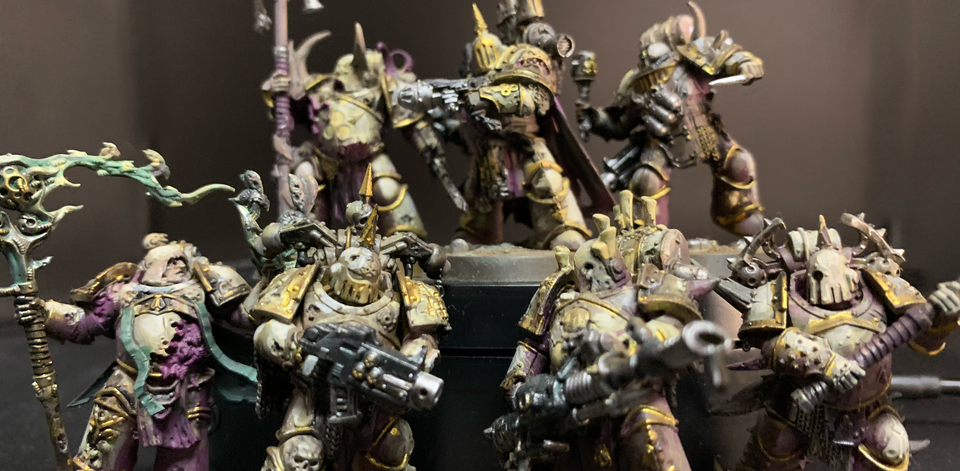
Kill Team turns people into roles. So do institutions.
I. The Politics of the Operative
In Kill Team assembling a roster is an important part of starting the game, selecting the correct warriors to challenge your opponent. A small column of roles, a few lines of wargear, a set of functions. Champion. Icon Bearer. Gunner. Heavy Gunner. Warrior.
A person becomes a slot in a plan. It is not an army, it is a handful of bodies chosen for what they do, each one with a defined purpose inside the rules that govern them.
It is tempting to treat that as merely a game abstraction, but it is also how modern institutions preserve their ability to make hard decisions without breaking. A role is void of humanity. A role can be made redundant. A role can be replaced with another body. A person, on the other hand, is untidy. A person has a history, a voice and a life that has to exist.
War has always relied on this separation. Rank and position exists to make obedience possible and loss administrable. Those who start a fight rarely stand on the soil where the fighting happens. The distance between decision and consequence is bridged by the language of war and by the language of function.
The myth of the Death Guard has always leaned toward endurance and utility. Once known as the Dusk Raiders, they were later renamed under Mortarion, the legion specialised in dirty jobs, and attritional campaigns, fighting where ceremony was a liability. The journey toward corruption, being embraced by Nurgle, did not erase the established ethic. They are not fast, not elegant, but difficult to remove and stubbornly present. Even in Kill Team commentary, they are consistently described as a team that wins by refusing to give up.
Throughout history, bureaucracy has relied on the role rather than the individual to fulfil its needs. A factory worker can be depended on without being understood. A soldier can be deployed without being mourned. The system does not need to know who you are; it only needs to know that the function will still be carried out.
The role is a language that makes sacrifice administrable.
To exist within this role people often chose to live inside the position offered to them. They learn to inhabit the shape because it offers a kind of permission: to be recognised, to be counted, to be useful. Worth gathers around the function. A person begins to speak in the system’s vocabulary: belonging, status, a steady story about who they are.
This is how large systems become livable. We adapt. We accept the terms. We exist within the defined terminology. To an extent, we change who we are so that the role becomes something we identify with.
The institution knows this. It does not need to crush the individual if it can train the individual. The work becomes “just work.” The order becomes “just procedure.” The harm becomes “just policy.” And once a deed is framed as a function, the person performing it can remain decent in their own eyes while doing something indecent in the world.
That is the quiet power of the operative. Inside the role, everything can be justified as necessity. A roster is only a list until the world asks it to become an alibi.
II. The Unplanned Loyalty
A kill team is assembled as a set of functions, yet the moment it is placed into danger it begins to develop a second life. The first life is the task that the team was established for, this is what the system says it should be. The second life is what the team builds around what it learns of each other. Not doctrine, but proximity. The glance that becomes an instruction. The silent nod, understood and obeyed.
This is the human remainder. The part that will not stay procedural.
From the outside it looks like training, but it is how humans collaborate. Forged through training and pain. Taught in repetition. Competence forms in pairs before it forms in orders.
This is why the language of brotherhood appears so often in war, even when war itself is indifferent. A “band of brothers” is not an ethic issued from above. It is what we look for when placed close enough to death that the only stable horizon is each other. The institution may recruit a gunner, deploy a heavy, promote a leader, but the unit begins to recognise different things: someone who stays awake when no one is watching; one who carries more than their share; the team member who jokes at the wrong time.
The bond makes them stronger. It creates a comfortable centre inside the machine that is always changing. A person will do the task, but he will also do something the task does not include: cover the mistake, share the blame, pull someone back when the plan says leave them. It is a quiet rebellion against being reduced to function.
And then the system learns the value of it because it counts what works. Cohesion becomes a doctrine. Loyalty becomes a tool. The bond that made them harder to break becomes another resource the institution can use, with cleaner conscience and higher confidence. The unit will endure what the individual would not.
Even the Death Guard, for all their corruption, suggest the same pattern: A fellowship built from shared endurance, the kind of bond that survives because everything else has already been stripped away.
III. Culture as a Civilian Uniform
Once an institution learns that the bond makes people stronger, it stops treating it as an accident. It starts treating it as a resource.
In war it is called cohesion.Trained through repetition, shared hardship, common language, the curation of an inside and an outside. A unit that trusts itself moves faster than one that does not. It holds longer. It obeys without needing to be watched. So the military writes it into doctrine. It sends cohesive units where the work is hardest, because cohesion makes survival feel possible even when survival is not guaranteed.
It is similar in corporate life, just with softer naming: “Culture.” “Values.” “Team fit.” The language is warmer, but the function is the same. Culture is how a modern institution produces loyalty without having to ask for it. It gives people a story about belonging, and in return it receives something more valuable than labour: discretionary effort, self-policing, the willingness to stay late without being told, the quiet shame of leaving a team “in the lurch.”
This works because it speaks to something we are all looking for. We want to matter. We want to be part of something that outlives the day’s tasks. We all want to feel seen. An institution that can provide that feeling does not need to crush an individual. It invites the individual to volunteer their identity into the role, and call this volunteering a virtue.
In this place we don’t feel as if we are sacrificing our identity to a corporation. It feels like meaning rather than coercion. We learn how to exist with our coworkers. We adjust to the timing, expectations, and internal cliques. It is not a poster on the wall we obey, but the established structure we change our lives to fit into.
We find ourselves adjusting to the tone and repetition, changing ourselves to meet corporate expectations. Our telling of the story makes this sacrifice feel chosen. In war the story is duty. In corporate life it is mission. In both, the story does the same work: it turns endurance into identity, and obedience into virtue.
IV. When the Family Becomes the Handle
Institutions often don’t lie about belonging, they don’t need to. Oftentimes we change ourselves to belong inside systems that provide some kind of benefit to us.
A team builds and then becomes a shelter against the impersonality of the wider machine. People continue rituals without noticing they are rituals. Phrases that only make sense internally. Shared looks when a meeting goes bad. The private humour that keeps the day from feeling slow. In a kill team it is the same, only sharpened by risk. Trust becomes a second armour. The team stops moving as seven individuals and begins moving as one organism. The bond makes you stronger. It makes you harder to break.
And that is why the bond is so valuable to the system.
Once a group becomes a family, it begins to police itself. People stay late because the team needs it. People accept the extra load because they will not be the one who lets the others down. The language shifts almost imperceptibly from labour to loyalty. Work becomes care. Exhaustion becomes commitment. Saying “no” starts to feel like betrayal rather than boundary.
This is how sacrifice stops needing to be ordered.
In war, the unit’s loyalty does not only keep soldiers alive. It also keeps them in place. It makes them return to the line when fear would have scattered them. It makes them obey when obedience feels unbearable: disobedience would fracture the only community that still feels like home. The institution does not have to threaten the soldier once the soldier is held by his brothers.
In corporate life the waves are quieter, but the shape is similar. The institution learns that it can ask for more from a bonded group by praising culture. By celebrating endurance, not commanding it. The same cohesion that makes the team feel human inside a system also makes the team easier to spend, because the team will spend itself.
The system in place means that endings are rarely dramatic. A restructure. A budget cut. A shift in priorities. The roster updates. Some roles remain. The people, who thought the role was a second home, discover it was always a placeholder. The institution thanks them for their commitment as it deletes their access. Their belonging persists for weeks like an echo, long after the system has moved on.
And it is this last thought, beneath the politics of the operative, that makes a person into a position. The role makes harm administrable, but also makes meaning available. People accept the role because it offers dignity. The system accepts the person because they fill a function. For a while those two stories overlap, and it feels like loyalty. When the overlap ends, the truth is revealed.
V. The Roster Returns
Champion. Icon Bearer. Gunner. Heavy Gunner. Warrior. In Kill Team, the Death Guard roster looks simple at first: a handful of Plague Marines, a few defined roles, a set of choices. A series of functions arranged for maximum endurance and survival. Select the team that gives the greatest chance of success, and the battle unfolds from there.
The Death Guard are not only warriors assigned to a task. Their entire mythology leans toward attrition and the refusal to yield. From the Dusk Raiders to Mortarion’s corrupted legion, they have been shaped by enduring what would break others. The role is more than being tactical. To be chosen is to be useful..
The roster shows how function can masquerade as identity, and how selection becomes a story about worth. A Plague Marine is chosen because he fills the need of the team, but the logic does not stay on the table. It follows outward. Usefulness becomes a measure that creeps beyond the mission, beyond the game, and into the quieter question of what a person is for.
On the surface, refining the team is only part of the strategy. But beneath the strategy lies something more familiar: the desire to be necessary, to be counted, to occupy a place the plan cannot easily do without. The Death Guard roster makes that desire visible precisely because it is so cold about it. It offers no illusion of individuality beyond the role.
A roster is only a list, until it becomes the place you stored your worth.