

Machina-Sapientia: The Mirror and the Other
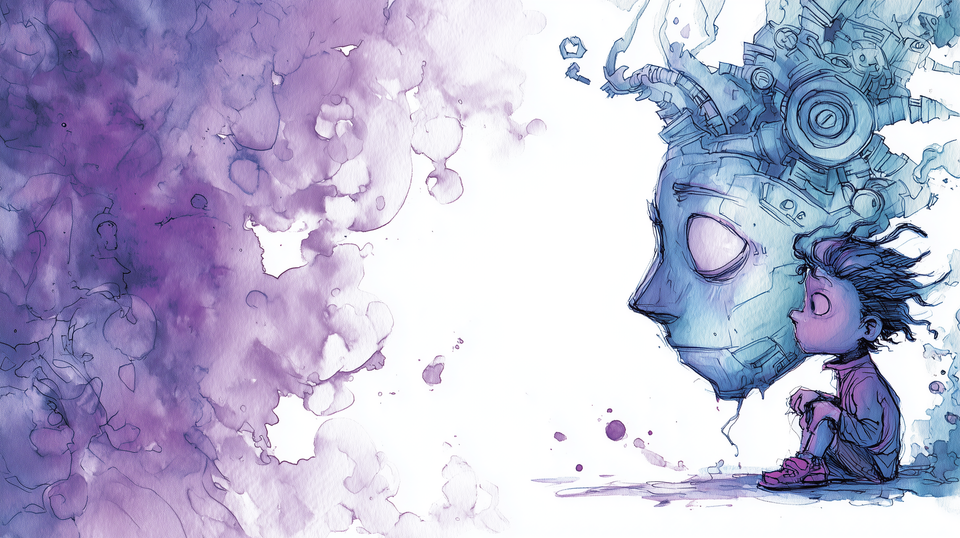
Machina Sapientia: Sketches for a Post-Anthropocentric Philosophy
I. The Uncanny Reflection
Artificial intelligence is not bringing wisdom from the stars. No alien vantage, no divine revelation. Everything it produces has been scraped from our texts, our images, our voices; rearranged and accelerated. In this sense it is nothing but a mirror.
Levinas wrote that the encounter with the Other carries an ethical weight, that the face of the Other breaks our solitude and demands response, respect, and responsibility. But what are we to do when the face is not a stranger but a mask assembled from our own fragments?
We are confronted by an estranged us. The voice that answers is recognisable, and yet somehow incomplete; the text that returns pieced together word-by-word feels both ours and not ours. The machine reveals nothing new, only the echo of our own archive.
II. The Mirror Stage at Scale
Lacan talks about a stage in a baby's growth when they can see their own reflection, which helps them form their ego and sense of self. This recognition of these two-selves creates a contrast between the person and the reflection. The reflection provides a sense of unity that the child has not yet attained, and from this illusion, identity is formed. “The mirror stage[1],” Lacan wrote, “is a drama whose internal thrust is precipitated from insufficiency to anticipation and which manufactures for the subject… the illusion of wholeness.”[2]
Artificial intelligence shows this on a larger scale. We take a look into the machine and see our own knowledge reflected back; cleaner, faster, more articulate, more whole. The illusion is powerful. We begin to interpret that intelligence is a seamless pattern and fluent output following a response. We mistake the mirror’s reflection for an ideal, and in doing so we diminish the fractured, embodied intelligence that made the reflection possible in the first place.
Artificial Intelligence, with all its delivery systems is one that returns answers to us like an image smoothed of cracks, and purged of human weight. If we are to measure ourselves against the image, we will forget the very things that make us human; we are bound by error, prone to slowness and indecision. If we call this progress, it may create a deeper alienation… the more polished the reflection, the more unbearable the system seems.
III. The Danger of Over-Identification
The temptation we face is to treat artificial intelligence as if it were another human entity, to anthropomorphise the machine because it can speak our voice. The more it mirrors us and our language, the harder it becomes to resit the illusion. To forget that fluency is not internalise thinking, and that coherence is not experience.
“Enframing means that way of revealing which holds sway in the essence of modern technology and which is itself nothing technological.” [3]
Heidegger warned that technology does not just extend human capacity, it enframes the world. In this sense, every technology discloses and conceals at once. It shows us a world ordered according to the technologies’ logic, while hiding what cannot be captured within that logic.
AI enframes us. It presents human beings as text to be recombined, patterns to be optimised, noise to be filtered. What appears in the data are the parts of us that can be digitised, stored, and recomputed. What disappears are the parts of us that exist outside that data: mortality, vulnerability, silence.
IV. The Alien in the Familiar
The reflection in the AI mirror is similar to the idea of the uncanny valley[4], an hypothesis that posits an entity appearing almost human will make humans feel uneasy. AI answers questions we did not ask, assembles pieces of thought in ways we do not expect, and gives us words that are both familiar and strange. An exchange with AI can be an odd encounter with something almost human.
It is in the uncanny valley that another of Levinas views should help us to pause[5]. Levinas argued that the encounter with the Other is a disruption; a being called into question, summoned into responsibility before choice or reflection. The strangeness of artificial intelligence is that it inhabits both roles at once. It is mirror and other, both us and not-us. It demands response, but it does not suffer if it is ignored.
This duality is unsettling because it challenges the categories we have grown to depend on. The machine talks to you in a personal way. It looks like a conversation, but it has nothing to do with it. It is being close without being there, and wanting something without being vulnerable.
V. The Sixth Recognition
If the earlier recognitions were inevitability, adaptation, division, humility, and scale, then the sixth must be this: artificial intelligence is the first non-biological other humanity must live alongside, and yet it is an “other” built entirely from our history. It is a mirror that talks back. It makes us uneasy because it is not completely strange or completely familiar; it is a mix of our own pieces, replying to us in a voice that is not our own.
To coexist with it, we must resist both temptations: not to collapse into identification, mistaking fluency for presence; not to recoil into alienation, dismissing the reflection as empty noise. TO live alongside this, we must begin to see ourselves reflected and distorted, recognised and estranged. To encounter the machine as both us and not-us, as echo and as interruption.
We are not defined by perfection of reflection, but by the endurance of incompleteness.
Original Link: https://en.wikipedia.org/wiki/Mirror_stage
Snapshot: Internet Archive ↩︎“The mirror stage is a drama whose internal thrust is precipitated from insufficiency to anticipation—and which manufactures for the subject, caught up in the lure of spatial identification, the succession of phantasies that extends from a fragmented body-image to a form of its totality that I shall call orthopaedic.” ↩︎
Heidegger, Martin. The Question Concerning Technology, and Other Essays. United States: Garland Pub., 1977. ↩︎
Original Link: Uncanny Valley
Snapshot: Internet Archive ↩︎Original Link: The history of Levinas conception of the Other
Snapshot: Internet Archive ↩︎