

Atlas of Unfulfilled Warnings: The Matrix - A Prison of Our Own Humanity
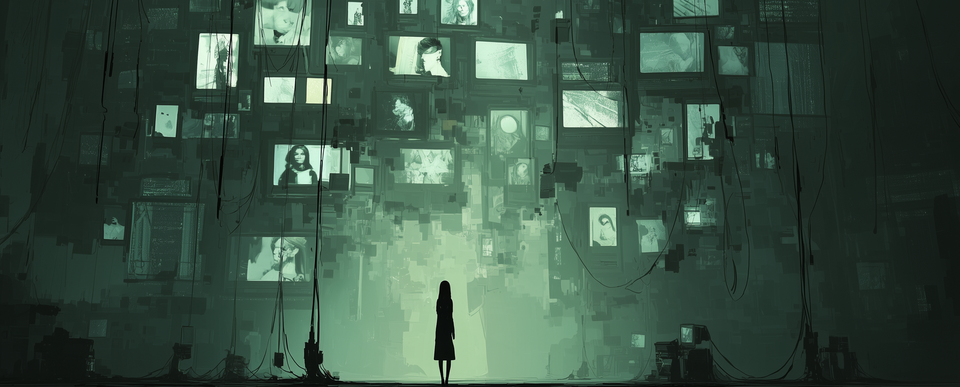
What if the perfect dystopia is the one that does not ask us to stop being human at all?
I. The World That Hurt Enough to Be Believable
Before the offices, the traffic, the small apartments and the dull weight of another working week, there had apparently been another Matrix. A better one. Agent Smith recalls it while standing over Morpheus, speaking about humanity and the way we smell.
“The first Matrix was designed to be a perfect human world. Where none suffered. Where everyone would be happy.”
It did not work. People woke from it. Entire crops of human energy cells were lost. Smith calls the failure a disaster, then offers his own explanation.
“Human beings define their reality through misery and suffering.”
It may be considered a bitter understanding of human existence, but upon further reflection it does speak to something that defines us as humans. We spend a considerable amount of our lives trying to make things easier. Progress carries a promise that there is the possibility of life with a little less suffering in it. And it would be strange to discover that, given such a world, we might begin to distrust it.
By the time Neo arrives in the fifth version, the Matrix is no paradise. People lose jobs. Marriages fail. Rent is due. None of this work seems necessary if the only purpose is to keep a body sleeping in a pod.
The machine built something better than the world humanity had given itself, and humanity would not stay inside it. So the machines returned humanity to something close to where they found it. Work and hunger, pleasure and disappointment, small victories followed by other problems. A world rough enough that nobody needs to ask why the surface is rough.
The prison does not feel particularly like a prison. It feels like Monday.
The machines do not remove disappointment from human existence. They have found it to be a feature, not a bug in humanity. Perhaps those things are merely artefacts required to make the simulation convincing. Possibly Agent Smith was right, and misery provides some necessary grain against which reality can be felt. Or perhaps we have already made a mistake by separating those things from a human life?
II. The Prisoner Who Missed the Prison
Cypher had been outside for years by the time he sat across from Agent Smith. He knew what the Matrix was. There was no mystery left in the steak in front of him, no illusion he had mistaken for truth.
“I know this steak doesn’t exist.”
Cypher is not asking Smith for a better world than the one he escaped. He wants to go back into the old one. Back into restaurants and money and whatever ordinary life had once surrounded him. The Matrix had been a prison, but it had also contained almost everything he had learned to recognise as a life.
“I don’t want to remember nothing. Nothing. You understand?”
Cypher cannot inspect what waits for him, cannot know whether he will wake rich and important, or wake at all. Smith offers a promise, and that appears to be enough. Somewhere between the grey food, the metal corridors and the ruined surface of the real world, the memory of what came before has gathered more weight than whatever the red pill offered.
We tend to imagine that leaving a time or a place gives us some distance from it. Once it is behind us, maybe its influence could begin to weaken. But the things we leave do not always remain behind us, they become reference points.
The machines had spent generations learning how to make their world resemble ours. And in that time they created a system that by which inhabitants understood comfort, success, food, and status. Leaving the Matrix did not erase those milestones. In fact, it may have forged feelings into memory that were hard to forget in difficult times.
III. The System That Learned to Contain Refusal
The Matrix could make itself believable, even desirable, but there remained a small number of people for whom neither familiarity nor comfort was enough. The machines seem to have discovered that this could not simply be corrected.
The Architect describes successive versions of the Matrix as though they were experiments, each one carrying some small failure into the next. The interesting part is not that the machines eventually gave humans choice. It is that the system appears to have become more stable once choice was allowed to remain.
We tend to picture control as the closing of doors. Fewer options. Narrower lives. A hand on the shoulder, a lock turned from the outside. Freedom appears somewhere on the other side of that image, in the opening of those same doors.
“Power is exercised only over free subjects, and only insofar as they are free.” [1]
So is the power of the Matrix in the freedom of the people that live inside it? People can take the red pill. They can build Zion, tell stories about escape, teach others how to wake. It doesn’t have to be a lie for it to exist as part of the system and its stabilisation for the living crops.
Likewise, the power of freedom in Zion is not diminished by being real. The resistance of the people who escaped the Matrix does not have to be theatre for the system to have learnt something from its existence. Perhaps resistance itself can become part of what a stable system expects.
“As I was saying, she stumbled upon a solution whereby nearly 99% of all test subjects accepted the program, as long as they were given a choice, even if they were only aware of the choice at a near unconscious level.” [2]
A world without choice collapses. A world with choice produces refusal. Refusal produces escape. Escape produces resistance. Somewhere along that line the machines stop trying to remove the problem and begin to make room for it.
The opposite of control is not necessarily choice. Sometimes choice is the condition that allows control to endure.
IV. Hope Inside the Machine
The arrival of Neo was built upon the human need for hope. The prophecy was told and retold, established from the Oracle, through Morphus, and spoken on the streets of Zion. But Zion could not survive without hope, as the Architect reveals.
The city had been destroyed before. The One had stood in the same room before. Faced with the collapse of the Matrix and the death of almost everyone connected to it, Neo's predecessors had returned to the Source, chosen a small group to begin again, and allowed humanity to continue.
People survive. Zion is rebuilt. Children are born who know nothing of the choice that made their lives possible. The war begins again somewhere further down the line.
A rebellion can survive for a long time on food and machinery. It can grow into a settlement, then a culture, and perhaps a way of life. But rebellion seems to carry a belief that the thing being resisted will not always be there. Without that, resistance looks like exile.
For the inhabitants of Zion, Neo represented both hope and promise. The prophecy had given the people hope for a future that is different from the present, not just that he could fight agents, but that he could alter the future. Morpheus had spent most of his life waiting for it. The war is no longer something to endure indefinitely.
Then Neo meets the Architect and discovers that the ending has happened before. The choice waiting for him is between the continuation of humanity and the possibility that the cycle might somehow be broken.
His predecessors chose continuation.
“Hope. It is the quintessential human delusion, simultaneously the source of your greatest strength, and your greatest weakness.”
Neo’s choice was confusing to the Architext as he had been shown the sensible path. The previous Ones carried their attachment across humanity as a whole. Neo's has narrowed onto Trinity.
Neo walks through the unexpected door, and became an anomaly that the system had not experienced before. Not because he possesses more hope than everyone before him, but because he refuses to exchange it for survival when the bargain is placed in front of him.
The earlier Ones preserve humanity. Neo behaves as though preservation may not be enough.
Hope is easy enough to accommodate while it remains a promise somewhere in the distance. The One can return. Zion can believe. Another generation can wait for liberation. A belief system can survive around all of that for a very long time.
But Neo introduced something less orderly. He chose through attachment. Through fear. Through love. Through whatever mixture of feeling made the rational path insufficient.
The Architect could see the error.
Another machine would eventually see an opportunity.
V. The Analyst's Improvement
By the time Neo wakes again in Resurrections[3], another machine has inherited the Matrix. The Analyst speaks about his predecessor with the impatience reserved for an old idea that has gathered dust. The Architect had facts and equations. The Analyst watches feelings.
“Here’s the thing about feelings. They’re so much easier to control than facts.”
The Analyst speaks as though someone eventually noticed the older machines had been measuring the wrong inputs. Neo and Trinity become his experiment.
They are kept close enough to feel the absence of one another, never quite close enough for the absence to disappear. Neo has a life. Trinity has a family. Neither is left with nothing.
The Analyst describes it simply:
“Quietly yearning for what you don’t have, while dreading losing what you do.”
The Analyst does not need Neo to be happy. He does not appear to need him broken either. The useful position lies somewhere between the two. Almost possessing what he wants. Almost losing what he has. A life held somewhere between fulfilment and fear.
The analyst learnt from the failure of previous versions. His predecessors trusted that humans would make rational choices in dire moments. Neo proved that incorrect. So with the latest version he needed to build stability on that unpredictability of what has not yet happened, and then perhaps the distance between possession and loss can itself become useful.
The Analyst boasts of greater output and almost no resistance. The language is crude, but the achievement is quieter than the Architect's enormous machinery. Humans remain recognisably human. Their feelings do not obstruct the system. They have become part of how it runs.
VI. The Doors That Remained Open
The machines begin with a prison and spend generations learning how little of the prisoner needs to be removed. Suffering remains because a painless world feels wrong. Familiarity remains powerful even after Cypher knows it is artificial. Choice remains because the system cannot survive without it. Hope gives the people a reason to continue. Eventually even desire and fear are features in the system.
Sifting through Foucault's thoughts[4], we can see that power does not always begin where freedom ends. The opposite of control is not necessarily choice. Sometimes choice is the condition that allows control to endure.
In many fictional dystopias we have been trained to notice the locked door, the forbidden book, the camera on the wall. The way things are put out of reach of the general public in order to exhibit control. We know what restriction looks like. We have spent a long time learning its silhouette.
The Matrix, on the other hand, leaves those restrictions behind. The people inside still work and love, fail and remember, choose and hope.
And in the end, the machines learnt that they never needed to take away the things we struggle with in order to cede control.
Magill, K. (1997). Surveillance-Free-Subjects. In: Lloyd, M., Thacker, A. (eds) The Impact of Michel Foucault on the Social Sciences and Humanities. Palgrave Macmillan, London. (Link)
Snapshot: Internet Archive ↩︎Original Link: The Architect Quote
Snapshot: Internet Archive ↩︎Original Link: The Matrix Resurrections (2021)
Snapshot: Internet Archive ↩︎The Subject and Power (see 2. What constitutes the specific nature of power?)
Snapshot: Internet Archive ↩︎