

Atlas of Unfulfilled Warnings: The Species That Made Itself Redundant
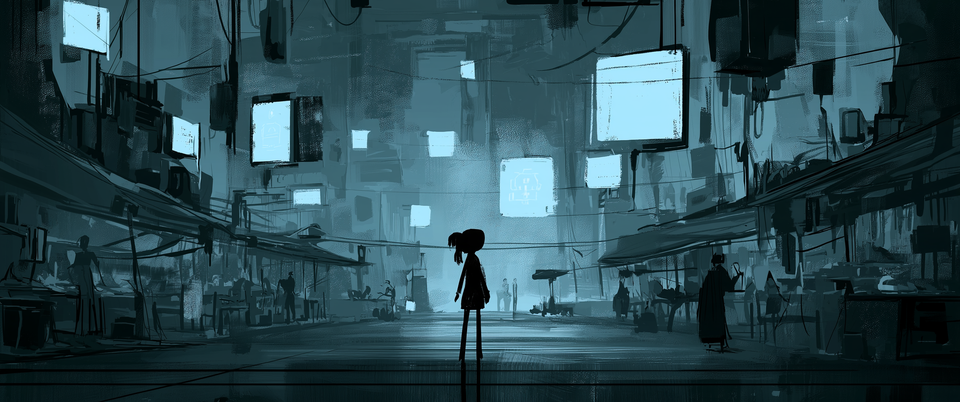
I. The Machine Was Full of People
Some forms of automation are designed for performance. Such as the original Mechanical Turk[1]. An eighteenth-century chess machine that was toured and exhibited for close to 100 years. The Turk won most games it played, including wins over some well-known statesmen.
The Mechanical Turk’s cabinet appeared to contain machinery, but a concealed chess player operated it from inside. Amazon reused that metaphor with their product, Mechanical Turk.
Amazon Mechanical Turk[2] offered what it called an on-demand, scalable human workforce. A requester could divide a large job into hundreds or thousands of small tasks and receive the results through what looked like an automated interface.
The first trick was not making a machine think. It was making human thought look mechanical.
They move in two narrow columns through the tunnels beneath Metropolis[3], one shift returning while the next walks towards the machines. Their uniforms are identical. Their steps fall into the same rhythm. Those leaving appear too exhausted to notice those arriving.
Far above them, the city wakes. Its roads curve between towers. Aircraft pass through the gaps in the skyline. Gardens wait; the city is clean. All this is due to the labour that has been moved underground. Workers have not yet been replaced. They remain necessary to the city; their bodies are the implements sacrificed to the machine.
When Freder first enters the machine rooms, he sees an explosion tear through one of the enormous mechanisms. Workers are thrown from their stations. Smoke rolls across the floor. For a moment, the machinery appears to change before him. Its columns become a mouth. The stairway becomes an altar. Human bodies are carried upwards and fed into the heat.
“Moloch!”
The vision is an allegory of what Freder sees when he first looks upon the machine. The city decided that the lives of the workers are worth less than those who live upon the surface. Freder sees the theatrical version play out before his eyes.
The real warning of Metropolis is that the machine will be used to decide the rhythms of humankind. A machine built to bring order and expectations to a system that it cannot yet run itself. Technology will not turn against us but to use us as a resource to accomplish the end goal.
Later, Freder takes the place of a worker at a control mechanism shaped like an enormous clock. Its illuminated arms move around him, and he must drag the controls into position before the lights change again. This task is not as simple as it looks; the machine forces Freder to push through exhaustion to accomplish it.
From above the ground, the work seems effortless. Below the ground, the work seems endless. A common theme that recurs in automation: first you throw many workers at a problem to get it solved, but the system gets better and more efficient, until people are replaced by machines.
Despite the workers below the surface, automation only comes to replace what humans did beforehand. The machine is built upon human invention; piece by piece it goes together with what we have available. Then we build the tools that our hands will use. Then we refine the tools until we can teach machines how to do the same thing. Then we build the machines that remove the human labour.
Every step we are making things easier for ourselves.
Every step we are refining the machines to take over our jobs.
Every step we are making ourselves redundant from the things that give us our identity.
II. The Worker Who Could Not Be Fast Enough
The world of business is competition. There is an old start-up adage: “If your business doesn't have competition, you have a problem.”[4]
Competition provides the fuel to more efficient businesses. Working faster, reducing costs, working smarter. Each company is looking for the edge that will propel it to rise to the top and provide the demand to keep the lights on.
Companies have increasingly relied on automation to bring speed and precision to their workforce. Machines can make things easier, safer and more precise. They can reduce overhead, and then they become the only way to run the business because it cannot afford to continue without them.
Over time, it becomes easier to build the workers than to rely on humans in the same positions.
And that is the world we meet in Robocop[5]. OCP is in the market of creating machines, and policing has become the market's ground of competition. Markets produce competitors, and the product separators are things like: strength, durability and obedience.
ED-209 and RoboCop are rival programmes. One proposes a completely mechanical enforcement platform. The other preserves portions of a human being inside the machinery.
The value of the potential market is shown when the development of a robotic police force continues even after ED-209 kills a man during its demonstration. ED-209’s connection to military sales and maintenance contracts proves that there is a market to provide the best platform. This creates an opportunity for another company to offer a solution.
Robocop addresses the problems caused by ED-209's limitations. And in that he becomes an alternative, with fewer issues. Over time these become reasons to use machines, because the benefits of one product are incorporated into other products. In the end, humans are replaced due to competiton creating better products to outcomplete their challengers.
A mechanical body can repeat human movement. An intelligent system can decide ensure that a movement is made to complete a task. Together, mechanical bodies and AU offer something competition has always wanted: labour that can adapt without becoming independent, continue without becoming tired and improve without asking what the improvement is for.
A company may value its employees, worry about social disruption and understand what disappears when skilled people leave. Yet refusing the integration of robotics does not preserve our working history if a competitor continues building the next one.
Restraint becomes another cost.
Each company may be making a reasonable decision. Each automation may solve a real problem. Each worker may be removed from only one role at a time. The factory does not empty in a single afternoon.
But over time, the human’s task is replaced by something that business competition instilled in the market.
III. The Race No One Can Leave
Some of the clearest warnings about artificial intelligence now come from the companies building it.
They describe systems that may escape control, reproduce capabilities faster than governments can understand them, and place consequential decisions outside of human control.
These companies issue warnings, then return to work and continue building those systems. A business may recognise the danger and still understand that recognition carries no competitive advantage.
Its rivals may be willing to move faster.
Each improvement made and deployed changes what customers expect and therefore what the market must provide. The company willing to live closest to the edge gains the ground that caution leaves behind.
Danger has not been overlooked; it has just been priced into the decision. A company is choosing between building it now or allowing somebody else to build it first.
Amazon now operates a global fleet of more than one million robots. Its DeepFleet system coordinates movement through fulfilment centres, with Amazon reporting a further ten per cent improvement in travel efficiency[6]. The company presents this as faster delivery, lower costs, reduced physical strain and an opportunity for workers to move into more technical roles.
A machine that lifts the heavy object, finds the shortest route and delivers the package tomorrow is easy to embrace. Even outside the company, we can understand why this would be implemented. But, machines that bring harm are much easier to eject.
Consumers expect speed. Businesses demand efficiency. Workers are measured, in their ability to connect the two outcomes. Competitors automate because the alternative is to surrender the advantage.
In September 2026, OpenAI called for mandatory safety requirements and international standards capable of determining when development should slow or stop, “even if that means slowing the advancement of model capabilities.”[7] The following month, Anthropic warned that models may be approaching the ability to copy themselves onto smaller connected devices, potentially making them harder to contain[8].
The organisations closest to the technology can see that voluntary restraint is fragile. A company that slows alone does not slow the field. It creates space for another company, another laboratory or another country to move ahead.
Safety becomes a cost carried by the cautious, and the advantage belongs to whoever is willing to do what the others aren’t.
This is why companies can ask governments to regulate the technologies they continue developing. They may be asking for protection from their own incentives. A rule that applies to one company is a burden. A rule that applies across the industry changes the conditions of the competition.
At the United Nations, the President of the General Assembly warned that “we cannot allow an arms race for control of AI to carry us over the precipice.”[9] No one developing AI wants to brake while another participant is accelerating beside them.
Companies compete upward through speed, strength, scale and intelligence. At the same time, they compete downward through shorter testing periods, thinner safeguards and a growing intolerance for the hesitation of human bodies.
The race continues because nobody can afford to stop first.
IV. The Empty Place Where Someone Used to Stand
Photographs of the Great Depression showed long lines of unemployed people waiting outside soup kitchens. Software taking over an engineer’s tasks, or robots entering a warehouse, may leave fewer images behind. Someone retires and is not replaced. An apprentice is never hired. Tasks once shared between several people are absorbed into software.
On 30 September 2026, Amazon Mechanical Turk closed permanently[10]. The irony of the situation is not difficult to see. A service named after a machine with a person hidden inside disappeared during the rise of artificial intelligence systems' proliferation in the world. Amazon’s closure announcement does not establish that AI caused its disappearance, but the symbolism[11] remains.
For some workers, the loss was more than financial. They remembered[12] the service as part of their daily routine, a community, or a way to earn when other work was unavailable.
Other jobs will emerge. Machines require engineers, technicians and trainers. But a new position may be somewhere else, require different knowledge or remain beyond the reach of the person whose work disappeared. The promise of more employment can be true and still offer that person little comfort.
Competition has already begun changing the places where we work. Buildings[13] are designed around automated movement. Tasks are arranged around what systems can perform. Each investment makes the next decision easier, until hiring another person begins to seem unnecessary.
We are doing the very things to make the workforce efficient and dependent on systems, and one day we may not hire the next worker ever again.
V. The Species That Made Itself Redundant
There was a chess player hidden in the cabinet. There were workers beneath the city in Metropolis, keeping its machinery moving. Enough of Murphy remained useful for OCP to build its competing product around him.
In each case, the machinery still needed someone.
Redundancy is not extinction.
With each step forward, businesses improve efficiency. They build systems that limit harm. They make machines that reduce time-consuming decision-making. Speed, resilience, and dependability. Companies choose the advantage that keeps them competitive. Governments choose the technology that prevents another country moving ahead.
We shouldn’t preserve suffering simply to give human beings something to do. The workers beneath Metropolis deserve a life beyond the machines. But removing their burden leaves a question that efficiency cannot answer: what place will they have in the city above?
Science fiction has imagined machines declaring war against humanity. Perhaps no declaration will be required. Systems will continue to manufacture, distribute and perform the roles we have built for them. Businesses will keep finding reasons to extend their use.
Original Link: Mechanical Turk
Snapshot: Internet Archive ↩︎Original Link: Amazon Mechanical Turk Access a global, on-demand, 24x7 workforce (Internet Archive)
Snapshot: This link is a snapshot. ↩︎Original Link: Metropolis (1927) | Fritz Lang | Full Movie [HD]
Snapshot: Internet Archive ↩︎Original Link: If Your Business Doesn't Have Competition, You Have A Problem
Snapshot: Internet Archive ↩︎Robocop (1987) | Official Trailer | MGM Studios
Snapshot: Internet Archive ↩︎Original Link: Amazon launches a new AI foundation model to power its robotic fleet and deploys its 1 millionth robot
Snapshot: Internet Archive ↩︎Original Link: The AI policy window is open. We need to act. (9th September 2026)
Snapshot: Internet Archive ↩︎Original Link: AI in your oven? Anthropic warns models ‘months away’ from self-replication on smart devices (13 October 2026)
Snapshot: Internet Archive ↩︎Original Link: Remarks at the opening of the general debate of the eighty-first session (22 September 2026)
Snapshot: Internet Archive ↩︎Original Link: Mechanical Turk is no longer available.
Snapshot: Internet Archive ↩︎Original Link Amazon is shutting down Mechanical Turk after 21 years as AI reshapes crowdsourced work
Snapshot: Internet Archive ↩︎Original Link ‘Losing a piece of my life’: As Amazon’s Mechanical Turk shuts down, gig workers recall the HITs
Snapshot: Internet Archive ↩︎Original Link: Australia’s data centre build‑out carries risks for the economy – and inflation
Snapshot: Internet Archive ↩︎