

House Delaque: Where Truth Goes to Hide
I. Where Truth Goes to Hide
There is a temptation to think that the truth is stubborn. The facts are there. Waiting. Many of our classic stories have taught us to expect this. A detective reaches the room and explains what happened. The hidden archive is uncovered. The conspiracy is dragged into daylight. Truth was hidden, then it was found.
I am not altogether sure the world works like that. The area between an event and our understanding of it is coloured grey, and more fragile than we like to admit. A fact does not walk into the public world by itself. It needs someone to see it, someone to remember, someone to write it down, and someone to keep the record.
There are many places for the truth to get lost.
In Necromunda, House Delaque is the secretive faction in a setting crowded with hidden contracts, ancient schemes, old grudges, and poor choices. House Delaque lives in the grey in-between what actually happened and the story that is told in the hive.
Hannah Arendt wrestled with the concern that public life depends on a shared factual world, which is much easier to tamper with than the facts themselves. An event cannot be made not to have happened. But the witnesses can be discredited, or the records can be buried. Or the actual events forgotten in light of something more attractive.
II. The Lore That Warns Against Itself
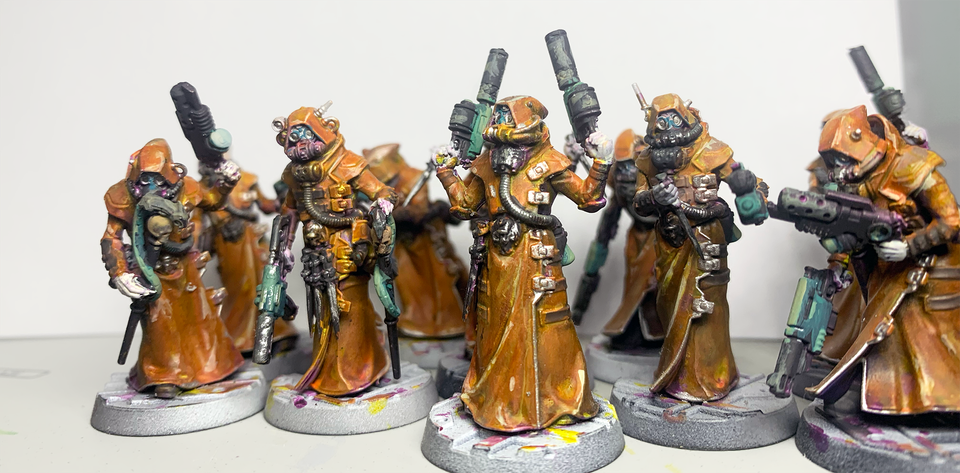
House Delaque was attractive to me because of my love of Dark City. Long coats. Pale heads. Dark lenses. Spies, informants, assassins, whisper networks. A group that deals in secrets, while the others deal in steel, labour, or weapons. It was their physical presence and hidden stories that pulled me into the house of shadows.
But as I started diving into the history, it became something far richer than I had initially thought.
The history of the House of Shadows is shrouded in mystery[1]. No-one quite knows the whole truth. Some accounts place the rise in the service of Lord Helmawr. Other stories suggest the house formed when there were still oceans upon Necromunda. They were mutant offspring of the first people upon Necromunda. A part of Immortal Assassins. Pick the story that sounds best to you; it is probably not the correct history, but it is an interesting tale.
It doesn’t matter which is true. The House of Shadows embraces the enigma and allows all versions to be true at once. Every tale changes what the house means. If they are tied to Helmawr, they serve as instruments of his regime. If they are mutant offspring, then they hold claim to the Imperial House. If they were created by the Immortal Cult of Necromunda, they are involved in mankind's psychic awakening.
The lore keeps all these stories active at the same time. Amongst others.
The Star Chamber may be a front for the Silent Ones or a council of powerful elders. The Silent Ones could be the source of Delaque’s strange abilities, or they could be remnants of an older civilisation. To ask who controls the Delaque is to assume there is a single answer – there are always more answers to find.
The lore about Delaque behaves like Delaque.
Delaque does not hide information by removing it from the light. The House of Shadows hides information by making every source part of the uncertainty. The Star Chamber may be real, but the stories about it may be useful to people who want to disguise their own authority. The Silent Ones may be manipulating the house, but Delaque leaders may also use the belief that they are doing so as a tool.
We are not asked to believe one lie. We are told so many plausible explanations, from so many sources, that belief becomes difficult. The truth may still be there. Somewhere. But the paths toward it have been made crooked, wet, and badly lit.
If secrecy only meant that a truth was hidden behind a door, then the old detective story would still work. Find the key. Open the room. Bring the thing into daylight. But Delaque suggests something more troubling: that the door, key, witness, and record may have been touched before we arrived.
III. Losing Our Bearings
Arendt was not writing about gangs in the dark, spies in long coats, or the particular nonsense of Necromunda. In Truth and Politics[2] she was writing about public truth: the strange and fragile process by which something that happened becomes something we can share, argue over, remember, and use.
“The result of a consistent and total substitution of lies for factual truth is not that the lie will now be accepted as truth, and truth be defamed as lie, but that the sense by which we take our bearings in the real world - and the category of truth versus falsehood is among the mental means to this end - is being destroyed.”
Most often we think a lie replaces one thing with another. Replace the truth with a story, and hope that it is accepted. But Arendt is alluding to something worse than a successful falsehood.
The danger is not only that the wrong story wins. It is that the means by which we decide between stories begins to fail. Our perception can be marred. Or worse, our understanding can be shaken so badly that our world-view is never true and never false.
This is not the same as being uninformed. A damaged sense of reality affects the standards by which new knowledge is judged. More evidence may not settle the matter if every piece of evidence is treated as part of the deception.
But deception still assumes that truth exists somewhere behind the false appearance. What changes in the situation Arendt describes is the relationship between appearance and fact. The distinction remains necessary, but confidence in our ability to make it begins to erode.
This is why the loss of bearings is so serious. We do not need perfect knowledge in order to act. We need some confidence that the world is not being continuously rearranged around us.
When those assumptions weaken, judgement becomes harder.
The result is not that people believe every lie. Often, they believe less and less. They withdraw from shared standards and retreat into suspicion, loyalty, habit, or force. If no account can be trusted, then the strongest voice may replace the most accurate one. If every record is compromised, then power can decide which version survives.
Arendt’s point is therefore more unsettling than the claim that propaganda can mislead people. Propaganda may persuade us to accept a false account. A deeper and more lasting danger is that it can weaken the common world in which accounts are compared at all.
IV. When Every Fact Arrives Damaged
The House of Shadows understands that an event in Necromunda is real to the people to whom it happened, but that event has a life beyond when and where it occurred. History is not simply what happened. It is what survives as a public account of what happened: The story that becomes available to other people, the story that institutions repeat, the story that later decisions rely upon. Whoever controls that story controls what the present is allowed to mean.
And the Delaque understand this. They do not need to erase every event. They need to decide what the event will become. The facts are arranged to suit the story that needs to be remembered.
This is the first method: rewriting history to serve the house.
The Delaque do not need to invent every part of that story. A partial truth is often more useful than a complete lie. They decide what will be remembered, what will be connected, and who will leave without an explanation. The resulting account may be accurate in every individual detail and still false in the only way that matters: it gives the event the wrong meaning.
Once a public world loses its common account of what has happened, people are no longer acting within the same reality. They may possess the same evidence and still inhabit different histories. The Delaque exploit that separation by making different groups understand the same event in ways that cannot be reconciled.
Next, the Delaque can elevate someone who needs the spotlight.
A minor gang can be made to appear more dangerous than it is. A weak leader can be credited with a victory. A rival can be presented as the architect of a conspiracy.
Reputation becomes an instrument. The chosen figure draws attention, resources, suspicion, and retaliation. They become the explanation for events they did not cause.
This is the second method: rewriting history to create a useful public figure.
The public world is built on appearance. People become politically real when they can be seen, named, discussed, praised, blamed, and remembered. The Delaque manipulate that space between the person and the story told about the person.
A Delaque operation may have several histories at once. The history known by the victim. The history repeated by the gang. The history entered into a guild ledger. The history whispered by informants.
Each version can be useful.
The Delaque do not need everyone to believe the same lie. They only need each group to have enough evidence to believe what they already want to believe. One gang prepares for war. Another seeks protection. A guild changes its contracts. The Delaque remain outside the visible chain of cause and effect, while the hive moves according to a history they have prepared.
This is the third method: manipulation is more powerful than simple misinformation.
A lie asks to be believed. History asks to be used.
The Delaque give people an account that fits their interests, fears, and habits. They make the false version practical. The past becomes a tool for arranging the future.
That is why the Delaque do not merely hide facts. They manage consequences. They understand that people do not act on events directly. They act on what they believe events mean. Change the meaning, and the action changes with it.
When the common world is damaged, people lose the shared ground from which judgement is possible. They can no longer argue about what should be done because they no longer agree about what has happened. The Delaque turn that condition into a weapon.
V. A World That Can No Longer Tell
Necromunda is a world built from exaggeration. The factories are too large. The weapons are too cruel. The chains of command have been allowed to rust into something almost religious.
A house of whispers makes sense in a hive crowded with reasons not to trust the person standing beside you. Their long coats and dark lenses lurk in the darkness. Their rumours echo in the recesses, where truth is fleeting. It is all wonderfully theatrical, the way Necromunda makes theatre out of social collapse.
We also live among events that have to travel before they become known. A decision is made in a room we will never enter. A report is written by someone we will never meet. A document is released with timing that immediately becomes part of the story.
Suspicion is not always foolish. Institutions do lie. Records are shaped by power. Public figures perform as versions of themselves, depending on the audience. Governments, companies, parties, churches, platforms, and private interests all understand that perception is not a soft thing floating above reality. Perception is one of the places reality is fought over.
Arendt’s warning is what makes this feel too real.
When every fact arrives already suspected, when every correction looks strategic, when every institution appears captured before it speaks, the world does not become more honest. It becomes harder to share, harder to perceive. Harder to discern.
And once that happens, the person with power does not need to convince everyone of one story. They only need to keep the ground unstable long enough for their version to be used. A false account does not need to be loved. It only needs to be useful. It needs to give someone an enemy, an excuse, a delay, a permission, a reason not to look elsewhere.
Facts have to pass through people. Through memory. Through paperwork. Through fear. Through institutions that may be tired, corrupt, protective, underfunded, overconfident, or simply built for another time and place.
By the time the fact reaches us, it may still be true. But it may no longer be whole.
This is where the old detective story begins to fail. It tells us there is a single room, a single clue, and a final speech that restores order. But once we move into the realm of perception, spin, and propaganda, those older tropes do not hold up to the light.
This is the larger danger of those who control perception.
They do not have to change the event itself. They can change what the event is allowed to become. They can make the truth arrive late, or ugly, or compromised, or attached to the wrong person. They can surround it with better stories. They can make caution feel like cynicism, and cynicism feel like wisdom. They can leave the fact standing there in the open while everyone argues about whether the open air was staged.
After a while, the truth starts to look like just another rumour.
Not because it has stopped being true, but because the common world around it has weakened.
That is where truth goes to hide. Not always in a vault, or behind a locked door. Sometimes the truth hides in public, buried under explanations, damaged by those that tell the stories, left behind or excluded from the stream of news we consume. Visible enough to be dismissed and uncertain enough to be left alone.
Original Link House Delaque: History
Snapshot: Internet Archive ↩︎Arendt, Hannah. On Lying and Politics: A Library of America Special Publication. United States: Library of America, 2022. ↩︎