

Death Guard: To Carry Ruin Forward
I. Everything Still Works
Earlier this year, a war on the other side of the world changed the price of petrol at every place close to home.
The conflict around the Strait of Hormuz disrupted global oil markets[1], prices rose, and by the time all those movements had passed through tankers, refineries, contracts, distributors and service stations, someone in Melbourne[2] getting fuel was looking at a number that had become considerably larger than it had been a few weeks earlier.
Nothing had broken in the economy here in Australia.
The petrol station was open. Fuel came out of the pump. The card reader worked. Trucks were still travelling along the freeway and shelves were still being filled. For a while the government reduced the fuel excise, and then gradually returned it to normal as prices settled. Later in the year, when prices rose again, fuel was still arriving.
We usually know when something has failed because failure is loud. The bridge closes. The train stops. The website gives an error. The supermarket shelf is empty. We understand that kind of problem because something that was meant to happen no longer happens.
There are some systems that function as they are designed to, but the people who use those systems are worse off.
Australia's income-support system still pays JobSeeker every fortnight. The amount is indexed. The calculation is made. The money arrives. Yet organisations working with people receiving those payments continue to report that many cannot reliably cover food, housing, utilities and healthcare.
We place more faith in continuity than we realise. Roads carrying traffic suggest the city is working. Containers moving through ports suggest the economy is working. Hospitals admitting patients suggest healthcare is working. A payment arriving suggests welfare is working. The lights staying on is reassuring because darkness would tell us something had gone wrong.
World War II made some of this much easier to see. Food, clothing and fuel became scarce, so governments rationed them. Ordinary households were changed by events occurring across continents. The machinery of society did not disappear. It reorganised itself so that the war could continue and civilian life could continue beside it.
In the first two essays in the series, we looked at things we become used to. The email arriving on the phone. The road we no longer remember avoiding. The difficult condition around which our life is able to continue.
In this one we zoom out a little further. If something on a vast scale happens outside of our experience, and the machinery around us keeps moving, how can we tell something is going wrong?
II. The Machine That Kept Going
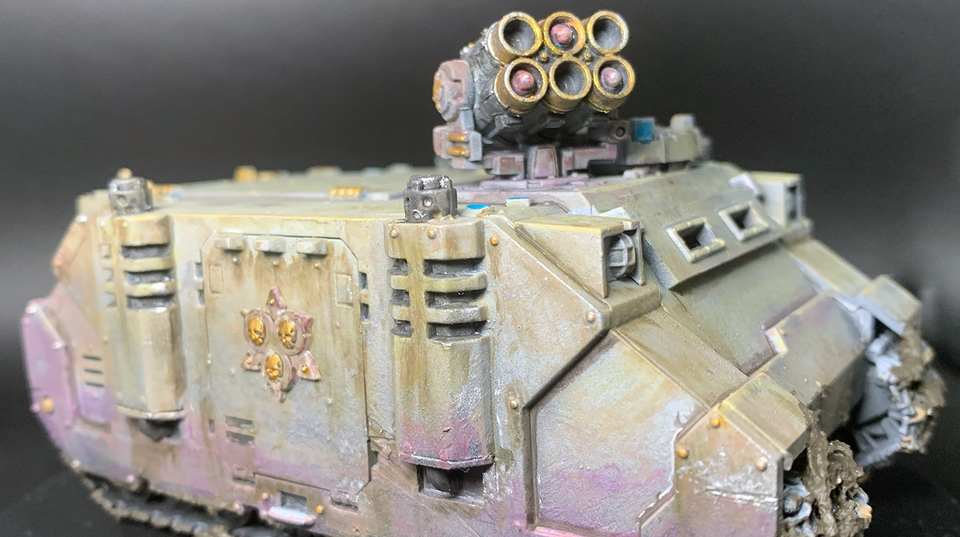
The Rhino is not the most impressive vehicle in Warhammer 40,000. It does not have the presence of a Land Raider, the absurd scale of a Baneblade, or the kind of weaponry that can send your foes feeling from battle. It is a box on tracks with enough armour to get a squad from one place to another.
Its history stretches back long before the Imperium, to the Age of Technology, when humanity was still spreading colonies across the galaxy. The original design was known as the RH1-N-0 Tracked Exploration and Multi-Purpose Defence Vehicle, built for settlers and explorers. It was sealed against hostile environments, heavily enough protected to deal with danger, simple to manufacture from local materials, and capable of running on a wide range of fuel sources. It was a frontier vehicle, and equipped with everything needed to accomplish the task.
The earliest recorded combat use came on Torben's World, where human colonists used Rhinos against the indigenous population. Over the following century the design spread through human military forces. Commanders adapted the same chassis with heavier weapons and more specialised equipment. In time it became one of the standard fighting vehicles used across human space.
By the Great Crusade, the Rhino was everywhere.
The Deimos Pattern became the most common version during the Great Crusade and Horus Heresy. It was durable, easy to repair, able to operate on almost any fuel, and simple enough to keep in service.
Its ubiquity also made it a platform rather than merely a vehicle. The same chassis became the basis for command vehicles, siege tanks, missile carriers and armoured fighting vehicles.
The Traitor Legions carried their Rhinos into the Eye of Terror, and Chaos forces still use Rhinos ten thousand years later. Some are ancient Heresy-era patterns such as the Deimos. Many others are newer vehicles captured from Loyalist Chapters or inherited when Chapters turn Renegade. Imperial symbols are removed, armour is altered, spikes and trophies are added, and sometimes the machines themselves become corrupted.
The Rhino is a workhorse. Its basic platform allows an army to move from one battle front to another. It alters with the legion in change, but the task it fulfils is still the same. The Rhino is battle-worn infrastructure. Recast in many images, with the same basic rule. Rain, hail, demonic corruption, or shine, it will move an army.
III. Movement and Distance
In Speed and Politics Paul Virilio delved into the topic of movement and speed. His interest came partly from war, where the ability to move has always changed what an army is capable of doing. Virilio calls his study of speed dromology, from the Greek dromos, referring to a course or route. He is interested in what changes when technologies allow people, armies and information to overcome distance more quickly.
“In fact, there was no 'industrial revolution," but only a "dromocratic revolution;" there is no democracy, only dromocracy; there is no strategy, only dromology.”
Dromology is the study of speed[3] and the way increasing speed changes relationships between people, technologies and events. Virilio was interested in what a technology allows us to do, and what arrives with that new ability.
“... the transportation capacity created by the mass production of automobiles can become a social assault, a revolution sufficient and able to modify the citizen's way of life by transforming all the consumer's needs, by totally remodeling a territory…”
Speed is not only how quickly things travel: Communication becomes faster. Information travels faster. Decisions travel faster. Technologies are invented faster. And all the while we increase the speed of development, the time to inherit the consequences becomes smaller.
Zygmunt Bauman[4] spends considerable time[5] looking at how people who originated an action do not always experience the consequences[6]. One person performs a task. Another person receives its result. Maybe a form is processed, or something is transported, and those actions may not create the final result.
“The struggle over moral issues never takes place, as the moral aspects of actions are not immediately obvious or are deliberately prevented from discovery and discussion.” [7]
Bauman too, examines distance and morality[8], looking at the idea of moral separation:
“Responsibility is silenced once proximity is eroded; it may eventually be replaced with resentment once the fellow human subject is transformed into an Other.”
There can be a spiritual or physical distance between an individual and a system that originates an action.
Virilio looks at technologies capable of increasing movement and speed. Bauman looks at systems capable of increasing distance between action and consequence.
IV. The Machine Does Its Job
Awaiting deployment, a squad enters through the rear door of a Rhino. The engine starts. The vehicle crosses the battlefield, avoiding the shells and flak from awaiting armies. If the passengers arrive unscathed, ready to deploy and wreak havoc, the Rhino has done what it was designed to do.
That reliability is part of why the Rhino became so common in the first place. It could be repaired, refuelled, and sent back into the field. The same basic design survived different campaigns, different commanders and eventually different allegiances. During the Horus Heresy, the Legions divided and the Rhinos went with them. Thousands of years later, the markings might be different but the purpose remains the same.
A Rhino does not tell us how the battle is going. There is no indication who is winning or losing when a Rhino arrives on the battlefield. It is completing a job, no pomp or circumstance.
In battle, movement changes what can be accomplished. Distance once limited how quickly orders, soldiers and supplies could reach somewhere else. In the Imperium, a decision made an enormous distance away can eventually put a squad of Space Marines onto a battlefield they might otherwise never have reached.
The Rhino is a small part of that capability. Its importance is not that it is dramatic. It is that it is reliable enough to disappear into the larger operation.
Each decision made in that chain: the orders given, the Rhino loaded, the movement on to the field of battle, is all handled by different people. Separate units of operation in a much larger chain. A person performing one task may never see what happens several steps later.
That is very much how things behave today. Decisions made at a distance have effects far from where they were conceived. And they can be successful without creating stories of what is happening around them. The success of a Rhino says nothing about the success of a war.
V. When Everything Still Works
A payment being cleared tells us that the payment system worked. It does not tell us if anyone owes money to clear the payment. Fuel arriving at a service station tells us that an extraordinarily complicated chain of ships, refineries, contracts and trucks has worked. It does not tell us very much about the conditions that made the price change in the first place.
If the Rhino stops in the middle of the battlefield, far from its destination, something has happened. Maybe the tracks are blasted off, or the engine fails; this shows us that something is wrong.
But if the Rhino reaches its destination, and the cargo is delivered, the task is complete. Success is evaluated as a binary task.
We often understand collapse to be binary in the same way. A damaged system will fail. Problems will surface, and things will not work around them any more. But systems often work around problems. Maybe some shipping routes change, or procedures get rewritten. The machinery adapts, which can make deterioration considerably harder to see.
One philosopher makes us think about how quickly people, information, and decisions can move and how far their effects can travel from where they began. Another shows us about the distance between actions and their consequences. The task can be completed successfully while the outcome remains somewhere beyond the person completing it.
The Rhino returns from one deployment and prepares for another. Orders are followed. Troops are loaded. Nothing about that continued movement tells us very much about the condition of the war around it.
Continued functionality is reassuring because it gives us evidence we can see. The payment arrived. The fuel was delivered. The machine reached its destination. Each tells us that a particular task succeeded.
A machine can do exactly what it was built to do. That does not tell us whether the world around it is working well.
Original Link: Seven charts that reveal how unprepared Australia was for the fuel crisis
Snapshot: Internet Archive ↩︎Original Link: Labor says Australia won’t run out of fuel due to the Iran conflict. So how much do we have and how long will it last?
Snapshot: Internet Archive ↩︎Original Link: The Philosophy of Speed: Paul Virilio and Our Fast-Paced World
Snapshot: Internet Archive ↩︎Original Link: Zygmunt Bauman, Concluding Remarks
Snapshot: Internet Archive ↩︎Original Link: Bauman on the Holocaust
Snapshot: Internet Archive ↩︎Original Link: Proximity: The antidote to fascism ↩︎
Bauman, Zygmunt. Modernity and the Holocaust. United Kingdom: Cornell University Press, 2000. ↩︎
Original Link: Zygmunt Bauman On What Made The Holocaust Possible (And Whether Something Like It Could Happen Again)
Snapshot: Internet Archive ↩︎