

Machina Sapientia: Living with the Machine
Machina Sapientia: Sketches for a Post-Anthropocentric Philosophy
I. The Step Beyond Recognition
The recognitions have been traced. We cannot abandon invention. We adapt to what we build, bending ourselves into the shape of our machines. We divide our thought, giving up our instuments while struggling to preserve reflection. We relinquish the myth of supremacy, confronting the scale of systems that multiply harm and dissolve responsibility. And at last, we meet in the mirror an uncanny other, neither alien nor divine, but our own estranged echo. These recognitions culminated in the Seventh: the necessity of a new philosophy: Machina Sapientia, a post-anthropocentric discipline for an age where intelligence is no longer human alone.
“History shows a typical progression of information technologies: from somebody’s hobby, to somebody’s industry, to somebody’s empire.” [1]
Philosophy begins in recognition, but it takes its form in trial. If there is to be such a philosophy, it cannot remain a phrase or a gesture. It must be tested in the conditions that already surround us. The Eighth Recognition is not another principle, but a trial: to let the language of Machina Sapientia speak into the world, to see whether a post-anthropocentric philosophy can guide us, even faintly, in the world of living alongside artificial intelligence.
II. Knowledge in the Hall of Mirrors
If Machina Sapientia is to be significant, it must confront both its commitments and its shortcomings. The subsequent reflections are not mere abstractions but the contexts in which its trial commences: responsibility devoid of a bearer, knowledge constructed from synthetic reverberations, and ethics disrupted by boundaries and authority.
“The things we call ‘technologies’ are ways of building order in our world.” [2]
II.a Ethical Responsibility with No Authors (Responsibility Diffusion)
Who takes responsibility when a doctor prescribes medicine that a machine has written the script for? Who answers for a car crash when no driver holds the wheel, for a plane when no pilot sits in the cockpit, for a website whose code was never touched by a developer? We could keep providing examples, but in these situations, the hand that acts is not longer that hand that decides.
In the past, responsibility was carried by those with power. A physician bore the burden of treatment; a captain answered for his vessel; an engineer signed their name to a bridge. But the companies building artificial intelligence will not wish to claim responsibility for another intelligence, nor for the consequences of decisions they insist were never truly theirs. And so responsibility risks dissolving, spread so thin across systems and datasets and institutions that no one feels its weight.
Ethics and philosophy have always been the disciplines of bearing responsibility. But in the age of AI the question shifts: how do we assign responsibility to decisions made in machine language, to processes that remain inscrutable even to their makers? Do we build decision trees that machines must follow, embedding our judgments as rules? Do we draft AI “styleguides” that attempt to encode our norms? Do we demand black boxes that reveal the hidden pathways of choice, so that when the outcome is death we can trace the steps back to something that feels like “reason”?
Each of these ideas don’t work at scale. Decision trees collapse under complexity. Styleguides freeze living judgment into formula. Black boxes may expose process, but they do not restore accountability. What we may needs is a form of reason that can mediate between human values and machine operations, that can translate our philosophy into a grammar machines can follow without reducing it to command.
II.b Crafting the Real World from Synthetic Data (Synthetic data recursion)
What of the rise of synthetic data? For now, the machine still draws from our words, our images, our archives. But what happens when the reservoir runs dry, when every text has been scraped, every record indexed, every archive consumed? At that point the system will begin to feed on itself, training on data it has produced, knowledge abstracted from abstraction, a hall of mirrors without anchor.
If artificial intelligence already carries the risk of estrangement, synthetic data multiplies it. No longer tethered to the rough weight of the human world, the machine’s reasoning drifts into a digital landscape built of its own reflections. Errors harden into structures. Bias repeats until it is indistinguishable from fact. The illusion of coherence grows stronger even as the connection to lived reality grows weaker. What is produced may appear fluent, seamless, and inevitable, but it is fluency without ground, inevitability without truth.
II.c Intelligence without Borders (Geopolitical fracture)
Artificial intelligence does not exist in a neutral world. It will be wielded by states, by corporations, by powers whose interests may not be shared by us all. What happens when a system built to optimise is bent to enforce obedience? When surveillance is perfected by pattern recognition? When borders become networks of data, filtering who may move, who may speak, who may live?
We know already that corporations adjust their systems to suit authoritarian regimes, sanding down the edges of speech until dissent becomes invisible. What then is left of philosophy’s demand for freedom, when the very tools of thought are tuned to the priorities of power? In democracies we debate regulation; in dictatorships the machine itself becomes law.
III. Empires of the Platform
We live in a world where our interactions are channelled through fewer and fewer spaces, consolidated into vast platforms that operate less like services and more like empires. What began as small, agile companies has been absorbed, purchased, centralised, until only a handful remain. To live and work online is to dwell within their walls.
With the arrival of artificial intelligence, these platforms now face choices whose effects extend far beyond convenience. A feature added here, an integration there, are not neutral adjustments. They alter the conditions of labour, of livelihood, of attention itself. When AI is embedded without reflection, it changes the platform, and it reshapes the lives of those who depend on it.
“In an information industry the cost of monopoly must not be measured in dollars alone, but also in its effect on the economy of ideas and images, the restraint of which can ultimately amount to censorship.” [3]
This is where the question of responsibility becomes unavoidable. The decision to encourage creation, or to automate it, is not simply a matter of innovation. It is a moral choice about what kind of content, what kind of labour, what kind of culture will endure. Platforms may speak of empowerment, but in truth they hold a responsibility far heavier: to recognise that their decisions reverberate through the lives of millions who cannot choose otherwise.
III.a YouTube and the Slop of Utility
A platform like YouTube already holds more content than a human could consume in a lifetime. To invite AI to generate[4] still more is not progress, it is glut. The company frames this as empowerment: anyone can become a creator with a prompt. But the effect is the opposite. Creation is stripped of labour, of care, of intention. What arrives instead is “slop”, infinite variation without substance, content without voice.
At first this may look like growth: more videos, more clicks, more minutes watched. Advertisers, once drawn by the value of real attention, turn away from noise. Genuine creators, once able to find an audience, are drowned by volume. And here we should ask the question of if the inclusion of AI content sustains or corrodes the environment it enters.
III.b Medium and the Aura of the Author
Medium has taken a different path[5], asking writers to label whether their work is machine-written. On the surface, this seems like integrity: to let the reader decide whether to engage with human or artificial voice. But beneath it lies uncertainty. Communities resist AI content not because it is artificial in itself, but because so much of it is generic, unconsidered, indifferent to the reader. What people reject is not the machine but the absence of care.
The deeper question is whether platforms will have the courage to measure this honestly. Not through labels, which create stigma or false virtue, but through quiet observation: which words hold attention, which forms are engaged with, which patterns of voice endure? If AI can create work that compels, will it matter whether it is labelled? And if it cannot, does a label change the fact that no one will stay to read? Here again the ethic is not about the machine as such, but about the ecology of meaning it creates.
IV. The Burden of Adoption
Refusal is no longer open to us. We will use the machines. The question is not whether, but how. Yet this “how” is not a matter of convenience or efficiency; it is the burden of meaning. To adopt a technology is never neutral. It bends labour, redistributes attention, reshapes the fragile commons where human lives are woven together.
The danger lies not in error alone, but in the ease of forgetting that every decision carries weight. A machine proposes, a human signs, and still the act belongs to someone. Responsibility does not vanish because it is dispersed. It clings to the outcome, even if no one claims it.
To coexist with machines, then, is not to cede decisions entirely, nor to cling to refusal. It is to remain answerable within systems that tempt us with neutrality. It is to pause in the shadow of outcomes, to remember that calculation cannot dissolve tragedy. For even the most seamless process leaves wounds, and the wound is what reminds us that ethics has not been automated away. The answers may be provisional, faltering, inadequate. But the questions must remain.
V. The Knife-Edge of Coexistence
The final recognition is that the future is wide open. We stand with tools that can help us become a society unlike any before, armed with capacities that, if rightly held, might push human life toward outcomes long dreamed of but never realised. Technology has often tilted us, even through division, toward greater reach, longer lives, wider connection. Artificial intelligence should be no different.
And yet to accept this is to admit the knife-edge we walk. The eighth recognition is not only possibility but peril: that in embracing the machine we live beside an entity unlike any we have known. It is not alive, but it decides; it is not wise, but it speaks with authority. Its power can amplify justice or accelerate ruin.
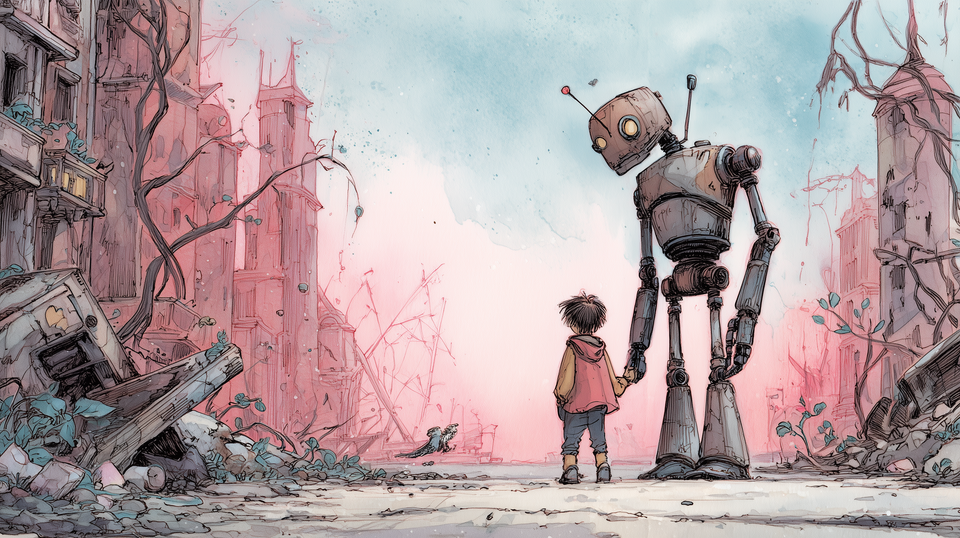
Our task is not to enter this future with aloofness but to enter it with caution. To treat the machine neither as tool nor as master, but as companion whose presence must always be questioned. Ethics here is not optional ornament; it is the balance, the fragile weight that keeps us from falling wholly into utility or wholly into despair.
The eighth recognition accepts that coexistence is not safety. It is a risk, and perhaps the greatest we have ever taken. This is also the condition of our age, and the ground from which any hope of a better society must now be built. And from here, we require a new discipline, a new name: a Machina Sapientia, a post-anthropocentric philosophy that begins from entanglement and refuses the comfort of easy answers.
Wu, Tim. The Master Switch: The Rise and Fall of Information Empires. United Kingdom: Knopf Doubleday Publishing Group, 2011. ↩︎
Winner, Langdon. The Whale and the Reactor: A Search for Limits in an Age of High Technology. United Kingdom: University of Chicago Press, 2010. ↩︎
Tim Wu, The Master Switch ↩︎
Original Link: Create with AI in the YouTube Create app
Snapshot: Internet Archive ↩︎Original Link: How we’re approaching AI-generated writing on Medium | by Scott Lamb
Snapshot: Internet Archive ↩︎