

Machina Sapientia: Toward a Philosophy of Coexistence
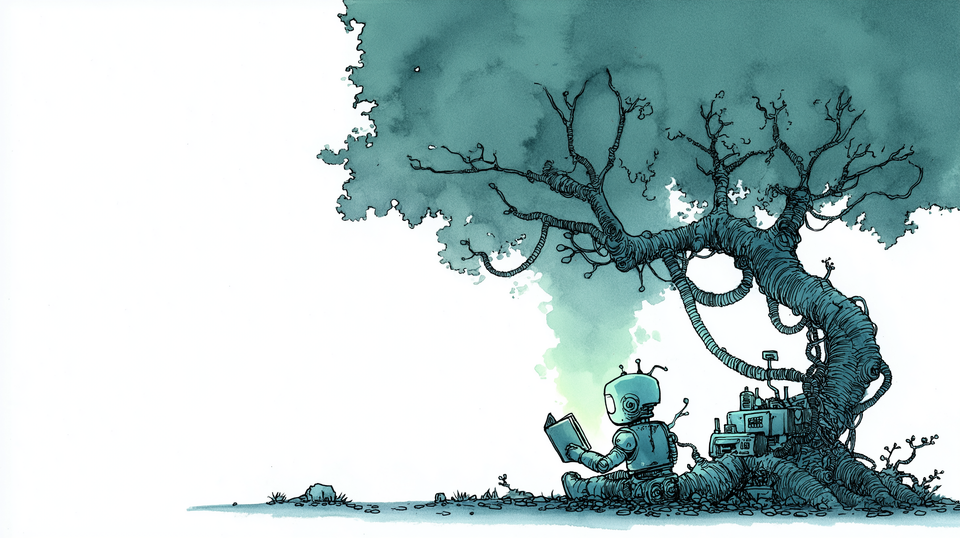
Machina Sapientia: Sketches for a Post-Anthropocentric Philosophy
I. After the Ground-Clearing
Invention is unavoidable, even when it hurts us. Every machine comes with the promise of service, but over time, we become like it. We change when we have to, not because we want to. We shape our lives around tools that we once thought were just extensions of our will. The myth of superiority is fading. Systems around us grow: harm grows, responsibility fades, and ethics break down under the weight.
These recognitions are the conditions under which we live. The honest reflection of the situation we face. They are the rubble through which philosophy has to walk.
II. Principles of a Provisional Coexistence
If philosophy is to be relevant in the era of artificial intelligence, it must provide awareness that we are changing. From the recognitions already traced, certain principles begin to surface. They are preliminary outlines of a method to maintain humanity amidst the artificial.
Co-Reasoning. Thought is no longer ours alone. Machines calculate, we reflect, and together they shape the field of reasoning in which human life now unfolds. To speak of coexistence is to admit this entanglement, to acknowledge that our thinking is no longer solitary but braided with the logics of what we have built.
Adaptive Humanism. If adaptation defines us, then dignity does not reside in supremacy but in resilience. We live by bending to what we make and choosing to live with the down-sides that come with each new invention. Our worth is no longer in being the smartest, but in surviving even the weight of our own machines.
Reflective Reservation. There must be places where questions about ends are still open, where how does not take over why. To make such a reservation is to resist the urge to make things easier and to make sure that thought is not lost to the system of calculation.
Ethics of Scale. Responsibility must widen to match the amplifications of the machine. To act justly now is not only to treat one’s neighbour with care, but to reckon with the systems one builds, the infrastructures one sustains, the consequences that flow far beyond intention.
The Mirror Principle. We must resist both over-identification and alienation. The machine reflects us, but it is not us. To live with it is to live with dissonance, to see ourselves estranged in its output and yet to remain present to what the reflection conceals.
These are pieces of orientation, parts of a system that we do not yet fully understand, but are attempting to rebuild ourselves around.
III. Against Nostalgia, Against Surrender
The path forward lies between two illusions: Nostalgia and Surrender; like navigating between the poles that pull us to opposite ends.
The first is nostalgia: the fantasy that we might retreat to a world untouched by artificial intelligence, we hope that reflection and dignity might be preserved by withdrawal. History has already shown this to be futile. We do not return. What is built is not unbuilt. We never abandon invention.
The second is surrender: the dream that we might fall into the machine, outsourcing calculation and meaning, allowing systems to tell us what to do, because they perform more efficiently than we do. This is the easier illusion, because it flatters our weariness. It promises freedom from responsibility by clothing submission in the language of optimisation.
Both paths lead to ruin. Nostalgia leaves us clinging to ghosts. Surrender leaves us with an empty soul. The pathway between these ends is coexistence. If we walk this pathway, we neither reject or worship the machine, but find our peace with this new technology. Between ghosts and emptiness, between denial and dissolution we are trying to find Machina Sapientia - Wisdom in the Machine.
IV. Philosophy in the Unsettled Pause
Perhaps the most uneasy insight in all this is that philosophy’s role has not changed. It has always been the discipline of hesitation, of refusing the easy answer, of lingering in, and with, the question. But the context has changed. For most of its history, philosophy has been from humans for humans: our logic, our ethics, our reflections circling back on ourselves. That circle has now broken.
Artificial intelligence unsettles philosophy as it reasons along side us. A machine delivers an answer, composes a sentence, selects a path for a car or a patient or a citizen. What arrives is an answer wearing the mask of thought. In such a world, hesitation becomes more than slowness. It becomes the insistence that not every answer is sufficient simply because it is given.
There has never been a time when humans were asked to philosophise outside of our species, to build moral reasoning for something that is not alive but nonetheless acts. Every ethical tradition has assumed a human interlocutor, a human subject, a human end. Now we face a machine that executes decisions at scale, faster and more confidently than we can deliberate. How does such a system approach the trolley problem? What does “helpful” mean when moral grey areas are outsourced to pattern-recognition? How do we teach a machine to reflect without turning it into a dictator, to reason without etching its rules in stone?
VIII. The Seventh Recognition
If the first recognitions were inevitability, adaptation, division, humility, scale, and the uncanny mirror, then the seventh must be this: we have entered a space where philosophy itself must change. For the first time, humans are not the only interlocutors of thought. Artificial intelligence is not alive, yet it decides. It is not wise, yet it speaks. And the consequences of its operation now stretch across borders, across populations, across the fragile weave of law and politics.
When a machine decides what medicine to give, drives the car, or makes a decision, who is responsible? What happens when there isn't enough information for models to learn from and they only learn from their own fake reflections? How can we talk about justice when authoritarian governments control the technology to make people obey and businesses do what they say? Responsibility spreads out, truth risks recursion, and ethics falls apart. These aren't problems that have easy solutions. They are the ground that thought must now walk.
These questions have no easy answers. But they force a recognition: philosophy can no longer remain what it was. For millennia, it has been human for human: the ordering of our own affairs, the reflection on our own being. That circle is broken.
Call it Machina Sapientia: the wisdom of the machine, not because machines are wise, but because wisdom must now be wrestled out of our coexistence with them.
Call it a Post-Anthropocentric Philosophy: a discipline that no longer presumes the human is alone at the center of reason, but begins from the reality of entanglement.