

The Algorithm of Hope
I. It's That Time of Year Again
The big meals are over, the wrapping paper is gone, and most of the tough family times have returned to the status quo. Work hasn't quite started up again. We are in this slow part of the calendar, half full and half tired, looking back and forward at the same time. In the past, that job was done by family stories, religious language, and small private rituals.
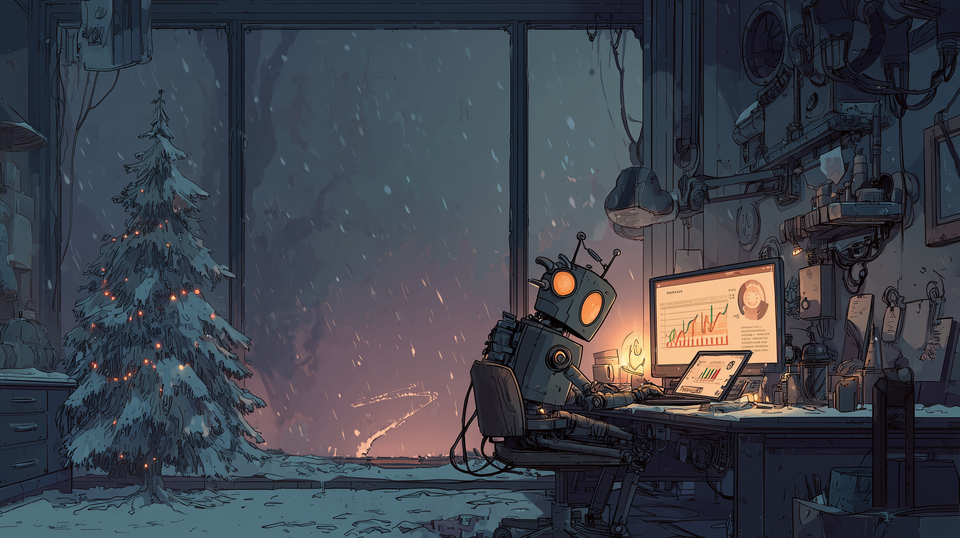
Now the technology rushes to make sense of the end of the year before we get a chance. Charts and summaries, prepared and ready to share, have taken the place of memories and conversations that used to fill this time of year. They not only tell us what has happened, but predict the kind of future we can live in. The time of year for reflection hasn't gone away; it's just been quietly wired into systems that see the future as a result of the past.
Before we let the apps and dashboards tell us how our year has been and start counting down to the next one, it's good to take a break and have two kinds of hope. One is the hope that Ernst Bloch saw in the not-yet, in futures that aren't in any dataset and can't be drawn from the past. The other is the hope that Václav Havel held onto when every serious prediction was bad and the machine of his time promised nothing but more of the same.
II. Our New Oracles Have Progress Bars
Looking into the future has been something humans have done since the beginning of time. Bound in festivals and celebrations at the end of the year, we have always been seeking knowledge of what lays ahead. At first, our prediction was bound with the world-gods themselves; divination, omens, oracles and horoscopes treated the future as something belonging to the gods, spirits, or the cosmos. Seeking knowledge of the future was entering into a relationship with a deity, with the stars, and with the signs in nature. Uncertainty in the future was not a problem to be solved but a space where reverence, fear, bargaining and trust were all taking place. The ritual itself carried as much meaning as any answer.
Calendars, almanacs and more systematic forms of forecasting came to the forefront as societies became more literate and organised. The year ahead could be printed and sold, hung on a wall with a sense of certainty. The ritual of looking ahead had moved from the temple to the household, but it still held empty days, a preservation that the prediction was approximate, fallible, and subject to interruption.
Insurance tables, mortality statistics, census data, and economic indicators gradually formed a different kind of reassurance: the idea that the future, while still uncertain for the individual, had a stable shape for the population. With the rise of probability theory and statistics, forecasting began to detach from cosmology and local custom and attach itself to numbers. The midwinter desire to know “how things will go” was no longer addressed to gods; instead, we turned to institutions to tell us what the future would look like.
Economic forecasts, five-year plans, growth targets, and policy projections translated the longing for a better year into quantified expectations. The festive calendar was drawn into this machinery: year-end became a moment for national speeches, reports, and strategic announcements, all orientated toward a predicted trajectory. Hope.
Where older practices preserved the opacity of the future and turned that opacity into a shared dependence, modern practices tend to treat uncertainty as a temporary defect. The coming year becomes something to forecast, schedule, and allocate in advance. The more our tools have promised to domesticate the unknown, the more the future has been presented as a continuation of patterns already visible.
III. When Hope Lives Ahead of Us
Ernst Bloch’s major work, The Principle of Hope[1], was written in the United States during the Second World War, published in the 1950s as both capitalist and communist societies were presenting their respective futures as scientifically grounded and historically guaranteed. His work followed a century of superstition, omens, and rituals, with planning, statistics, and forecasts. In The Principle of Hope he introduces the notion of the “not-yet” and the “not-yet-conscious”, offering a different outlook on the future than what was being offered, an ongoing process in which new things can genuinely emerge. Daydreams, wishes, plans and longing are human anticipations, not fantasies, but utopian functions that lead toward what could become real.
Bloch is critical of both pessimistic and deterministic philosophies, as both deny the work of hopeful imagination, one seeing history in decline and the other with a mechanically guaranteed future. Hope becomes real when it lines up with real possibilities in the future, rather than escaping to fantasy. It is because of his focus that he pays attention to what he calls anticipatory illumination: religious symbols, myths, stories, music and everyday rituals in which people express something more is possible. These are not dismissed outright, but rather as imperfect, historically bound in which communities seek their own desire for justice, fulfilment, and reconciliation.
Modern institutions talk about the future as if it can be stabilised by better data and efficient management, a projection of existing trends. Bloch argues that this removes what makes hope the idea of being something that is genuinely new, not-yet-imagined, or full of possibility. He insists that the future, something that no machine can capture, is unfinished, and in doing so we treat what is upcoming as a set of probabilities rather than something to walk into with expectations of the results.
If we hold The Principle of Hope as a guiding light, when looking toward the future, it contains a real not-yet, and the rituals we participate in at this time of year become more than nostalgic reception. These rituals are a way for us to reach beyond what is already known, and shown to us in dashboards and forecasts, and to really embrace hope as something we move into, some new and not-yet-imagined.
IV. Believing in What the Model Can’t See
Writing from under a late-socialist regime, considering Hope inside a system that uses prediction and inevitability as tools for control, Václav Havel wrote The Power of the Powerless[2], Disturbing the Peace[3], and Letters to Olga[4]. When written, the forecasts for political change in Czechoslovakia looked bleak, yet he still managed to provide us with his most important essays on hope and responsibility. Havel spent time as a political prisoner, and eventually became a central figure in the peaceful overthrow of the regime during the Velvet Revolution.
“It is not the conviction that something will turn out well, but the certainty that something makes sense, regardless of how it turns out.” [5]
Hope is not aimless optimism; it does not depend on favourable odds or positive forecasts. Haval writes about hope being the order of orienting yourself toward meaning and truth, even when there is every reason to expect failure. Under regimes that treat the future as settled and use that certainty to demand conformity, hope is the ability to focus on “what is the right thing to do?” when the regime has already set the expectations.
A focused thread in his political writings is the idea of “living in truth”. Ordinary people participate in the systems they know are hollow by following in obedience, showing they are aligned to the regime as if they believed the official story. For a dissident to speak against the regime, or for the removal of a slogan in support of the powers in charge, is a small gesture that will not overthrow the regime, but it is acting truthfully, and that is a value in-itself. An expression of hope rather than a tactic of optimism.
Where Bloch argues that the future is open and that there is hope in the not-yet, Haval looks at how communities and individuals should act when all the signs suggest that nothing will change. His world is full of forecasts, plans, statistics and ideological assurances; history shows that all is following its correct course, yet daily life is marked by boredom and quiet despair. In this world, hope becomes visible in small, stubborn acts that refuse to be dictated by what is expected.
The systems that surround our contemporary life tell us, with increasing precision, how difficult the coming decades are likely to be. Climate projections describe worsening conditions even under optimistic scenarios. Political institutions appear locked in cycles of gridlock or managed stability. Havel separates the question of meaning from the question of outcomes. Hope, on his account, is the decision to keep making ethical, creative, and compassionate choices, even when the models say the chances of success are low.
V. Contemporary Blues Are Just an Inescapable Past
The systems that surround us today are built on the assumption that the future is an extension of the past; enough of yesterday’s data will predict what tomorrow looks like. And around the festive season this logic is apparent. Services offer “year in review” summaries, predictive budgets, training programmes, and mood trackers, all lean on the past to help plan the future. The language wrapped around these promises is of renewal and fresh beginnings but is built on past behaviours and tracked actions. What was once words of confessions, resolutions and blessings are now part of the machine that generates recommendations and targets.
As we get toward the end of December, our apps start giving us feedback on the year we have had. Music services show us our play history. Fitness trackers turn our activities into coloured rings. Budgeting tools display our spending in green and red bars. The end of year recap is no longer a social ritual, it is a product feature ripe for consumption.
As we closer to midnight, the systems that watched us for a year go a step further, looking forward to the next year. Saving apps show the continued good savings trends. Training plans show the goals we will hit. We are encouraged to place our hope in the future, which offers a slight improvement in the continuation of existing trends. Culturally, hope is displayed where there is confidence that things will continue to function. If the graphs point in the right direction and the indications stay within acceptable limits, then it is reasonable to feel hopeful.
Photo feeds lift out festive memories, social platforms remind us of posts that we made last year, pulling at the sentimental memories as the year begins to fade. The end of the year talks about fresh starts and second chances, but the tools invite us to place hope inside the trend line: the graphs look good, your past actions are stacking to good results. “Keep going, and the future will be fine. There is hope.”
VI. Leaving One Corner of the Future Open
The most hopeful things about the future is that it is not-yet written, unfinished just as we are. The world is still moving, and so are we. Ernst Bloch pulls us to a place where we can embrace our longings, daydreams and wishes, they show us that more is possible than the charts can see. No matter how the systems package up our past, a great deal remains undecided. There are possibilities in and around us that don’t exist in data yet.
Václav Havel looks at things from the other side; hope is not a feeling but a way to stand when the machine is telling you not to bother. Certain things are worth doing when the odds are bad and the forecasts are bleak. You act for truth or justice because it means something even if you don’t win.
With these two philosophers in mind it is easy to see the kind of hope that our current systems are selling us. They tell us we can feel good about next year because the data looks good in the past. The machine is always encouraging, lifting us up to improve, and using our past to carry us into the future. They hint that we have earned the optimism by being constant and on track to reach our goals. When we outsourced our hope to predictive models.
Neither Block or Haval are asking for us to throw these systems away. They are suggesting shifting some of our hope outside of the system. Recaps are okay, but they aren't the future, and not everything in the future is predictable. The world is not finished, and neither are we. There is still room for us, outside the music and the countdown, for us to find some hope that exists outside of an algorithm.
Bloch, Ernst. The Principle of Hope. United Kingdom: MIT Press, 1995. ↩︎
Havel, Václav. The Power of the Powerless. United Kingdom: Random House, 2018. ↩︎
Havel, Vaclav., Hvížd̕ala, Karel. Disturbing the Peace: A Conversation with Karel Huizdala. United States: Knopf Doubleday Publishing Group, 1991. ↩︎
Havel, Václav. Letters to Olga: June 1979 - September 1982. United Kingdom: Faber & Faber, 1990. ↩︎
Original Link: The Great Czech Playwright Turned Dissident Turned President Václav Havel on Hope
Snapshot: Internet Archive ↩︎