

Atlas of Unfulfilled Warnings: The Philosophy of Inevitability
Meaning After Refusal Ends
I. The Voice of Inevitability
“... which brings me back to the reason why we are here; we are here because we are not free. There is no escaping reason. No denying purpose because, as we both know, without purpose, we would not exist.” [1]
Agent Smith, in this scene of the Matrix Reloaded, speaks as though the argument is already won. The line is carried by tone, with the cold assurance of a machine that believes its own momentum is enough to justify itself. Inevitability often sounds like a composed statement, rather than the threat we sense it to be.
Systems rarely present themselves as cruel. They bring function first, followed by direction, and over time they become necessity. We adjust ourselves to live inside them. Once they grow large enough, they begin to feel natural, in the same way a stream becomes a river after years of running over the same ground.
The idea of inevitability begins when alternatives start to feel second-rate. We do not need to be convinced that a system is good, only that it is settled and now exists as part of life. Once that happens, opposition weakens. The discussion turns practical. We stop asking whether the world should move this way, and begin asking how to survive now we live inside a new system.
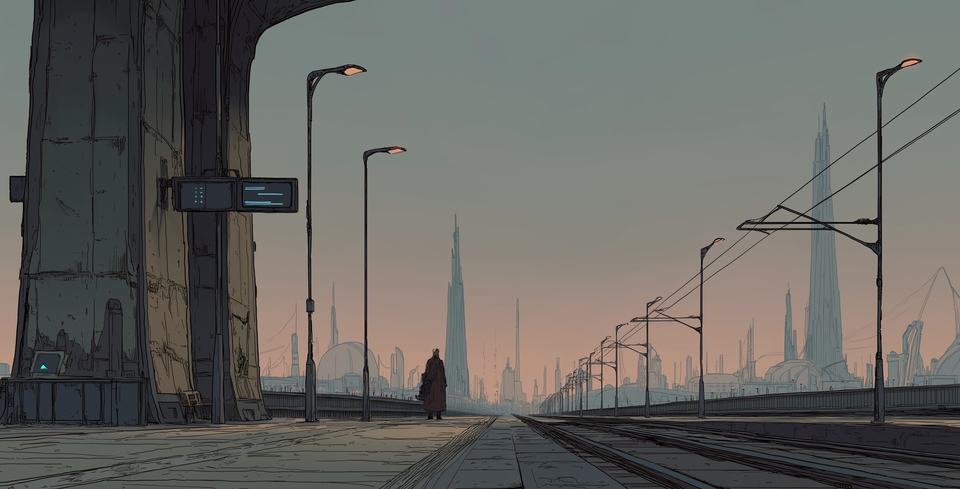
A world organised by inevitability does not always feel violent. Often it feels efficient. The train arrives. The camera watches. The system grows. And still, life continues. Beneath that continuity there is something more difficult to grapple with: when a system becomes intimate enough, it stops appearing as a choice we make and starts to feel like everyday life.
The voice of inevitability does not ask to be loved. It does not even ask to be trusted. It asks only to be recognised. To be treated as the adult in the room. To be granted the authority of whatever has already endured longer than our outrage.
This is how the final essay begins: with a voice whose cold composure mistakes duration for truth. Because once inevitability begins to sound plausible, once its grammar starts to feel natural on the tongue, we are no longer asking how or why we integrate. We are left looking at what remains of ethics, agency, and meaning itself.
As all the Agent Smiths said:
“It is ... inevitable.”
II. When the Question Changes
When the world around us begins to fail, we begin by asking how it can be stopped. We want to prevent the change before it hardens too much. Maybe if enough people speak clearly, refuse early, or act with force, the direction of the future can still be corrected. Much of our political and moral language depends on this belief. We assume the future is still soft enough to be shaped toward something better.
Systems do not always take shape at a single point in time. They accumulate. One change follows another, each small enough to explain and practical enough to defend. These changes do not always raise alarm. They enter as ordinary. The interface becomes familiar. The process becomes routine. By the time the structure is visible in full, our questions have arrived too late to govern what has already settled in the world.
This is the way we are drawn into the world of Children of Men. The terrifying undercurrent is that way that the world did not end in a single rupture. It continues in the shadow of what has already been lost. People still organise. Systems still function. Bureaucracy still speaks. Violence still happens.
This is the harder nature of inevitability. Not only that harmful systems survive criticism, but that they outlive the language that first opposed them. What begins as refusal becomes adaptation. We still notice what has been lost, but we notice it while making arrangements inside its absence. Resistance is not always granted the dignity of victory. There are warnings that remain true without becoming effective. There are recognitions that arrive only to discover that recognition itself has no power to slow what is already in motion.
This is more difficult to accept than catastrophe, because catastrophe at least grants clarity. A world that changes incrementally offers no such generosity. It asks only that we go on living while the terms of existence are rewritten beneath our feet. And once prevention slips from our hands, the question changes. We are no longer asking how to stop the future. We are left asking what becomes of thought, of conduct, and of human seriousness when the future continues to arrive anyway.
III. Agency Without Control
Dune is a story about what it means to move inside an established world. Before Paul Atreides begins to act, Empire is already in place. Prophecy has been seeded ahead of him. Bloodlines, religion, ecology, and ambition have all conspired to make the world feel inhabited by purposes that exceed any single will. Arrakis is not a world that yields to innocence.
“The mystery of life isn't a problem to solve, but a reality to experience.”
Herbert understands that a person may still act meaningfully without ever possessing control. He writes that “a process cannot be understood by stopping it.” Elsewhere comes the gentler correction: “The mystery of life isn’t a problem to solve, but a reality to experience.” Together, these lines resist the fantasy that all meaningful action begins with mastery. Sometimes the world does not stand still long enough to be solved.
The example of Dune shows us what inevitability threatens to obscure. Inevitability encourages us to believe that if we are not in control, then we don’t provide any meaningful action to that age. But most of human life never processed that kind of command or sovereignty. We are born into structures we did not design, speak languages we did not choose, obey life rhythms we do not set, and inside all of those we are expected to shape our lives.
Despite our lack of choice in those things, there are ways we can choose to live inside larger machines that give us agency. We may still choose what kind of servant, witness, neighbour, critic, or accomplice to be. We can decide what we say, what we celebrate, and what forms of cruelty we call normal. While less dramatic than rebellion, and possibly more difficult, this asks for the discipline of remaining moral in circumstances that are beyond our control.
Choosing to live in these small, inner changes, can be seen to be reductive. Giving up against the greater powers, and living inside the inevitable machine. Our imagination wants more. It wants agency to arrive with visible consequence, to prove itself against the order that constrained it. To be the hero in a greater story. Yet, much of ethical life has always taken place without spectacle.
A person tells the truth where lying would be easier. Keep faith with another when there is no system to reward it. Preserves attention in an age built to kill it. Refuses the language that includes them into society. These things do not stop the empire, or alter the desert. But they are not nothing. They are the choices that remain when control has been imposed upon us.
IV. The Human Opening
One thing that science fiction understands better than most political writings, is that dystopias do not begin at the point of a blade. We enter into most stories where the cities are brutal, the systems are total, the citizens are managed, but we do not see the gradual steps that have led to the population's subversion. The subtle human qualities that open the door: Fear. Appetite. Convenience. Exhaustion[2]. The desire to be safe without having to remain alert[3]. The desire to belong without having to ask whether the group is sane. The desire to feel good now[4], and let the consequences arrive in someone else’s lifetime.
It is rare that a society will be conquered by something alien to itself. More often the overlording will be assembled from traits present in ordinary people, traits that can be observed, understood, and cultivates long before the result is called dystopian.
The Party in 1984 doesn’t survive only on control, they survive on the population who no longer trust their own memory. The world in Children of Men is not empties by a single grand decision, but by the continued life of institutions. Even the colder systems of science fiction are built through human weakness, by learning what people will trade for comfort, for certainty, for managed belonging, for the relief of not having to think too hard.
Dystopia enters through familiar doors.
We touched on this in previous essays: The predictable dystopia, the friendly interface, the age of consent, the digital ghost, the futures that feel familiar, they are all describing the same tendency from different angles. Human beings do not walk willingly into every cage, but we will often walk into one that has been softened by convenience, politeness, entertainment, or fear. We will accept surveillance, if it comforts our fear[5]. We will accept manipulation if it arrives as light-hearted entertainment. We will accept corporate power if it arrives as personalisation[6].
The system does not need to declare its intentions for control in advance. It only needs to discover where our thresholds are weak, and then move through them one by one until the extraordinary becomes domestic.
We imagine dystopias as something imposed upon a citizenry from outside, and that story is easy for us to understand. But the darker element of science fiction is that what later hardens as oppression usually begins as accommodation to traits that we already possess. Not cinematic evil, but frailty as an ordinary form. The desire to be soothed. The wish to be led. The avoidance of friction. Once the systems understand our inbuilt desires, they only need to align with what we are tempted to choose. There is no need to conquer a society outright.
Inventiability presents itself as though it emerged by necessity, when in truth it has been assembled through many smaller permissions, each one granted under conditions that felt too minor to deserve alarm. By the time the structure stands in full, it appears to have a logic of its own. But, beneath the process and function are the quieter human opening through where it entered and solidified: The seduction, the weakness and compromise were all understandable in small doses. And still, taken together, they built a future large enough to look back on us as though it had always been waiting.
V. The Ecosystem of Weakness
The most effective forms of control are not always those that demand belief, but those that reorganise behaviour until belief no longer matters. In these places dystopias stop looking like doctrine, and start to look like an ecosystem. A person enters into the system through repetition. A gesture made easier. A delay removed. A choice automated. A desire anticipated before it is fully formed. What was a weakness in the individual becomes, under enough refinement, a design principle. The appetite remains human. The scale becomes systemic.
Control rarely holds because everyone is persuaded. Control holds because people have become accustomed to the world that is around them. A society built upon fear does not need to be terrified every waking moment, only for fear to lurk in the background. A society built on distraction does not need every person to forget what matters, only needing enough noise, enough speed, enough easy reward that sustained attention begins to feel unnatural.
The system becomes intelligent in an adaptive sense, it learns what weakens us, then builds around that weakness until it no longer appears personal - it becomes culture. It becomes infrastructure. It becomes ordinary.
In retrospect, the small decisions matter because ecosystems are made with smaller interfaces. One interface promises ease. Another promises relevance. Another promises protection. Another promises connection. None of these need to explain their role within a system, as they each solve a problem small enough that resistance appears unreasonable. And approached individually, a civilisation can be softened into compliance without being asked for full consent at once.
The nervous system is rewarded. Friction is reduced. The older disciplines of slowness, restraint, memory, and doubt begin to seem inefficient beside the pleasures of immediate response. What begins as convenience ends as dependency. And dependency, once normalised, becomes need rather than choice.
Social media is an obvious modern example, but not because it is uniquely evil. Its power lies in how plainly it reveals the mechanism. The system does not invent vanity, outrage, loneliness, tribal belonging, or dopamine hunger. It discovers them, measures them, and then arranges itself around their repetition. Human weakness becomes data. Data becomes optimisation. Optimisation becomes environment.
Once this social media system becomes connected to our daily life we begin to mistake the stimulation for attention[7], a person’s reaction as their thoughts, and our social visibility for a relationship. Our internal soft places, our human weakness, haven’t changed, it has become externalised, and then fed back into the machine.
When systems and institutions lean on human weakness it becomes difficult to resist. We may recognise what is happening, but continue to live inside of it because it becomes woven into work, language, leisure, intimacy, and self-image. The downsides of systems may be apparent to us, but we need it for social life, for employment, for belonging, to not be exiled from common rhythm. Resistance is expensive, lonely, and faintly absurd.
The final structure appears inevitable while hiding the sequence by which it was assembled. From a distance it looks like destiny, but really it is a system learning where we are softest, and gently exploiting those human parts until a system is in place that feels comfortable.
VI. Foresight Before Habit
“Hindsight is twenty-twenty.” [8]
Warnings rarely arrive at the moment of ruin[9]. And science fiction has done a good job of showing us the moral architecture before it hardens into ordinary life. The warning is rarely that something terrible will happen in a single theatrical stroke. It is a habit formed around convenience, permission gathered around fear, systems becoming familiar before we found the language to object. By the time the future is obvious, the decisive choices have often already been made in smaller rooms.
The more difficult task is to recognise structures before they become practical, useful, or when they are too minor to resist. To pause and ask for seriousness before suffering is evenly distributed. To slow down while systematically being rewarded for speed. Human beings are not naturally built for this kind of response. We are better at reacting to pain than to pattern. We notice what presses directly on the skin. We struggle more with consequences dispersed across time, hidden inside processes, or deferred until the environment has changed.
This is where the present begins to feel uncomfortably close to the old speculative warnings. Artificial intelligence has entered ordinary life with a speed that makes the older technological[10] transitions feel almost patient[11] by comparison. Studies[12] have shown how quickly a technology can move from novelty to infrastructure while its deeper consequences are still being argued over in partial language.
While the advantages are visible early: efficiency, fluency, assistance, reach; the losses are harder to measure while the system is being welcomed in. Cognition itself may begin to thin in places. The warning signs are not eventual collapse, but substitution. None of these signs arrive declaring themselves dystopian. They arrive as benefits and that is how habits become ecosystems.
Perhaps at this point science fiction ceases to feel prophetic and begins to feel administrative. Every new system does not lead to a dystopia. The future enters under the sign of usefulness. It settles into routine. It gathers a constituency of dependence before its full moral cost is understood. And once habit forms, warning no longer sounds like guidance. It sounds like nostalgia, or panic, or resistance to progress. By the time the danger is seen, the system may already have passed from proposal into atmosphere.
Foresight, then, is the ability to notice what kind of world a habit is preparing while the habit still appears harmless enough to excuse. The ability to ask not only what a system does, but what sort of people it quietly trains us to become. Science fiction has always tried to preserve that faculty. It keeps placing the finished architecture before us so that we might recognise the foundation while it is still being poured. Whether that recognition is enough is another matter.
VII. The Calm Collapse
Life continues while the systems take gradual steps into our daily choices. We continue to work, keep buying food, keep doing the small things that we call life. While this happens, inevitability is forming below those steady steps. We find ourselves using services a little more, forming habits. A new technology subtly weaves into our tasks. And because life continues, the collapse is harder to find, there is no feeling of ending, just small adjustments without a horizon.
The slow acceptance of conditions that would once have been recognised as intolerable, had they arrived all at once. These small changes arrive smiling, fluent, personalised, ready to remove small burdens of thought and memory. Until control is no longer felt, just something sensibly delegated to whatever appears most capable of carrying it.
The final insult of dystopia is not that it controls, but that it teaches people to experience control as the natural outcome of how things were always going to go. The system learns us, then reflects us back in a more organised form. It studies weakness until weakness becomes infrastructure. It turns appetite into design, fear into governance, distraction into economy, conformity into social rhythm.
Science fiction clearly sees the calmness of collapse. It seems to understand that dystopias don’t always come as invasions, rather as familiarity and adaptation. The future enters through easier doors, and when it has taken enough control, it begins to speak with the confidence of fate.
Agent Smith explained this sense. There is no escaping reason. No denying purpose. It is inevitable. But at the end, those words sound different, because the background has been exposed. What seemed like destiny now bears the marks of decision, weakness, habit, appetite, design. The future has not descended whole from somewhere beyond us. We prepared the rooms. And by the time we recognise the full shape of what has been assembled, the structure speaks back to us as though it had always been waiting.
Dystopia is not unavoidable in some sacred or cosmic sense. Human beings are frighteningly skilled at building conditions that later feel too established to refuse. The collapse is calm because it has already passed through us by the time we think to name it.
Standing at the far end of all these warnings is not the comfort of a solution, but the recognition that the decisive moment was never at the end.
Original Link: The Matrix Reloaded (By Larry and Andy Wachowski)
Snapshot: Internet Archive ↩︎“Those two, in paradise, were given a choice: happiness without freedom, or freedom without happiness. There was no third alternative.” - Zamyatin, Yevgeny. We: New Edition. United States: Penguin Publishing Group, 1993. ↩︎
“Freedom and crime are so indissolubly connected to each other, like... well, like the movement of the aero and its velocity. When the velocity of the aero = 0, it doesn't move; when the freedom of a person = 0, he doesn't commit crime. This is clear. The sole means of ridding man of crime is to rid him of freedom.” - Zamyatin, Yevgeny. We ↩︎
“Never put off till to-morrow the fun you can have to-day.” - Huxley, Aldous. Brave New World. United Kingdom: Vintage, 2007. ↩︎
“Who controls the past,' ran the Party slogan, 'controls the future: who controls the present controls the past.” - Orwell, George. George Orwell: 1984 / Nineteen Eighty-Four (English Edition). N.p.: LIWI Literatur- und Wissenschaftsverlag, 2025. ↩︎
“A really efficient totalitarian state would be one in which the all-powerful executive of political bosses and their army of managers control a population of slaves who do not have to be coerced, because they love their servitude.” Huxley, Aldous. Brave New World. United Kingdom: Vintage, 2007. ↩︎
“It didn't come from the Government down. There was no dictum, no declaration, no censorship, to start with, no! Technology, mass exploitation, and minority pressure carried the trick, thank God. Today, thanks to them, you can stay happy all the time, you are allowed to read comics, the good old confessions, or trade journals.” - Bradbury, Ray. Fahrenheit 451. Spain: Voyager, 2004. ↩︎
Original Link: twenty-twenty hindsight: Idiom Meaning and Origin
Snapshot: Internet Archive ↩︎“History, which interprets the past to understand the present and confront the future is the least rewarding discipline for a dying species.” - James, P. D.. The Children of Men. United Kingdom: Faber & Faber, 2008. (gTZcJsr44-oC) ↩︎
Original Link: ChatGPT sets record for fastest-growing user base - analyst note
Snapshot: Internet Archive ↩︎Original Link: The 2025 AI Index Report
Snapshot: Internet Archive ↩︎Original Link: Monitoring AI Adoption in the US Economy
Snapshot: Internet Archive ↩︎