

Burden of Civilisation: The Tribe Before the Interface
I. A People Close to the Ground
Modern life has made it easier to say we belong, but harder to feel it. There are platforms for every affiliation, channels for every interest, signals for every preference. A person can be seen by thousands and remain, in most of the ways that matter, untouched. A sliver of life exposed, enlarged, passed around; and yet the depth of that person, the weight of what they carry, remains mostly unknown.
This is not to say that modern forms of community are false. People do find friendship in them, recognition, humour, and rescue. A message can arrive at the right hour. A stranger's voice can speak to a recent thought. The interface does not invent emptiness. It creates something thinner, faster, more portable, and easier to leave without being noticed.
There is a difference between sending a fragment of the world through glass and standing together in the same weather. More and more, conversation reaches toward an external object to sustain itself: the phone is opened to show a clip, an image, a post. Something vivid enough to carry the discussion onward.
Civilisation often asks us to be individuals first, and members second. We are encouraged to choose our identities, curate our affinities, and refine our public selves in the slow effort to become more fully ourselves. This has loosened old cruelties. It has given refuge to people the older tribe would have buried.
But there are some things about existing inside a community that keep a person warm in ways that choice alone cannot always reach.
The tribe, in its older forms, is frightening because it demands. The interface is frightening because it expects so little. Between them sits a hunger that neither fully answers: the desire to belong somewhere more deeply than preference, more bodily than a notification, more durable than the brief warmth of being seen.
II. Beast Snaggas and the Memory of the Hunt
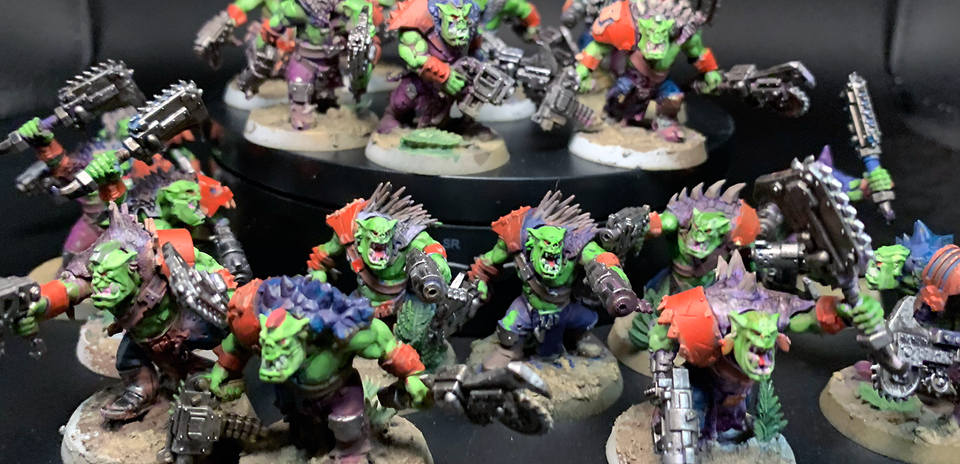
No Ork is ever far from scrap, noise, crude weapons, and the violent joy of the battlefield. The Beast Snaggas are nomadic, traditionalist, drawn toward old ways; they prefer squigs, beasts, and greenskin company over the dependence on armoured vehicles.[1]
Their belonging is lived beside others in a mob moving together because the hunt requires it. They fight the same battle, endure the same danger, and are marked by the same rough grammar of appetite and impact. They are described as master squig-breeders riding to war on ferocious red steeds, kicking, biting, and stabbing anything close enough to be caught in the rush.[2] There is little distance between animal, rider, weapon, and tribe. The borders between self and mob are porous, almost beside the point.
The Beast Snagga Boyz are brutal and belligerent, hulking warriors carrying sluggas, choppas, thump guns, and power snappas.[3] They do not arrive in low numbers. They drop in as a horde, each Ork feeding on the noise and courage of the others, made larger by proximity, made more itself by the press of the mob around it.
Beast Snagga stampedes thunder across rain-lashed plains, baking deserts, and ruined cityscapes, always searching for larger prey, whether that prey is a monster, a tank, or anything else that moves.[4] Their trophies are not decoration. They are social memory. Proof that the mob was there, that the danger was real.
Morgrim's Butchas use two mobs of Beast Snagga Boyz to overwhelm infantry, monsters, and vehicles, while Beastboss Morgrim drives those around him to fight harder.[5] The Beastboss commands, but the Boyz make the command into a world. They are the bodies around him, the noise that confirms his authority, the crude social field inside which instinct becomes belonging.
There is no innocence in this. Beast Snagga community is violent, narrow, and built around exclusion as much as fellowship. Their belonging together is not a statement of intention: it is forged from repeated action. The same charge. The same hunt. The same instinct felt across many bodies at once.
III. Belonging Before Abstraction
Yet the frantic abolition of all distances brings no nearness; for nearness does not consist in shortness of distance. What is least remote from us in point of distance, by virtue of its picture on film or its sound on radio, can remain far from us. What is incalculably far from us in point of distance can be near to us.[6]
This is a strange thought to carry into a world where distance has become so easy to defeat. A face can cross oceans in an instant. A voice can arrive from another continent while the kettle boils. A private thought can be posted, copied, flattened, praised, misread, and forgotten before the day has finished. Distance has been shortened, and yet nearness has not followed in the same measure.
Heidegger's word for this older depth is dwelling. Not merely occupying a place, not simply having shelter, but living in a way that the things revolve around repeated care. In Building Dwelling Thinking, he writes that the basic character of dwelling is to spare, to preserve.
“But the basic character of dwelling is to spare, to preserve. Mortals dwell in the way they preserve the fourfold in its essential being, its presencing.”
The world of the Beast Snagga Boyz is crude, brutal, and morally narrow. It is also built from repetition. The hunt returns. The mob gathers. The same dangers are sought, the same trophies remembered, the same bodies move together through mud, noise, weather, and impact. They do not belong because they have explained themselves to one another. They belong because they have been shaped by the same world and thrown into the same dangers.
Modern communities often begin with declaration, with profile, with the relief of finding people who use the same words for the same issues. Many people have found life-saving forms of belonging through mediated spaces, especially when the old forms of tribe would have rejected them. But the interface also allows belonging to remain light enough to leave no mark. A person can pass through one another without being changed very much.
Heidegger writes that mortals are in the fourfold by dwelling[7]. The language belongs to his own strange architecture of earth, sky, divinities, and mortals. Human life is not an isolated mind surveying a collection of objects. It is always already placed among things: weather, bodies, histories, tools, absences, and rituals. We are not first profiles, we are creatures who need a world.
The modern interface can gather people with extraordinary speed, but gathering is not always dwelling. It can connect without rooting, display without holding, summon without keeping. The Beast Snagga Boyz show the opposite, a belonging so thick it can barely breathe. Between those two ends, the older hunger remains: to be near enough to matter.
IV. The Loneliness of Civilised Belonging
The modern world has groups for every weakness, channels for every obsession, platforms for every taste. And in this, many lives have been steadied by distant voices. People have found names for themselves in rooms they could never have entered physically. The interface has rescued people from older tribes that would have buried them alive.
The same systems that connect us also thin the conditions under which belonging becomes heavy enough to hold. They remove friction, distance, silence, awkwardness, duty, and the slow accumulation of repeated presence. They give us the gesture without always giving us the world around it. A message arrives. A heart appears. A clip is shared. A thread continues for a while, and then the day breaks apart into other windows.
To the extent that it exerts a disembodying influence, digitalization weakens common ties. Digital communication is disembodied communication.[8]
The body is not an accessory to community, it is one of the ways belonging becomes real. Digital communication often spares us from difficulties and inconveniences of placing our physical body into a community. But something changes when our communities become contact without a shared location, or the bonded passage of time. Modern belonging often gives the self so much room that it can drift untouched.
The Beast Snagga mob has almost the opposite problem. It is all body and shared space. It gathers through noise, threat, shared appetite, and the violence of being sent to Waaagh. There is not much room to become private.
Han's work says that rituals are not merely ceremonies. They are repeated forms that stabilise time, give bodies something to do together, and let meaning gather without needing to be explained each time. It can make a world feel continuous. Without such forms, community becomes more dependent on expression, on constant communication.
Perhaps that is why the our digital devices enter conversations so easily. Even when people are together, the device is often called upon to complete the moment. A video is shown because silence feels insufficient. A post is mentioned and sent to a group chat. A joke has already happened somewhere else, and the group gathers around its reproduction.
Between being trapped inside communities, or weightless in ephemeral communities, the human creature remains difficult to satisfy. It wants freedom, but not abandonment. It wants recognition, but without unending performance. It wants to be acknowledged, but also to be known in ways that do not need to be explained.
Civilisation has given us softer ways to gather. Safer ways, broader ways, ways that let the rejected find one another across distance. These are not small gifts. But every gift carries a shadow. The interface can connect without claiming. It can let us speak without making us stay. It can build communities that function, even flourish, while leaving some older hunger unhandled: the hunger for a world shared deeply enough that belonging does not have to keep being proven.
V. What the Beast Remembers
The Beast Snagga Boyz are not an answer to the loneliness of modern life. They are too violent for that, too narrow, too willing to build warmth from shared hostility and to make belonging out of exclusion. Their world is not a refuge. The old tribe held people closely, and it also held them tightly. It gave people a place, and then often punished them for wanting something different.
Still, there is something about that type of community that we long for. The gathering mob. Leaving for the hunt. Bodies moving through mud, noise, weather, and danger. The crude reassurance of being surrounded by others who understand the same rhythm without needing it explained. Belonging is not declared, it is enacted.
Perhaps this is what the modern interface struggles to replace. It can gather people quickly, carry voices across impossible distances, and build rooms for those who would have been abandoned by older forms of community. These are real gifts. But the interface often finds us as isolated selves first, then offers connection afterward. The older tribe began alongside other who were already there.
That older form cannot simply return. Nor should it. Civilisation burdens the beast because it cannot allow life to remain in those forms. It cannot permit belonging to be built only from blood, soil, threat, and the closing of ranks against a stranger.
But civilisation burdens us as well. In freeing us from the old enclosures, it leaves behind hungers it does not always know how to satisfy. The hunger to be known without performance. To be claimed without being consumed. To belong somewhere more deeply a notification showing briefly and then falling into silence.
Across these three figures, the same buried truth keeps returning. Power still wants a body. Desire still wants a charge. Belonging still wants a world. The beast survives because civilisation did not create these hungers. It only inherited them, feared them, and disciplined them.
The image of the Beast Snagga Boyz are not as a future to desire, but as a memory we have not entirely escaped. A rough reminder that the human creature was never built for abstraction alone. We need distance, yes. We need freedom, mercy, and the right to become strange to the tribe that made us. But we also need nearness. Repetition. Shared time. A group to exist within.
Original Link: Beast Snaggas
Snapshot: Internet Archive ↩︎Original Link: Who Are Those ‘Beast Snagga’ Gits, Anyway?
Snapshot: Internet Archive ↩︎Original Link: Beast Snagga Boy
Snapshot: Internet Archive ↩︎Original Link: The Beast Snagga Orks Army Set
Snapshot: Internet Archive ↩︎Original Link: Starting an Ork Army
Snapshot: Internet Archive ↩︎Heidegger, Martin. Poetry, Language, Thought. Taiwan: Shuang Ie, 1983. ↩︎
Original Link: Building, Dwelling, Thinking
Snapshot: Internet Archive ↩︎Han, Byung-Chul. The Disappearance of Rituals: A Topology of the Present. United Kingdom: Polity Press, 2020. ↩︎