

Atlas of Unfulfilled Warnings: Age of Consent
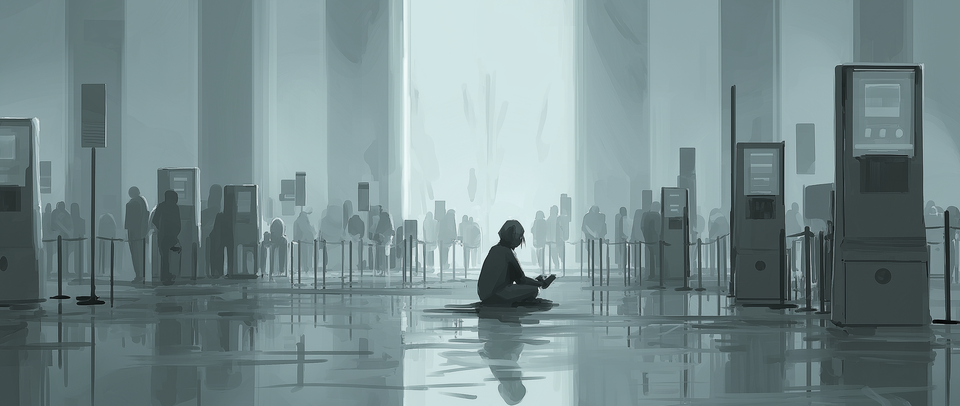
What does consent mean when systems are designed so that participation is continuous, ambient, and difficult to exit?
I. When Agreement Became the Default
The HTML checkbox has been a standard form element since around 1995. Since that time, no other form element has had to carry the same burden as the checkbox. The small box is often the gateway to many website signup-processes, without clicking that checkbox, you are forced to stop and read the many legal pages of Terms and Conditions before proceeding.
But most of us don’t read. We mark the box, and continue on our way. And, with the layout providing the interface we have adjusted the nature of consent. A single checkbox signals that we agree to a legal document that is unread, and binding. But, we agree to this on the way through a process in a system.
Consent was once an act of understanding, a pause, and a decision. There was a conscious decision to agree or disagree, based on the provided information. And, while we use the same word, our consent is now given as a part of a motion. The language remains, we understand what the term means, but now it exists everywhere, attached to every interaction that might carry risk, responsibility, or consequence.
What has changed is the context in which consent is given.
Agreement is something that arrives in mid-process, often while we are trying to accomplish another task. Consent is assumed as we use systems, signaled by a small checkbox, or a laminated notice as we enter a store or shopping centre. It is not a single-minded decision, posed to us in which we get time to think and respond. Consent is a small disruption to what we are trying to accomplish.
The design of modern systems rely on this shift of handling consent. Systems are established on it. We can opt out but we have to dig through many screens to find it, we can find other alternatives but it is at our inconvenience. The systems offer refusal, but it is through a complex set of navigations, and agreeing is simply easier.
This is not an accident, it is the result of years refining processes, and watching how we all respond to options presented to us under conditions of momentum. The same research that learned to reduce hesitation online now governs how consent is requested in systems.
Consent no longer marks a deliberate act of will. It marks successful passage through a system. We are no longer asked if we agree to something, but only asked a narrow version of the question, while moving through a system or a place. In some situations it is not something we can walk away from either, as this happens in city streets and supermarkets too.
II. Consent as Interface
Over time, agreement has moved from being a decision into being an interaction. We are being asked if we understand terms that we don’t read, instead we take it as another step in a process. The interface became the point of consent, and the interface has been optimised to lead us through the process.
Researchers studying so-called “dark patterns” have shown how interface design can steer users toward agreement through default settings, visual hierarchy, timing, and framing. The presence of choice remains, but its visibility diminishes. Refusal requires us to make an effort, but agreement just needs to keep us moving.
“Dark patterns in user interface (UI) design leverage various psychological principles to manipulate user behavior and decision-making processes.” [1]
One of the most persistent examples is the checkbox.
We get presented with long terms of legal language spanning thousands of words. If we were to stop and read them in the detail they require, we would not get to our direct task anytime soon. Over time the checkbox becomes a symbol, a ritual of confirmation to grant us access to tasks we can complete.
Studies consistently show that the vast majority of users do not read terms of service or privacy policies in full. Some research suggests that doing so for every service a person uses would require hundreds of hours per year.
“According to international research, it would take the average person 244 hours per year (six working weeks) to read all privacy policies that apply to them, not including the time it would take to check websites for changes to these policies.” [2]
What we have is a difficult situation, where consent is ubiquitous but the understanding of what is agreed to is murky, at best. Agreement is recorded, but not deliberated. The system shows compliance, but with no way to demonstrate understanding. This is what happens when consent is scaled across millions of interactions. Because when things are run at scale, deliberation is a friction. And friction is a failure point, so the interface adjusts to reduce it.
This, of course, is measurable. Platforms have high sign-up rates that show good engagement. When we look from the perspective of the system, consent is working fine. But from the perspective of the individual, consent fades away. We hand it over as a matter of process.
III. When Fiction Solved the Problem First
In Aldous Huxley’s Brave New World[3] there are no consent forms. There are no declarations of loyalty, no moments where characters are asked to submit. The system does not need permission, because resistance never quite forms. Conditioning replaces coercion.
“People are happy; they get what they want, and they never want what they can’t get.”[4]
The world Huxley imagined is often described as dystopian because of the freedom, depth, and suffering that it removes. But what if we look at what continues? People continue. They work, consume, and socialise, they do not feel trapped. The system relies on comfort, habit, and smoothness, but punishment is not a consideration.
Systems do not need to overpower individuals if they can align desire, convenience, and stability. This is a simple recipe for compliance, which, achieved through ease, is more durable than compliance achieved through fear. When participation feels like the natural continuation of life, refusal appears irrational rather than heroic. The same logic appears again and again in science fiction’s pictures of large systems. In 1984, surveillance is overt and brutal, but the most effective control is the internalisation of expectation, created by the camera. In The Matrix, the system works because exiting requires abandoning familiarity, identity, and continuity itself.
“The Matrix is a system, Neo. That system is our enemy.” [5]
These systems shape the environment so that certain behaviours feel obvious and unthinkable. They persuade and argue through hidden means, leaning on human instinct, to establish structure and order. Science fiction seems to understand this better than we allow ourselves to be aware of.
Philosophy can help us to describe freedom, autonomy and coercion, but science fiction has always had the ability to take us into worlds; to show us what happens when none of these are directly violated. Worlds where choice remains, but it is functionality irrelevant. These stories make clear that erosion of consent doesn’t begin with force, it begins when participation is easier than reflections, when agreement becomes indistinguishable from momentum.
IV. The Cost of Refusal
Consent only functions when refusal is meaningful. And in modern technology, and in theory, refusal still exists. Terms can be declined. Permissions can be revoked. Accounts can be deleted. But in practice, refusal delays progress and restricts access. It marks the individual as difficult, non-standard, or incompatible.
Hannah Arendt wrote about the erosion of judgement as a gradual displacement of responsibility into process. When actions are performed because “this is how things are done,” slow deliberation becomes almost useless. Responsibility does not disappear; it becomes diffuse. No single moment feels decisive enough to warrant refusal.
“When all are swept away unthinkingly by what everybody else does and believes in, those who think are drawn out of hiding because their refusal to join in is conspicuous and thereby becomes a kind of action.” [6]
In contemporary systems, consent is often asked at moments when refusal would require disproportionate effort. Often this refusal has to happen at an inconvenient time, when momentum has been established. The system does not argue against refusal; it simply makes agreement easier to live with.
“The fate of our times is characterized by rationalization and intellectualization and, above all, by the disenchantment of the world.” [7]
Max Weber described rationalised systems as ones increasingly governed by calculation rather than judgement. In such systems, Weber observed, “the ultimate and most sublime values have retreated from public life,” no longer shaping collective action, but surviving only at the level of personal belief.
What replaces refusal is not obedience, but adaptation. We learn how to move through systems with minimal resistance. Adjusting behaviour, accepting defaults, and complying because non-compliance exacts a steady toll.
This is why consent can be continuously recorded while dissent quietly disappears.
The system does not punish refusal overtly. It exhausts it. Over time, saying no feels less like an assertion of autonomy and more like a failure to participate correctly. The individual is not coerced; they are outpaced. At this point, consent no longer protects agency. It measures compatibility.
V. When Consent Leaves the Screen
Up to this point, consent has been attached to participation in systems we can still, in principle, refuse. Websites can be avoided. Accounts can be deleted. Platforms can be abandoned, even if doing so carries inconvenience or social cost. The checkbox, for all its flaws, still appears at the edge of a voluntary interaction.
But that boundary is now dissolving.
Consent is starting to become a condition of moving through ordinary life. Entering a supermarket, walking through a shopping centre, using public transport, or passing through a city street now involves acceptance of recording, tracking, and data capture.
There is no meaning or agreement in this form of consent. No alternative is presented, no comparable option that removes surveillance, no pause where we could possibly refuse without consequence. Choice is not between yes and no, but between participation and absence.
In Australia, for example, major retailers such as Bunnings Warehouse[8] have trialled facial recognition systems in physical stores, capturing biometric data from customers as they move through retail space. Entry signage functioned as consent, and while you could choose not to shop at a particular location, that decision would be made upon entry to the store to accomplish a pre-planned task.
City streets are monitored. Transport hubs are recorded. Driver’s licence photographs are incorporated into national facial[9] recognition systems[10], not as part of a specific service request, but as a background condition of identification. The data does not belong to a single interaction, it isn’t connected to a web page, or internet service, it is collected, stored, and assumedly accessed.
While collating surveillance data in this way feels dystopian; granting companies access to personal biometric data by entering a public space, it shows the vanishing of consent as a moment or choice. There is no checkbox to use while walking to work. No opt-out path when entering a supermarket to buy food. No reasonable alternative when identity systems underpin access to employment, transport, or housing. Consent becomes environmental rather than transactional.
The techniques that made online consent frictionless now operate at the level of space. Signage replaces interfaces. Presence replaces agreement. Data capture becomes the default condition of access. The individual is not asked to decide; they are informed after the fact.
This is where the logic of UX completes its migration.
The system no longer needs to persuade or guide behaviour through design alone. It embeds consent into the structure of everyday life, where refusal is technically possible but practically untenable.
VI. When Consent Becomes a Condition
Consent was once an action. It implied a moment of pause, a decision taken before entry. Even when poorly designed or aggressively framed, it allowed us to pause, think and then make a choice. Something offered, something accepted.
In the systems we now inhabit, consent is not requested in the same way as optional services, but assumed as a condition of usage and participation. To shop, travel, work, or appear in a public space will leave data behind. And there is no way for us to opt-out of some of these tasks; we can’t choose not to get to work by walking in a public space, or to not buy food at a local supermarket to feed our families.
This change in agency means that consent is no longer a moral boundary. It is an administrative detail that is symbolised by our presence.
The data created under these conditions does not belong to a moment of agreement, nor even to a specific interaction. It is collected quietly, persists beyond context, and belongs in the hands of companies or governments that can use it under different environments.
Consent by existing in a space creates a life beyond our physical existence that we have no control over.
Original Link: Understanding Dark Patterns: Manipulative UI Design Tactics
Snapshot: Internet Archive ↩︎Original Link: It's rational that 94% of Australians do not read all privacy policies that apply to them
Snapshot: Internet Archive ↩︎Huxley, Aldous. Brave New World. United Kingdom: Vintage, 2005 ↩︎
“You can't make flivers without steel - and you can't make tragedies without social instability. The world's stable now. People are happy; they get what they want, and they never want what they can't get.” - Quote
Snapshot: Internet Archive ↩︎“The Matrix is a system, Neo. That system is our enemy. But when you're inside, you look around, what do you see? Businessmen, teachers, lawyers, carpenters. The very minds of the people we are trying to save. But until we do, these people are still a part of that system and that makes them our enemy.” - Quote
Snapshot: Internet Archive ↩︎Arendt, Hannah., Kohn, Jerome. Between Past and Future. United States: Penguin Publishing Group, 2006. ↩︎
Weber, Max. Sociological Writings. United Kingdom: Continuum, 1994. ↩︎
Original Link: Bunnings breached Australians’ privacy with facial recognition tool
Snapshot: Internet Archive ↩︎Original Link: Identity Verification Services (Australia)
Snapshot: Internet Archive ↩︎Australia Advances National Facial Recognition Network Despite Privacy Concerns
Snapshot: Internet Archive ↩︎