

Atlas of Unfulfilled Warnings: The Afterlife of Data
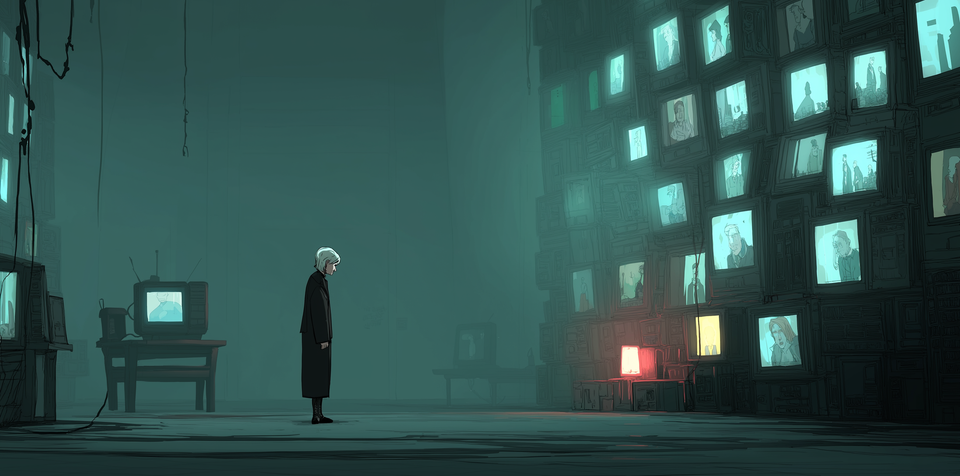
Persistence is no longer an exception. It is the default condition.
The data we generate now outlives us. Profiles, histories, associations, and inferred traits persist, stored in systems that have no endpoint, no expected end-of-life and no obligation to forget. What remains is a record we curate, as it accumulates over time.
This digital remainder may outlast physical items, personal and even collective memory. It may form a more continuous and detailed portrait of a life than anything preserved in the material world. It reflects who we believed ourselves to be, but also who these systems learned us to be.
The world this data creates may not be an accurate portrayal of a life lived. But it will be the version that survives.
I. The Architecture That Does Not Sleep
Data does not fade in the way physical traces do. It does not yellow, misplace itself, or slip quietly into obscurity. It accumulates. It is indexed, duplicated, backed up, and made resilient against loss. Every interaction leaves a data point, and every data point is useful, maybe now and maybe in the future.
The persistence of this data is not accidental. Modern data systems are designed to assume continuity. Profiles are not snapshots but living structures, constantly revised, re-weighted, and enriched by new signals. What was once entered for one purpose becomes relevant to another. What was collected passively gains meaning later, like gold found in a shallow stream.
Systems optimise for retention because retention enables correlation, prediction, and reuse. The more that is added to the timeline, the more rich the data source. The longer the data survives, the more valuable it becomes.
What emerges is a shadow record that walks beside a life as it is lived. A parallel presence of logs, preferences, movement patterns, associations, and inferred traits. A digital collection of interactions within a system that goes unnoticed by the person that it represents.
Without any intention from the data source, the system produces data by participation, by using services, moving through monitored spaces, and interacting with interfaces. The systems are not dragging data out of us. And, over time, this becomes a more stable record than our lives it is reflecting. Relationships change, memories blur and we rewrite stories with every retelling. Yet, the data remains fixed, timestamped and searchable.
This is the ghost that modern systems create.
II. What the System Chooses to Remember
Persistence produces leverage. The more time information remains available, the more that can be learned from it, the more than it can be used for. What was once relevant due to recency, becomes valuable once it can be correlated with something else.
Social platforms, such as Facebook, have described data as something that retains value indefinitely. Platform policies[1] and academic research[2] alike point to the long-term usefulness of historical data for refining behavioural models, training machine-learning systems, and stabilising identity inference over time. What the user considers past interaction, the system treats as an ongoing signal.
Data deletion is non-binary. Studies looking into account closures and the data retention practices around them find that data can be retained for longer periods, “for legal, operational, or analytical purposes.” But further to the user’s data, or shadows data created within the system, there are also logs, backups, derived data, and data about people uploaded by friends, that can be retained.
This asymmetric correlation of data shows that digital permanence exists for everyone who has been online. A single post may seem trivial in isolation, but over time it generates a probabilistic portrait. Inferred attributes of a user, interests, affiliations, tendencies, or risks, are often more durable than the original data points. The system builds assumed links between created data, and then treats that as truth.
The system has inputs that are limited on what the total life experience could be. A text box for a status update does not measure the emotion of a user, or remember what sparked an update to be provided. An uploaded photo is a static view, a video overlooks experience and feelings; we upload in the format the system can consume. The digital record reflects a life uploaded in understandable formats
The data set of our uploaded data is a limited view of our life. It becomes more stable, searchable, and accessible than our lived one. Friends forget conversations. Families misremember details. Physical trinkets are lost. But the system retains its version intact.
In this way persistence becomes authority, because it is treated as more reliable. The system remembers consistently. The human does not.
III. Memory That Does Not Belong to the Living
To consider the afterlife of data, we’ll take our queues from some of the warnings about persistence but skip surveillance or authoritarian control. What happens when memory becomes something that can be stored or reused?
In the 1998 file Dark City, the city resets each night. Buildings shift. Relationships change. People wake up into lives they do not remember. What remains constant is an archive, a store of memories extracted, catalogued, and reinserted.
“We’re little more than a sum of memories. From them we reference who we are, where we're going. Without a past we are nothing.”[3] - Schreber
The Strangers in Dark City are engaged with collecting human experience as material, removing memories from people, recombining them in other places, or as Dr. Schreber explains, “They were searching for the secret of what makes us human.” Not through dialogue or consent, but through extraction and repetition.
The characters continue to exist, even as the content of their lives are no longer inside them. They walk, the work, they love. Dark City shows that memory is kept alive even when the people they came from are altered, overwritten or made obsolete. Immortality is a persistence of record, the preservation of data that can be reused, carried from one person to the next.
The unease that the film creates is showing that death is not the end, forgetting is not the end. What ends is authorship, who created the thoughts, who lived them in the beginning. That person no longer controls what memories endure, what are discarded, or even how they will be interpreted later.
The city is an archive, a place where the past is endlessly repurposed. Nothing can rest, and everything is potentially useful again. Played back in another story line, in another body.
Dark City understood that the most disturbing futures are not those where humans live forever, but those where records do. Where memory is too valuable to be allowed to disappear.
What persists in the data is a version assembled from fragments, endlessly searchable and repurposed. Data that is detached from the life that once gave them meaning.
IV. Training on the Dead
What makes Dark City an interesting parallel in this regard is that lives can be stripped of context and used as raw material. Once we have placed a memory into a system, it can be reused beyond human preservation: the data in it’s raw form can help with refining patterns, or creating data structures.
The Strangers do not study subjects as life progresses, they work from archives. They extract what has happened, recombine and reconstruct it, and then observe what happens. The persistence of usable fragments from one body to the next is what they find important, as the value is found in a life that resists interpretation.
Modern data systems operate under a similar assumption.
Large-scale models are not trained on present data, they rely on accumulated histories; posts written years ago, photographs uploaded without foresight, location trails left behind by movement. These traces are gathered because they exist as inspectable blocks of data, they are stable and do not change. A stream of data in real time is still evolving, data from the past is steady.
Even when the people who created this data are still alive, their earlier selves are functionally inaccessible. What remains in the system is a version of a person, fixed at a moment in time, flattened into signals that can be sorted, weighted, and reused. Context remains steady. Meaning is interconnected.
Once data survives its original purpose, it can be repurposed again and again. What was written as communication becomes training material. What was shared socially becomes statistically meaningful. In Dark City, memories are removed from people while they sleep. In contemporary systems, extraction happens from the participation in the system. The effect is similar. Experience is detached from agency and fed back into a mechanism that learns without remembering who taught it.
The past was once uneditable, revision happened through thought and discussion, and memory recall is often padded to make the history a little softer. It does not work the same way with data in systems. The people represented in the data cannot clarify, contest, or revise the versions of themselves that persist. The past actions are final statements, even if that was not the initial intention.
In some ways, this creates a form of inheritance without consent.
The living are shaped by patterns learned from those who are absent. The system becomes an archive that teaches the future using voices that speak from the past, but have no voice in the present.
In Dark City, the city reshapes itself nightly using stolen memories, searching for something. In our systems, training data reshapes behaviour more gradually, guiding recommendations, classifications, and decisions. The mechanism is less theatrical, but the structure is familiar.
What is learned is not wisdom. It is correlation.
V. Identity Without Agency
The systems we use only require us to be observable enough to get a record, once that record exist, it can still be used to predict outcomes. Messages, once recorded, can be used in other environments or data structures to provide value. A facial recognition capture can be used well into the future as food for predictive algorithms. The idea of the person stored in these systems is residue, flattened into patterns, extracted from time.
This version of us that we place into systems has lost authorship. We cannot revise, cannot withdraw statements, contextualise actions or correct how it is interpreted. This was us, frozen in time at the moment we recorded it, but it is endlessly reanimated. A ghost of us, left behind in the system.
Slowly over time this persistence becomes power. Decisions made using versions of us that are no longer present, informing risk scores, eligibility assessments, or behavioural predictions - all derived by ghosted images no longer update.
In Dark City the substitution of people is the remaining image. Memories are reassigned, identities swapped, people waking into lives they have no previous experience in. The Strangers don’t care that the memories are true, but that they serve a function. The body that informed original memory is no longer necessary, the use of the data is more important.
The systems we use do not rewrite data so bluntly, they do achieve something similar through accumulation. When enough data points exist, the system doesn’t need to know who you are, it has the answer already in the data. This is where there is identity, but no agency. We exist continuously, but never contemporaneously. To be present everywhere, except in the moment a decision is made.
A ghostly data point.
VI. Haunting as Infrastructure
Ghosts are remnants. Echoes left behind after something has ended. But the systems that hold our data are not tracking ghosts, they are building structures that retain and reuse data long after participation has ceased.
The haunting in this situation is not metaphorical. This data does not hang around by accident, it is preserved, indexed and reactivated. These systems that store us are not archives, in the traditional sense. They do not remember us to honour the past, they retain us as material for future use, future optimisation, future control.
In this story, a ghost is not a figure of loss, but one of function. We no longer need to be present to influence outcomes. Our recorded behaviour can shape predictions, adjust thresholds, train models and justify decisions. The dead continue to speak because they are useful.
In Dark City, the city is haunted by lives stitched together to build meaning and understanding. Lives built on the fragments of others. Identity is modular, and memory is interchangeable. The past is constantly reinstalled.
Our world is less dark, but no less haunted. Our systems have built an architecture that reconstructs meaning, and informs decisions from the afterlife. They hum beneath the interfaces, databases and policies written in neutral language. No single point of entry, no watchful eye, just data slowly growing, gathering more and more. Persisting and retaining its usefulness.
Consent created the ghost. Participation sustained it. And now persistence ensures it outlives us.
This is not an afterlife we enter. It is one we are building.
“If you delete your account on Facebook or Instagram, we delete your information, including the things you've posted, such as your photos and status updates, unless we need to keep it as described in "How long do we keep your information?" Once your account is permanently deleted, you won't be able to reactivate it, and you won't be able to retrieve information, including content you've posted.”
Original Link: Meta: Privacy Policy
Snapshot: Internet Archive ↩︎“This study demonstrates the degree to which relatively basic digital records of human behavior can be used to automatically and accurately estimate a wide range of personal attributes that people would typically assume to be private.”
Michal Kosinski, David Stillwell, and Thore Graepel. (2013). "Private traits and attributes are predictable from digital records of human behavior." Proceedings of the National Academy of Sciences of the United States of America (PNAS). 110 (15) 5802-5805.
Original Link: Private traits and attributes are predictable from digital records of human behavior
Snapshot: Internet Archive ↩︎Original Link: Dark City Script
Snapshot: Internet Archive ↩︎