

The Hour that Disappeared
I. The Weight of a Word
Some words seem to carry more weight than others. Searching for the balance of power between the word and the meaning is normally subtle, but it is important when thinking of weighty-words.
Pleasure is one of these words that I struggle to engage with.
Not because it lacks meaning, but because it feels like a word that belongs somewhere private. Behind a closed door, perhaps. It could be salacious, something excessive, or something so inward that saying it aloud reduces the value of it. It is not a word I would reach for if someone asked what I had done on a Tuesday night.
I do not say that painting models gives me pleasure.
I say that I enjoy it.
That seems like a small distinction, and it probably is. Most people would not think twice about the difference. We talk about finding pleasure in the small things: a coffee in the morning; a walk; a tasty meal. The phrase makes sense when I hear it. I know what it means. But it is not how I speak about the things I come back to.
I enjoy painting models. I enjoy the process of watching the figure come together. I enjoy getting towards the end, and finding that part where I say “It is done.” A sense of completeness. A sense that I get to try again on the next thing.
Pleasure sounds like something that I don’t get to experience. Something far away, like the sunrise over rolling green hills. I can see it, but I don’t get to reach out and touch it.
And maybe that is because the things I enjoy are rarely easy.
II. The Desk Calls My Name
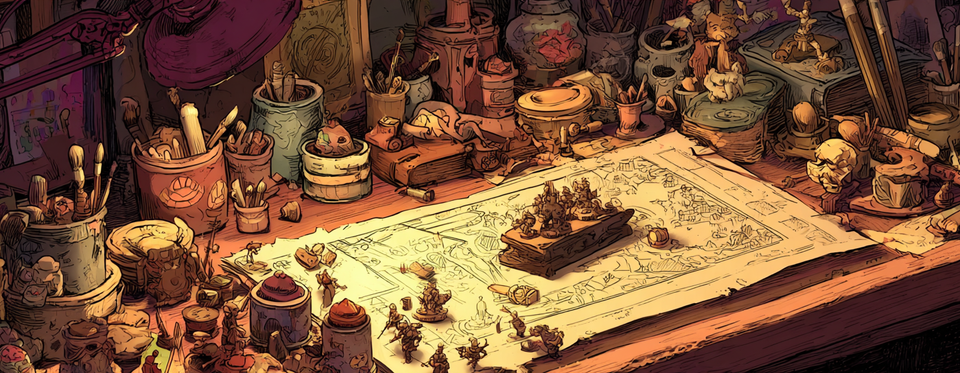
My desk is a mess. A mess of good intentions, plans and left over thoughts. Empty sprues, filled paint bottles, paint brushes I haven’t over committed to. Recently, after a year, I got a cutting mat to cover the paint stains and the knife marks in the hardwood. Past projects have been moved to combat patrol boxes, no order, just thrown in to move them out of the way.
When I look at the desk, it calls my name and then it calls me names. It is two things at once. Yin and yang. My desk is an invitation, telling me there is something worth doing. But it is also a reluctance, showing me all the times I said I would spend time there, but did not.
The unfinished projects are not failures. They are evidence of older evenings. Different plans. Versions of myself with more time than the one standing here now.
Maybe, there are more direct ways to feel good?
Watch something. Eat something. Buy something. There are industries built on the idea of making something easy to find or enjoy. The work has been removed. There is no pain, and no waiting. You can remove the discipline from a task, and read the sales slogan in the same sentiment.
But painting a model, that leaves most of the hard things in.
The difficulty is not only that painting takes work. It is that it needs other elements of life to fall into place, like playing Tetris with allocating time: An evening not dedicated to other things. Enough concentration left after a long day at work. And a willingness to be bad at something, while the skills evolve.
III. What Remains at the End of the Day
“Men lose their high aspirations as they lose their intellectual tastes, because they have not time or opportunity for indulging them;” [1]
Mill was not writing about miniatures. But he understood that people do not always choose the easier thing because they believe it to be better. Sometimes it is simply what remains at the end of the day, and our internal batteries have been drained.
There are evenings when the difficult pleasures become difficult to reach. We haven’t stopped caring about them, but the part of us that was capable of meeting them has been used up elsewhere.
There is a tendency for us tired people to fall into low-effort enjoyment, not out of preference. Life sometimes gets the best of us. Busy at work, too much time finishing the house chores, or social obligations that stretch us thin.
This is not an argument against television, takeaway, games, or buying something nice when the week has been hard. We are allowed to be tired. The problem lies in when the easier things become the only things we can still find time for.
IV. The Next Project Is Already Waiting
“No attained object of desire can give lasting satisfaction, but merely a fleeting gratification;” [2]
Schopenhauer is less interested in whether the project is a success, he is interested in what happens after it begins. The kit arrives. The miniature is finished. Somebody says something kind about it. Then that starts again, an endless loop of: begin, finish, relief, recycle.
The next project is already waiting.
This is not to sau that the finished miniature is bad. But a completed project cannot complete the impossible task for solving the wanting underneath it.
The model hobby has many aspects that are separate, and each include their own kind of pleasure. Finishing a miniature, buying a new kit, learning a technique, receiving praise, or completing an army may feel good, but each of these are renewed with each step. Once a miniature is finished, there is work before the next reaches that stage. Learning a new technique is easy at the beginning, but harder with more years of refining those skills.
Each of these single pleasures are for a short time, and then vanish, only to be replaced with the desire to do that again. But the period in between is full of work. Being at the bench, pushing pigments, assembling plastic, or refining the bases.
Schopenhauer sees ordinary desire as self-renewing. Not a single pathway, but something that leads from one achievement to the next. The attainment does not end the underlying feeling of wanting.
The finished model is not the whole reward. Sometimes it is not even the main focus. The thing that stays with me is the time spent painting: the corrections, the wrong colours, the small choice to keep going, even when the easy answer would have been to put it back in the box.
V. The Hour That Disappeared
Mill makes me think that some kinds of enjoyment are about returning to a project, for they do not survive by themselves. They need time, attention, and enough focus available at the end of the day. Painting is not difficult because it is noble. It is difficult because it asks for something that the rest of life is good at taking away.
Schopenhauer makes me understand that no finished model will settle anything for long. The pleasure of buying it, completing it, showing it to someone, putting it on a shelf; each of those things fades. There is always another project waiting to become the answer.
That is why the hour painting matters more than the finished miniature. For that time, there is no need for the hobby to become anything else. No need for the next box to justify the last one. No need to turn the work into proof that I have used my time well.
As the hour passes, the room is dark beyond the lamp. The afternoon’s coffee has gone cold. The little figure has become slightly more complete, the paint seems a little more convincing than it was an hour ago. A fold of cloth has depth now. The metal looks weathered.
Nothing important has happened. And still, something has changed.
Maybe pleasure is the wrong word, as though it should be immediate, uncomplicated, and without cost.
This is not that. This is slower. It asks for time. It asks for failure. It does not always feel good. Sometimes it feels like work because it is work.
But then the hour disappears.
“Men lose their high aspirations as they lose their intellectual tastes, because they have not time or opportunity for indulging them; and they addict themselves to inferior pleasures, not because they deliberately prefer them, but because they are either the only ones to which they have access, or the only ones which they are any longer capable of enjoying.”
Mill, John Stuart. Utilitarianism. Australia: Floating Press, 2009. ↩︎“No attained object of desire can give lasting satisfaction, but merely a fleeting gratification; it is like the alms thrown to the beggar, that keeps him alive to-day that his misery may be prolonged till the morrow.” Therefore, so long as our consciousness is filled by our will, so long as we are given up to the throng of desires with their constant hopes and fears, so long as we are the subject of willing, we can never have lasting happiness nor peace.”
Schopenhauer, Arthur. The World as Will and Idea (Vol. 1-3): Philosophical Classic (Complete Edition). Czechia: Good Press, 2023. ↩︎