

Burden of Civilisation: The Body That Commands
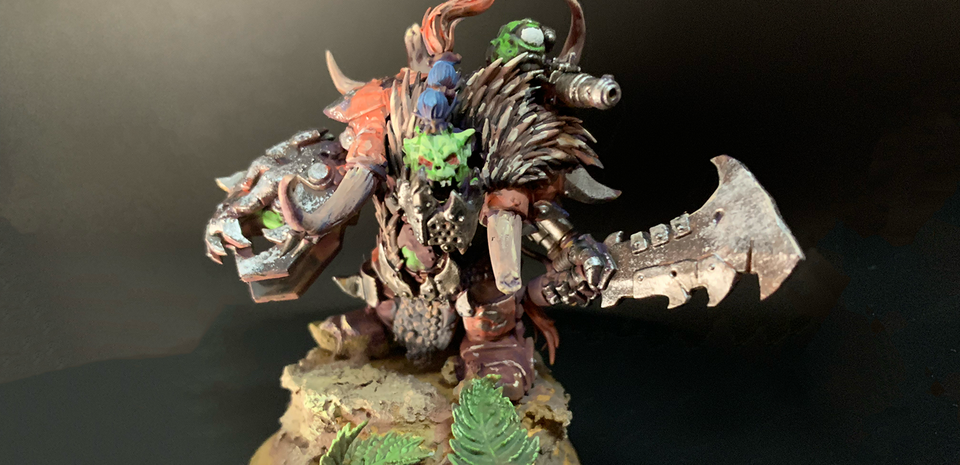
The Figure Who Does Not Need Permission
There are figures that do not ask to be understood before they are obeyed, the Beastboss is one of them. He stands in the old tradition of command, where power is not explained but carried in the body itself: in mass, in scars, in the visible promise of violence, and in the blunt fact that those around him know he can survive the world he is leading them into.
Civilisation likes to imagine that it has moved beyond this kind of authority. It tells itself that power has matured, that force has been refined into process, that domination now passes through cleaner hands. The old tyrant has been replaced by systems, committees, procedures, and neutral words. But there are moments when the disguise slips, and what looks civilised begins to reveal a more ancient structure beneath it. Someone still commands. Someone still decides. Someone still moves at the front while others are gathered into his wake.
The Beastboss does not pretend that authority is a matter of consensus, or that leadership emerges from moral cleanliness. He appears, instead, as a reminder of something older and less flattering: that power may have first belonged not to the wisest, or even the most just, but to the one who could embody it most completely. The one who could make others feel, long before they had words for it, that resistance would be costly.
We are meant to see such a figure as primitive. And perhaps he is. But the word often conceals as much as it reveals. Primitive can simply mean visible. It can mean a form not yet hidden behind institutions sophisticated enough to deny their own hunger. In that sense, the Beastboss does not stand outside civilisation as its opposite. He stands nearer to its buried foundation, to the part it would rather not recognise in itself.
II. The Beastboss in the Ork World
Among the Beast Snaggas, leadership is not inherited or elected. It is not protected by title, nor buffered by distance, nor made respectable by administration. It is held in the open and kept only so long as it can still be demonstrated. A Beastboss[1] remains a leader only so long as he can defend his position. Strength must be seen. Cunning must be proved. In the Ork world, power is exposed, keeping one foot on the throat of chance.
Orks are not deceived into obedience by polished myth, nor abstract duty. They recognise force when they see it. Prestige is not far from blood. A Beastboss does not stand above this order as an administrator, quietly orchestrating from a distance. He stands at its point, as its most brutal expression. The beast he rides, the enemies he slays, the wounds he survives; these are not decorations around leadership. They are the nature of his leadership.
Mozrog Skragbad is said to have preferred the company of Squigs to other Orks. He spent his life hunting monstrous beasts. During the invasion of Yrwyn II he was swallowed by a Gutmaw, survived within its stomach, then clawed his way free and killed it, returning days later dragging its eyeballs behind him. After that, whole warbands followed him, hoping to share in the glory. This is a stack expression of Beastboss authority: not office, but survival turned into myth while the blood is still wet.
Snarl Rukkskar rises from the mass of invading Orks on Paradyce V, builds a Waaagh from the toughest Orks and Squigs he can find, and turns his warband toward the biggest prey the world can offer. This is what Beastbosses are: figures whose right to lead is inseparable from the fact that they remain nearest to danger without being consumed by it.
And this is why the Beastboss is an ominous figure. He leads because he can remain at the top of the pile, where leadership is most exposed, at a point where the body gives answers for the command that it gives.
III. Power Before Legitimacy
There are older philosophies that do not begin by asking whether power is just. They begin with the harder fact that life is exposed, contested, and never fully secure. Before power was made respectable, it was often understood as a condition of survival. Hobbes wrote of “a perpetual and restless desire of power after power, that ceaseth only in death.”[2] Power is not a virtue. It refuses to treat command as an accidental corruption.
Power is a continuation of insecurity, the need to hold enough force that one is not overtaken by the next threat. The Beastboss leads because he remains standing at the front-line where others would be crushed. He does not persuade others that he is the ethical choice to lead the masses. His authority is not abstract.
Machiavelli looked at leaders and made a suggestion to “...take care not to misuse this clemency.”[3] Pointing out that mercy can lead to ruin, as in the case of the Florentine people. Saying: “It is much safer to be feared than loved,”[4] when one cannot be both. Not because fear is admirable, but because fear binds more tightly to consequence. Love wavers. Affection drifts. Fear stays close to the instinct for self-preservation.
This is something that current political leaders prefer to hide: that rule is never sustained by warmth alone. Beneath legitimacy, there remains the older machinery of threat. Fear and consequence walk hand-in-hand, with the understanding of what happens when command is resisted.
The Beastboss does not disguise the power he exudes. He is not mistaken for a servant of common good. He does not provide soft commands in the hope to gain followers. He is the image of the first face of power, where authority has not learned to apologise for the result of its actions.
In today’s social and political landscape the image of a leader like the Beastboss is uncommon. It is easy to condemn force when it appears openly, in muscle, scars, and domination. It is harder to notice when the same structure sits beneath the surface, diffused through office, process, and polite necessity. The civilised world speaks as though legitimacy replaced power. But perhaps legitimacy more often follows power?
IV. The Gravity of the Powerful
Open power, the kind that the Beastboss shows, survives because others gather around it. They watch it, imitate it, defend it, excuse it, dream of standing close enough that some of its magic may pass onto them. The Beastboss does not only command obedience. He attracts a following.
Power is not a torchlight to be feared. It is a campfire to be admired.
Part of this attraction may lie in how incomplete ordinary life can feel from within. Most people do not move through the world as though they are sufficient. They borrow symbols, affiliations, victories, or names. They fasten themselves to celebrities, champions, leaders, and causes because these figures appear to contain something larger than their lives contain.
Becker writes that “underneath throbs the ache of cosmic specialness”[5]. There is an innate hunger in people to matter beyond the scale of the ordinary. Power offers a shortcut to that feeling, even when it belongs to someone else.
That is why followers gather so easily around figures who seem calm, certain, victorious, or untouched by doubt. A president continuing a war can be known as a strong leader. A pop star can become larger than their musical talent. An athlete can carry more than a game. The avatar changes, but the worship remains. People lean toward the visible source of force because proximity to power can feel like protection. Standing close to command, and one can imagine that they have escaped insignificance.
The Beastboss belongs to that older and less concealed arrangement. Others follow because he is concentrated power, displayed in the flesh. He survives. He imposes. He rides at the front. In that sense he reveals something civilisation has never managed to outgrow. We say that authority belongs to law, process, fairness, institutions. Yet again and again attention bends toward the figure who seems to embody force, the one who makes decision look effortless and command look natural.
Power also spreads by acting through others. It passes through admiration as easily as fear. It teaches people how to turn toward whoever appears to have more life, more certainty, more consequence. The powerful do not stand alone for long. They are surrounded by those who want to serve, echo, defend, flatter, inherit, or simply be seen close by.
Civilisation has not taught people to stop loving power. It has taught us to dampen the strong connections to power, to call our attachment by gentler names. Inspiration. Leadership. Influence. Stardom. But the older version remains, somewhere beyond our choice: human beings are drawn to visible force, and in that attraction the beast keeps finding new admirers.
V. Civilisation Never Abolished the Beast
We tell ourselves the comforting story that we have replaced brute power with better things. Law, rather than domination. Character, as opposed to force. Reason instead of appetite. This flattering story that we tell ourselves allows us to imagine modern life as a clean break from the older order. We left the beast behind with the tyrants, warlords and crowned bodies that once stood in a place to be visible at the centre of command.
But power is not so easily dismissed. It remains where it has always been, in the figure who could gather enough attention, loyalty, imitation and fear into a single entity. The names changed. The clothes changed. The language softened. Yet we continue to turn toward visible force. Toward the victorious. Toward the certain. A president speaking with composure in wartime, a champion whose body seems to settle the question before it is asked, a star whose presence exceeds the work itself; these are not departures from the old order so much as its refinements.
The beast returns in forms polite enough to be admired.
This could be why power continues to draw followers rather than subjects. People do not only obey what is strong, they want to stand near it, to be reflected in it. The Beastboss makes this difficult to sentimentalise. His authority is too obvious, too physical, too close to violence to be mistaken for anything other that what he offers. He shows, with embarrassing plainness, that civilisation did not end our attraction to the commanding figure. It only taught us to admire him under names that sound less compromising.
The Beast was never abolished, he was dispersed. Into leaders and idols, into champions and icons, into the faces that gather crowds and the voices that make call those to order. He no longer carries a blade, or rides at the front of the charge, or bears the cost through scars and trophies. Sometimes he appears in a tailored suit, beneath stage lights, behind a podium, on a movie screen. But the gravity remains. People still look upward. Still gather. Still search for the figure who seems more alive than they are.
This may be the burden civilisation never solved. It gave us better language, gentler rituals, cleaner rooms in which to praise the powerful. But beneath them, the older hunger still waits, patient and familiar, for a body strong enough to carry it.
“I put for a general inclination of all mankind a perpetual and restless desire of power after power, that ceaseth only in death. And the cause of this is not always that a man hopes for a more intensive delight than he has already attained to, or that he cannot be content with a moderate power, but because he cannot assure the power and means to live well, which he hath present, without the acquisition of more. And from hence it is that kings, whose power is greatest, turn their endeavours to the assuring it at home by laws, or abroad by wars: and when that is done, there succeedeth a new desire; in some, of fame from new conquest; in others, of ease and sensual pleasure; in others, of admiration, or being flattered for excellence in some art or other ability of the mind.” Leviathan - Thomas Hobbes - Chapter 11: Of the Difference of Manners
Snapshot: Internet Archive ↩︎Original Link: Concerning Cruelty And Clemency, And Whether It Is Better To Be Loved Than Feared
Snapshot: Internet Archive ↩︎“... whether it be better to be loved than feared or feared than loved? It may be answered that one should wish to be both, but, because it is difficult to unite them in one person, is much safer to be feared than loved, when, of the two, either must be dispensed with. Because this is to be asserted in general of men, that they are ungrateful, fickle, false, cowardly, covetous, and as long as you succeed they are yours entirely;” CHAPTER XVII: Concerning Cruelty And Clemency, And Whether It Is Better To Be Loved Than Feared
Snapshot: Internet Archive ↩︎“In our culture anyway, especially in modern times, the heroic seems too big for us, or we too small for it. Tell a young man that he is entitled to be a hero and he will blush. We disguise our struggle by piling up figures in a bank book to reflect privately our sense of heroic worth. Or by having only a little better home in the neighborhood, a bigger car, brighter children. But underneath throbs the ache of cosmic specialness, no matter how we mask it in concerns of smaller scope.” - Becker, Ernest. The Denial of Death. United Kingdom: Souvenir Press, 2011. ↩︎