

Burden of Civilisation: Riding the Teeth of Desire
I. The Creature That Wants Before It Thinks
We like to imagine that the mind commands the body, that choice descends cleanly from some higher chamber of the self, but much of life begins lower down, in heat, in appetite, in the dark animal insistence that something must be pursued.
Civilisation is built around the delay of instinct. It teaches the creature to wait. To speak instead of strike. To negotiate instead of take. A world without restraint would not be free. It would be unbearable. Yet restraint does not abolish appetite. The beast is not removed from the human being. It is trained to walk indoors.
Perhaps this is why desire unsettles us even when it appears harmless. It reminds us that the self is not a single ruler sitting calmly over its kingdom. The self is a field of hungers, some noble, some ridiculous, some violent. We do not always choose what moves us. Often we discover it after we have already begun to follow. A craving becomes a plan. A fear becomes a principle. An ambition becomes a life. Then, looking backward, we call the path our own.
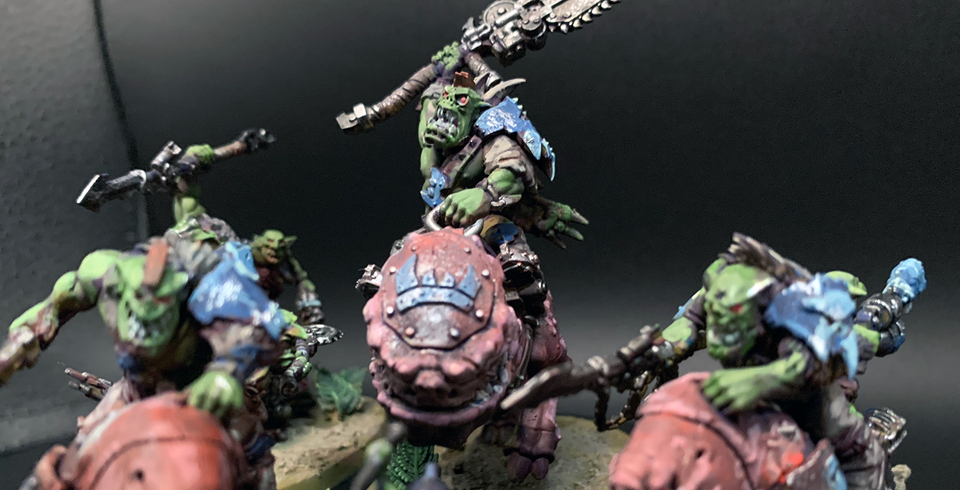
The Squighog Boyz are mounted on appetite itself, strapped to a creature that lunges before it reasons, all tusk, muscle, and forward motion. The rider may hold the reins, but the beast beneath him has its own idea of the world. There is no clean separation between command and surrender. There is only the wild compromise of direction: a body leaning forward on another body already running.
The Bomb Squig is appetite with a single destination, a small living urgency turned into a weapon by those who know how to aim what cannot truly be governed. There is something absurd in it. A creature that wants, runs, and then explodes. A life reduced to momentum.
Let’s not try and find if instinct is good or bad, nor if civilisation saves us from the beast, or if it kills something vital in us doing so. Let us ask how much of what we call agency is really intention, or if we just mistake motion for command. Desire moves. The self follows. And somewhere after the charge has begun, we begin composing the story of freedom.
II. Beast Snaggas, Squigs, and a World of Predation
Among the Beast Snaggas, the battlefield is a feeding ground, a test of nerve, a place where flesh, machinery, tusk, and instinct collide until something gives way. They are master squig-breeders, Orks drawn toward “da old ways”, riding to war on ferocious red beasts, kicking, biting, and stabbing anything close enough to be caught in the rush.[1] They do not reject technology, but their core desire remains, sitting closer to the animal. Closer to teeth.
The Squighog Boyz are the fast cavalry. Tough, determined, and armed for close range, they charge ahead of the Ork lines on living mounts that are themselves part weapon, part appetite, part accident waiting to be aimed.[2] They are not elegant riders. Nothing about them suggests the clean discipline of cavalry in the old imperial imagination. Their motion is more brutal than that. A Squighog is not a noble animal made obedient by training. It is a hungry force with legs, jaws, and momentum.
The Squighog Boy is not separate from the thing that drives him forward. He is not in control, using reason above instinct. He is a rider strapped to a creature that wants before it thinks. In battle, this becomes a kind of symbiosis, ugly and effective. The Ork brings direction. The Squighog brings impact. Between them is not mastery, but collision given a rough purpose.
In Ork warfare, a Bomb Squig is a common Squig with explosives strapped to it, goaded toward an enemy target. A tiny delivery system for a powerful explosive.[3] A living thing is made useful by being made single-minded. Its hunger, confusion, and loyalty are not suppressed, but exploited.
Bomb Squigs are described as covered in explosives and sent hurtling toward the enemy. More interested in biting the nearest foe than in the mines, stickbombs, and other dangerous scraps fastened to their bodies.[4] That is the Ork genius: not the elimination of instinct, but the weaponisation of it.
That is the dark little truth sitting beneath the red hide and comic violence. The Squighog Boyz reveal a world where instinct is not overcome, educated, or redeemed. It is mounted. Pointed. Encouraged. The Bomb Squig is a smaller and crueler form, a creature whose vitality has been narrowed into usefulness. In the Beast Snagga world, predation is not an exception to life. It is the grammar life speaks when nothing has yet taught it to be ashamed.
III. Desire as Transgression
Desire does not always seek happy endings. Sometimes it seeks dominance. Sometimes it seeks failure. Sometimes it wants the body to feel most alive. Georges Bataille[5], in Erotism, Death And Sensuality[6], discussed the darker sides of desire. Movement from the safety of the self, toward intensity, danger, and exposure. Bataille gives desire a darker shade than comfort permits.
“Eroticism, it may be said, is assenting to life up to the point of death.”
The rider, the beast, the impact, the roaring, the tusks and crude weapons and animal weight. A Squighog Boy hangs on to the creature that wants before it thinks, an attempt to give direction to something that was never fully his to command. The charge is not elegant. It is not wise. Just inner desire of the beast, assenting to life.
“The transgression does not deny the taboo but transcends it and completes it.”
Bataille refuses the civilised hope that appetite can be made harmless by naming its boundaries. Civilisation draws lines around correctness, violence, pleasure, around what may be wanted and how openly it may be pursued. These lines are necessary. Without them, life would become unliveable. Yet the civil boundary does not remove that desire. It shapes the discourse that we share, keeping some things in the dark where light never reaches.
“We have to take into consideration the irrational nature of taboos if we want to understand the indifference to logic they constantly display.”
The forbidden things are not outside the order of civilisation. They simply wait in the dark, beyond the shadow, a waiting heat to be found. A taboo does not erase the desire it forbids. A taboo sets the name of something, draws the lines that must be crossed, but it does not stop the wanting of what is forbidden.
The Squighog Boyz are bodies moving through the boundary between control and surrender. The Ork points the beast, but the beast carries the Ork. Direction and appetite become difficult to separate. The one riding, while looking in command, may just be holding on, finding joy in the desire of the beast below.
The Squighog Boy does not simply ride an animal. He rides the problem civilisation keeps trying to solve: that the creature wants before it thinks, and that thought often arrives too late to be master. The body crosses toward danger, and the will calls it choice. And somewhere after the charge has begun, reason begins composing the story that will make the movement bearable.
IV. The Managed Instinct of Civilised Life
The modern world studies desire, names it, tracks it, anticipates it, and returns it to us as choice. The old taboos still exist, but now there is money attached to them. Appetite, once a danger to be restrained, is now a resource to be monetised. The once hidden parts of life have been put behind paywalls, hidden in the dark-web, or made free to generate interest and secure future users.
“Achievement society is the society of self-exploitation. The achievement-subject exploits itself until it burns out.” [7]
Byung-Chul Han’s account of modern life turns on a grim reversal: the contemporary person is not controlled only by prohibition, but by permission. It is told it can do more, become more, produce more, display more. We are no longer denied from outside. Rather we are shown possibility, and possibility becomes an obligation for us to respond. This is why Han can describe achievement society as “the society of self-exploitation”: the subject drives itself forward, mistaking possibility for freedom.
Ambition feels like personal destiny. Visibility feels like existence. Desire feels like authenticity. One works harder, performs more, posts more, sharpens the brand, and then calls this agency. We feel as if we have a choice, and there is a possibility for success, but the path has been marked by incentives, rankings, metrics, comparisons.
The beast runs because running belongs to it, but the road beneath its feet was built by someone else.
“Neoliberal psychopolitics seduces the soul; it preempts it in lieu of opposing it. It carefully protocols desires, needs and wishes instead of ‘depatterning’ them. By means of calculated prognoses, it anticipates actions – and acts ahead of them instead of cancelling them out. Neoliberal psychopolitics is SmartPolitics: it seeks to please and fulfil, not to repress.”
Modern power does not need to crush desire when it can anticipate it. It “carefully protocols desires, needs and wishes.”[8] Desire becomes legible before it becomes conscious. It is sorted, predicted, nudged, offered back in a shape that feels chosen because it resembles what we already wanted. Yet we feel as if we made the choice, when one was offered for us.
The modern world has not conquered appetite, it has learned more refined ways to harness it. It does not always chain the beast. Sometimes it feeds it, excites it, points it forward, and lets it feel the movement as its own. The charge continues. The roar continues. Only the target has become harder to see.
V. Velocity Without Wisdom
The rider always looks more in control from a distance. He is upright. He has his weapon raised. His body leans in the direction of the charge, and from far enough away that may look like command. But closeness can be less flattering. The beast beneath him surges, bites, recoils, lunges, and drags the rider to the destination of its own hunger. What looked like mastery may only have been balance held for a moment.
We assume that the Squighog Boyz are in command, but the beast may be in control of the situation more than the rider. Much of human life has the same posture. We lean forward on hungers already moving inside us, then claim responsibility when we arrive. Ambition grows inside us, and we name it purpose. Desire finds us in action, and we name it authenticity. Outrage makes us shout, and we name it conviction. Our internal drive moves us toward something, and we tell the story as if it is our own.
Civilisation is not wrong to fear appetite. The unrestrained creature does not become free merely because nothing stops it. It becomes dangerous, to itself and to others. But the sadness is that restraint has not made us masters of our domain. It has only made the movements more difficult to see. Desire now wears the clothes of productivity, identity, wellness, visibility, pleasure, improvement. The beast has learned to walk indoors.
The Bomb Squig is a creature running by its own nature, but toward a purpose fastened to it by someone else. An allegory that the modern world has become very good at: attaching purpose to our internal desires. We are offered goals that feel like plans, paths that feel like choices, metrics that feel like we are doing something correct. Our body in motion, with a target selected by outside forces.
Without appetite there would be no art, no love, no revolt, no hunger for a life larger than bare survival. Desire is one of the motivations for us to press on through tough times. But it is also one of the ways we are taken or distracted. Desire and wisdom are not the best of friends. And when the world learns how to use desire as a resource, freedom can begin to feel almost indistinguishable from acceleration.
We ride our hungers, our ambitions, our social drives, our algorithmic urges, and call this freedom. But much of the time we are only leaning forward on something already running. And somewhere ahead, almost hidden by dust, the target waits.
Original Link: Who Are Those ‘Beast Snagga’ Gits, Anyway?
Snapshot: Internet Archive ↩︎Lexicanum: Squighog Boyz
Snapshot: Internet Archive ↩︎Warhammer40K Wiki: Squigs
Snapshot: Internet Archive ↩︎Original Link: A Comprehensive Guide To Squigs On This Week's Loremasters
Snapshot: Internet Archive ↩︎Bataille, Georges. Eroticism (Penguin Modern Classics). United Kingdom: Penguin, 2001. ↩︎
Original Link: Erotism Death And Sensuality
Snapshot: Internet Archive ↩︎Han, Byung-Chul. The Burnout Society. United States: Stanford University Press, 2015. ↩︎
Han, Byung-Chul. Psychopolitics: Neoliberalism and New Technologies of Power. United Kingdom: Verso Books, 2025. ↩︎