

Death Guard: A World We Have Grown Used To
I. A World We Have Grown Used To
I don’t enjoy change. A shift in something I expect makes me feel uneasy. But change is not always sudden; sometimes I notice things are different after I have adjusted to them.
There has been a closed road on our way to the grocery store that I can’t use, but I don’t think about avoiding it anymore because I go a different way now. That is a small thing, but it happens in larger ways.
We make changes around family illness, helping where needed to keep schedules where possible. Daylight savings disrupts sleep. Work schedules change during school holidays. Nobody has made a decision to change how life works, it just becomes the way to get through the day.
Human beings are excellent at adapting. Sometimes that is what allows us to cope rather than fall apart.
But our skills of adaptation do not care about the quality of what we are adapting to. Nothing says that we are good at adapting to only good things, and fail when they are bad. A workplace can become worse and still acquire routines. A relationship can become unhappy and still have dinner at the same time.
Adaption is a skill that applies to all outcomes. And that skill can help us to live in some testing and trying times. After a while, the things we found bad or uncomfortable become part of our lives.
That doesn’t make those things good. It just means that we have been able to make life go onwards.
II. The World Inside the Ship
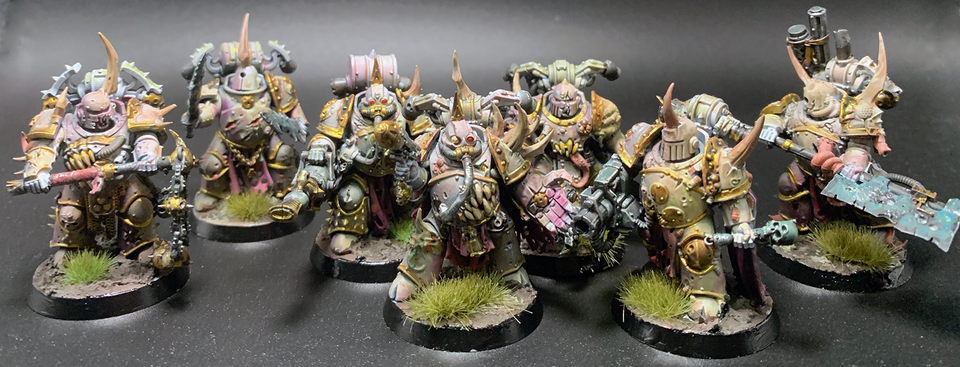
Disease and pestilence are the visible markings of the Death Guard. An army known by resilliance, were to join Horus in their rebellion against the Emperor. On their journey to Terra Calas Typhon, one of Mortarion's oldest captains, lead their fleet into the warp where they were bound by Nurgle’s corruptions.
The Destroyer Plague and Nurgle's Rot spread from warrior to warrior, turning flesh into swollen pustules, ruptured and barely recognisable. Their armour warped with them. Their great strength became part of the problem. Yet, they endured.
And because they endured, the suffering continued.
Mortarion eventually surrendered the Legion to Nurgle in exchange for release from the pain. The Death Guard rebuilt, but physically they became something else. They became an army that could keep going, despite what had happened to them.
Chris Wraight's The Lords of Silence[1] introduces us to Dragan, a senior warrior who was not one of Mortarion's original sons. He was once a loyalist Space Marine. Somewhere roughly two thousand years before, he crossed over. Dragan cannot properly remember the world he came from or even why he turned against it.
What remains is surprisingly ordinary. Dragan wants advancement; corruption has not removed ambition from him. He wants more than he has. He carries grudges. He has colleagues he distrusts. All of these very ordinary concerns continue, something that the person who he once was would find incomprehensible.
Later in the novel, Vorx attacked Sabatine. The White Consuls are defeated, and the conquered planet begins to change under the Death Guard's occupation, reshaped toward the conditions of the Plague Planet they already know. The Death Guard will often change a planet to make it familiar for them, imprinting their form, their disease, and their god-print onto the worlds they touch.
III. The Ordinary Shape of Crisis
Lauren Berlant writes about lives that continue while the things around them become hard. In Cruel Optimism[2], a crisis is not always a single event. A crisis could be something small, maybe about work, relationships, money, health, or expectations.
“A relation of cruel optimism exists when something you desire is actually an obstacle to your flourishing. It might involve food, or a kind of love; it might be a fantasy of the good life, or a political project. It might rest on something simpler, too, like a new habit that promises to induce in you an improved way of being. These kinds of optimistic relation are not inherently cruel. They become cruel only when the object that draws your attachment actively impedes the aim that brought you to it initially.”
The attachment remains with us because it carries something important. Cruel optimism holds us to an object or fantasy that promises good while also causing harm. Berlant[3] returns often to the difficulty of continuing under those conditions.
“... turns towards thinking about the ordinary as an impasse shaped by crisis in which people find themselves developing skills for adjusting to newly proliferating pressures to scramble for modes of living on”
Crisis does not need to be a massive change to society or our daily lives. It can continue on while we adjust our schedules, relationships, or social structures around it.
'Slow death' is a phrase Berlant uses to describe how someone can be worn out, rather than breaking apart. Wearing out takes time, it happens while other things continue on around it.
“The phrase slow death refers to the physical wearing out of a population in a way that points to its deterioration as a defining condition of its experience and historical existence.”
Martin Heidegger approaches life from a different direction. In Being and Time[4], he examines what it means to exist in a world as someone already involved with places, objects, routines and other people.
He writes that Being-in carries the sense that the world is already full of things that make sense to us. We don’t need to re-examine a room every time we enter it. We don’t need to learn about a tool each time we pick it up. Much of life works because the world is something that we exist inside of.
But later, as he writes about anxiety, he shows that sometimes our being in the world starts to fail.
“But here uncanniness also means not-being-at-home . . . as Dasein falls, anxiety brings it back from its absorption in the world. Everyday familiarity collapses.”
The ordinary world, the one we don’t have to re-examine constantly, can become strange again. Things that had been obvious lose some of their obviousness. What had felt settled no longer feels quite at home.
Berlant writes about crisis embedded in the ordinary, a world that wears people down while they continue inside it.
Heidegger writes about familiarity, absorption, and the moment when familiarity gives way. Describing how deeply a world can become familiar before anything in it is questioned at all.
IV. A World That Still Works
Dragan has not learnt to tolerate the Death Guard environment. His ambitions depend on it. The people he wants recognition from are here. The hierarchy he wants to climb belongs to this world.
Part of Berlant's work keeps coming back to: life does not wait for conditions to become good before it continues.
When we look at Heidegger's language of Being-in-the-world, it does not show us that familiar conditions require our approval. Things happen, and we need to adjust, and things continue on.
People can become good at living inside difficult situations. The adaptation is real. Often it is necessary. Berlant's “cruel optimism” seems close to that thought.
“something you desire is actually an obstacle to your flourishing.”
The Death Guard world has taken almost everything from the person Dragan once was, but it is also the only world in which the person he is now makes sense. His loyalties, ambitions, resentments and sense of status all depend upon it.
When Vorx and the Lords of Silence conquer Sabatine, they do not simply occupy it. They begin remaking it into something closer to the conditions they already know. The environment changes. The corrupted world travels with them. The Death Guard have adapted so completely to their own damaged world that adaptation no longer ends with survival.
V. What We Become Used To
Most of the changes that we adapt to do not happen to us with a philosophical lesson attached. They show up as a detour, a new schedule, another appointment, a thing we complain about for a while before we work out how to live around it.
There are periods where keeping things moving is enough. Getting through the week can be enough.
Dragan has adapted so completely that the world before the Death Guard has almost disappeared from him. He still has ambition, loyalty, resentment and purpose. The Solace still has routes, rooms and routines. Sabatine can be changed until it begins to resemble the places the Death Guard already know how to inhabit.
We tend to imagine decline as something inevitable. Things break. People leave. Systems fail. But there are other kinds of decline that become organised, scheduled and familiar.
Heidegger suggests a that the world around us does not need to be good before it becomes the world we have to live in.
And Berlant gives that familiarity a cost. We stay attached to the things that still hold life together. Sometimes those attachments support us. Sometimes they wear us down. Often they do both at once.
That is where I think the Plague Marines are difficult to see as monsters. They have survived. They have endured. They have become extraordinarily good at living inside what happened to them.
Because adaptation can keep us alive and keep us moving. But it can also make the world around us harder to understand. After enough time, we may no longer be asking whether the conditions are good. We may only be asking whether we know how to live inside them.
Wraight, Chris. The Lords of Silence. United Kingdom: Games Workshop, 2019. ↩︎
Berlant, Lauren. Cruel Optimism. United Kingdom: Duke University Press, 2011. ↩︎
Original Link: Lauren Berlant: The Theorist of Cruel Optimism
Snapshot: Internet Archive ↩︎Heidegger, Martin. Being and Time. United Kingdom: Blackwell, 1978. ↩︎