The Worlds We Make and Remember: The World That Outgrew Its Creators
I. The Things We Used to Make
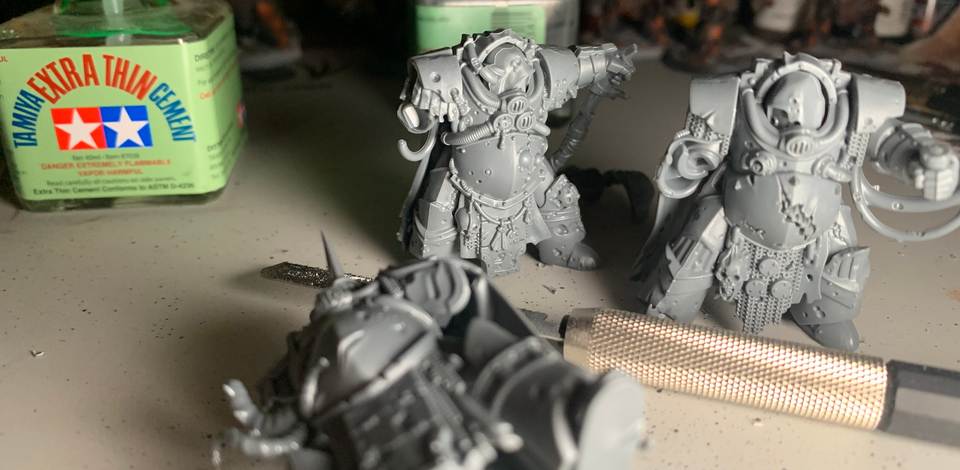
The Deathshroud Terminators I have planned for my army are wonderful models. The aesthetic of the Death Guard is what drew me to them. But building several units means repeating the same three miniatures, with the same poses and equipment. If I follow the instructions, I will end up with six Terminators, half of whom look remarkably like the other half.
They are fine models and will look good on the tabletop. But I have never been particularly interested in building an army where every miniature looks exactly the same.
Kitbashing has always been an important part of the hobby. It allows us to make something unique. Most hobby projects begin with some kind of idea about what we want to create. We imagine an army, a character, a colour scheme or a small collection of figures for a game with friends.
When Warhammer 40,000 first appeared in 1987, under the title Rogue Trader[1], much of the universe was still taking shape. There were Space Marine Chapters, strange alien species, Imperial institutions and the beginnings of a history that would eventually become enormous. But a great deal remained undefined. The early rules allowed for small battles and unusual collections of miniatures.
Players could invent their own Chapters, develop colour schemes, create characters and build stories around the battles they played. Through White Dwarf[2], we could see the work of other hobbyists, their conversions, and painting.
We were taking pieces of a fictional universe and building battles and interactions within it. A battle could become part of a Chapter's history. A converted commander might acquire a name and a story. Our inventions became part of the version of Warhammer we shared with our friends.
Games Workshop created the setting, made the miniatures and gave us the rules. Without those things, much of what we made would never have existed. Yet the world that developed around Warhammer was larger than anything contained within its publications.
Over the years, that universe has expanded. There are more stories, established characters, detailed histories and wonderful miniatures than we could have imagined when Rogue Trader appeared. But as I plan to saw the arms off my Deathshroud, I wonder whether something of that earlier relationship has changed. Our creations still have a place in Warhammer, although increasingly we seem to look towards what Games Workshop has already established before deciding what to make.
II. When the World Became Complete
In 1975, three friends in London began a small mail-order business selling fantasy and board games. They were enthusiasts sharing an interest in something that was still relatively obscure.
The first Games Workshop store opened in Hammersmith in 1978. By then, White Dwarf had begun publication, bringing together people interested in role-playing games, unusual rules and miniature figures. Citadel Miniatures followed, producing models that were not necessarily attached to any particular fictional universe. It was a business built around the interests of hobbyists, many of whom invented parts of their games for themselves.
The arrival of Warhammer Fantasy Battle in 1983[3], and later Warhammer 40,000: Rogue Trader in 1987, gave Games Workshop fictional worlds of its own, with their own histories, characters and conflicts. These worlds gave people a reason to collect armies and Games Workshop a reason to keep expanding them.
Yet the early version of Rogue Trader was quite different from the game we know today. Games Workshop's own retrospective describes a system that allowed players to use almost any miniature they owned, sometimes with only five or ten figures on the tabletop. It was closer to a loose collection of battles and adventures than the enormous armies that would become common.
By 1993, the second edition of Warhammer 40,000[4] had arrived. The boxed game contained Space Marines, Orks, Gretchin and the familiar cardboard Dreadnought, while the expanding codex range began establishing the lore that we engage with today. Games Workshop describes this as the period when the game's lore became properly codified[5].
An invented Chapter or an unusual conversion could now find its place within an established universe, with its own politics, religions, military traditions and thousands of years of history.
In the early 90’s Games Workshop underwent a management buyout and was floated on the London Stock Exchange[6]. A company started with a few enthusiasts had grown to become a publicly traded business. Black Library was established in 1997, allowing characters and battles that might once have occupied only a few paragraphs in a rulebook to have entire novels of their own.
Models became more sophisticated, the artwork more elaborate, and the universe acquired a sense of scale. But with every established character and new publication, the world became something Games Workshop had a greater commercial interest in keeping consistent.
By 2026, Games Workshop reported annual revenue of £659.7 million and operating profit of £275 million. The small business that began with three enthusiasts had become an international company whose fictional universes were valuable commercial assets.
A company of that size cannot operate as a handful of enthusiasts selling whatever happens to interest them. It has employees and shareholders, and its obligations[7] do not always align with the interests of those who made the hobby successful. A hobbyist might spend months creating an unusual army, while the company must decide which models to manufacture, which characters to develop and which product ranges deserve continued support.
Games Workshop still encourages us to invent Chapters, convert miniatures and develop our own histories. Even in 2025, White Dwarf devoted twenty pages to creating custom Space Marine Chapters[8]. The invitation to create has not disappeared.
But I wonder whether our place within that universe has changed. What was once a relatively open setting has accumulated decades of established characters, histories and carefully developed product ranges. Our own creations can still exist, although they increasingly sit alongside a fictional world whose identity is maintained by the company.
III. The Rules of Belonging
An army I had built years ago started calling from the cupboard. It sat in a small cardboard box, covered in several years of dust. Opening it, I could see the models had seen better days. Broken weapons had come loose, and some of the old Firstborn Space Marines were missing shoulder pads. But the models inside carried their history of assembly, all the time I had spent developing the paint scheme. These boys had been through many battles.
Opening the new codex, I discover that much of the army no longer fits the rules I remember. Units have changed, and some of the choices I made when building it are no longer supported in the same way. The models are still sitting in front of me, but the army I remember playing no longer quite exists.
Warhammer Legends[9] is where these older and discontinued models are moved to when the fallout of the codex. The miniatures can still be used in various forms of casual and narrative play, but even these demoted minis are less inspiring in local games.
The company cannot realistically manufacture and maintain competitive rules for everything it has ever produced. But this situation creates an odd relationship between hobbyists and the company; we purchase a model, spend our own time building and painting it. Yet the official value of that miniature on the tabletop depends on decisions made by a company trying to make a profit.
“There is nothing left for the consumer to classify. Producers have done it for him. Art for the masses has destroyed the dream but still conforms to the tenets of that dreaming idealism which critical idealism baulked at.” [10]
Adorno and Horkheimer[11] were concerned with how commercial culture came to organise not only what people consumed, but the categories through which they understood it. Those categories could become so familiar that people stopped questioning who had established them.
In his reflections on leaving modern Warhammer 40,000 behind[12], Guy from Midwinter Minis described missing the unpredictable events that once made games memorable. A damaged vehicle might lose its weapon, become stranded or survive long enough to do something wonderfully ridiculous.
His frustration was with the work required to remain familiar with the rules. New editions, adjustments to points, changes to army lists and regular balance updates had made playing a game feel like something all encompassing. He still enjoyed collecting, painting and playing tabletop games, but increasingly found more pleasure in systems where he and his friends could concentrate on their own characters and stories.
A figure can lose its place in a competitive army without losing the time and memories invested in it. The first is what it means to the company, and the second is what it means to us.
A question that I wonder is what control do we have over what we create?
IV. The Permission We Never Needed
Games Workshop has not prevented us from creating unusual miniatures, inventing Chapters or writing our own histories. Yet when we start a project, we spend time considering what it will proxy for, and how it will function in the game, before we start to build the project.
Adorno and Horkheimer's concern was not simply that commercial institutions restricted the choices available to us. It was that the organisation of those choices could influence what we came to regard as reasonable, desirable or even possible. We become accustomed to the boundaries of a system, sometimes without noticing how much of our thinking has come to depend upon them.
“As we read, we take up materials that someone else created for their reasons, and we make them our own. We take them over and reallocate them, to speak to alternative interests.”[13]
In Textual Poachers, Henry Jenkins examined how fans took the stories and characters provided by television programmes and created interpretations of their own. Drawing on Michel de Certeau, he likened fans to poachers, taking material belonging to someone else and putting it to uses its owners had never intended.
A fictional world can be commercially owned without every experience of that world belonging to its owner. Warhammer has always depended on that kind of participation. Its models arrive as manufactured objects, but the armies people build from them rarely remain quite so impersonal.
The company may never acknowledge it. That does not prevent it from existing.
The commercial structure does influence our choices, but we do not surrender our imagination simply by participating in a copyrighted universe. We adapt models, invent characters and make compromises when we want our creations to fit within an established game. Sometimes we build exactly what Games Workshop intended, and other times we make something that exists nowhere in its publications. Neither approach is necessarily better.
But I wonder how often we abandon an idea because we cannot find a place for it within the official world. At that point, the company has not necessarily told us what we cannot create.
We have begun doing that work ourselves.
V. What Remains on the Workbench
My next three Deathshroud Terminators are still on the bench. Their grotesque armour and the collection of spare parts I've gathered to make them a little different are scattered in a mess of plastic saw dust. There are so many ways I could build them, and most of those ideas would leave me with models that no longer resemble what the instructions intend.
I could simply follow the instructions. They are excellent miniatures, and there is nothing wrong with building them as Games Workshop designed them. But I have a vision for this army, and the models in front of me are only part of it.
Games Workshop has spent decades building an extraordinary fictional universe. Its success has given us remarkable miniatures, stories and opportunities to explore worlds that might otherwise never have existed. Along the way, the company has established rules and expectations that shape our participation in what it has created.
Cutting an arm from a plastic miniature does not change any of that. Games Workshop will continue to develop its universe, and we will continue to decide how much of it we want to follow.
The models before me are only a small part of my collection. And there exists a small plan for that. And, there is only one way to find out what it will end up looking like.
Original Link: Wikipedia: Warhammer 40,000: Rogue Trader
Snapshot: Internet Archive ↩︎Original Link: Wikipedia: White Dwarf (magazine)
Snapshot: Internet Archive ↩︎Original Link: Wikipedia: Warhammer (game)
Snapshot: Internet Archive ↩︎Original Link: Oldhammer: Warhammer 40,000 2nd Edition
Snapshot: Internet Archive ↩︎Original Link: Warhammer Day – 35 Years of Only War
Snapshot: Internet Archive ↩︎Original Link: Games Workshop: Out History
Snapshot: Internet Archive ↩︎Original Link: Games Workshop Group PLC - Results for the 52 Week Period Ended 31 May 2026
Snapshot: Internet Archive ↩︎Original Link: White Dwarf 515 – Inner mysteries of the Adeptus Astartes
Snapshot: Internet Archive ↩︎Original Link: The Legends Live On
Snapshot: Internet Archive ↩︎Original Link: The Culture Industry: Enlightenment as Mass Deception Theodor Adorno and Max Horkheimer
Snapshot: Internet Archive ↩︎Horkheimer, Max., Adorno, Theodor. Dialectic of Enlightenment. United Kingdom: Stanford University Press, 2002. (l-75zLjGlZQC) ↩︎
Original Link: Midwinter Minis, I Think I'm Done With Warhammer 40K
Snapshot: Internet Archive ↩︎From an interview “... from the historic archives of the Aca-Fan world: an exchange between Camille Bacon-Smith and myself at Gaylaxicon 1992” Henry Jenkins and Camille Bacon-Smith at Gaylaxicon 1992 (Part One) (February 21, 2010)
Snapshot: Internet Archive ↩︎