

Death Guard: The Calm After Horror
I. The Calm After Horror
There are things in life that I would rather not accept. Being unhappy with something can be what makes us change the situation. We complain, argue, or try something different. There are circumstances where accepting what is in front of us too easily would probably be the worst thing we could do.
But there are other things we cannot change because we are angry with them.
Someone dies, or an illness changes what a person can do. We can dislike what happened, wish that it had been different, and spend time imagining a life where it never happened.
It doesn’t change the thing itself, but it is a form of wrestling with the change - trying to process the situation. Not approval. Not deciding that what happened was good. Maybe simply admitting that life will have to continue going on.
I think grief makes that distinction easier to see. We do not expect someone grieving to eventually conclude that loss was acceptable. The acceptance is of a different kind. The person is gone. The world has changed. It is acceptance, but looking forward into the future. And, there can be relief in that.
In the other essays in the series we looked at the other side of human adaptability. An alarm can sound for so long that we stop reacting to it. A situation that can become familiar to continue living with. Systems continue functioning, and that functionality is enough to reassure us that everything around them is still all right.
In each case, we have become accustomed to something that should still bother us. Adaptation has carried a small danger.
But adaptation is also how we survive things that cannot be reversed. There must be some way to stop fighting without saying that the thing we stopped fighting was ever good?
We need to be able to say: “This is the world I am living in.” And we should also need to be able to say: “This is not everything the world could be.”
How do we live with change without allowing it to become our definition of reality?
II. The Shape That Remains
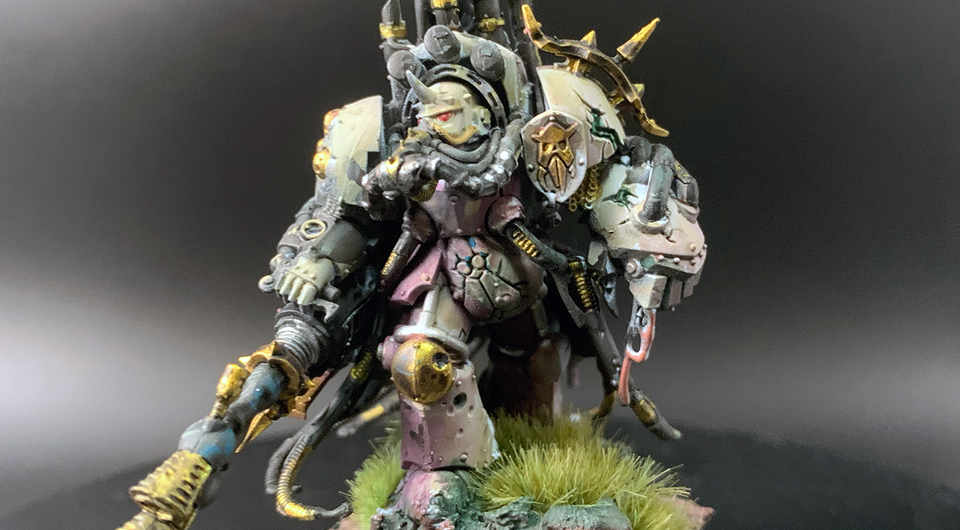
The Lord of Virulence[1] is deep inside the Death Guard. The armour is swollen and mutilated, pipes breaking through the surface, fumes escaping around him. The person underneath is almost secondary to the machinery that has grown around him. Official descriptions call the Lords of Virulence masters of bombardment whose duty is to “amplify the spread of the Death Guard in battle”. Their armour does not merely protect them from the environment they inhabit. It participates in it. Noxious fumes pour from the suit, and even those fumes have become useful, their colour and smell guiding artillery fire from behind the lines.
The Death Guard have always endured. That was true long before Nurgle. Mortarion chose warriors who could survive poisonous worlds and brutal campaigns, and the Legion built much of its identity around taking what other armies could not. After their corruption, disease no longer injured them.
The damaged condition has become part of what they are.
During the Charadon campaign[2], one Lord of Virulence, Ghulgh Thraxoplasmox[3], commanded a large Death Guard warband called the Tide of Filth, serving Typhus as the campaign spread through the sector. He is described as methodical and relentless.
At one point, his Pox-seers led him to an Imperial silo containing hundreds of untouched battle tanks. There are probably several obvious things a Death Guard commander could do with a cache like that. Destroy it. Deny it to the enemy. Leave it ruined behind them.
Thraxoplasmox summoned the Tide of Filth and ordered the tanks corrupted so they could be absorbed into his own forces.
The Death Guard do this repeatedly. They do not always leave dead things behind them. Sometimes they leave working things that now belong to the conditions they have created. Machines are corrupted. Worlds are reshaped.
The Lord of Virulence is not waiting to be released from the corruption of Nurgle. The blessings of Nurgle are what define him now. Grants him his position on the battlefield and determines his armour and weapons. The things he would have wanted to get away from have become the things that make him effective.
Mortarion selected the Deathshroud from among the Legion’s most capable veterans before Nurgle had blessed the army. These warriors had survived where the rest of their squad had fallen in war, showing a resilience that attracted Mortarion’s selection. They became his silent bodyguard, with at least two remaining within forty-nine paces of him.
Ten thousand years later, the Deathshroud remains. Many things have changed since their appointment was first granted: their armour has changed; their Primarch has changed; the world around them has become different from the one in which they were first chosen.
But there they are. Still close to Mortarion. Still no more than 49 paces away.
III. What Is Not Yet Finished
“It is a question of learning hope. Its work does not renounce, it is in love with success rather than failure. Hope, superior to fear, is neither passive like the latter, nor locked into nothingness. The emotion of hope goes out of itself, makes people broad instead of confining them, cannot know nearly enough of what it is that makes them inwardly aimed, of what may be allied to them outwardly. The work of this emotion requires people who throw themselves actively into what is becoming, to which they themselves belong.” [4]
Ernst Bloch begins The Principle of Hope[5] by building upon the important premise that hope is something that can be learned, cultivated, and directed toward what has not yet happened.
It makes people larger than they currently are. Growing, rather than slowing. Allowing people to align themselves inside to what they see themselves being in the world.
Hope is not waiting.
Much of The Principle of Hope turns toward what he calls the Not-Yet, and particularly the Not-Yet-Conscious: possibilities that are not fully present, but which are not therefore unreal. The present is not complete.
Bloch’s language keeps returning to that unfinished quality. Hope begins with the possibility that what is before us has not yet become everything it could be.
Minima Moralia[6], subtitled Reflections from Damaged Life, looks at the way larger social and economic conditions do not remain outside our private lives. Theodor Adorno looks at how larger forces shape society: work, money, institutions, social expectations and the demand for us to adapt to the world.
“Wrong life cannot be lived rightly.” [7]
An individual cannot construct a good life for themselves while remaining inside social conditions that produce suffering and distortion. Like the way a shadow of something outside a window will alter the light inside the room.
Adorno’s formulation does not separate the individual from the world in which they must live. Small habits, private comforts and personal decisions remain inside the world that is pressing its influence upon us.
Lastly, Emil Cioran spent much of his writing suspicious of hope. Where Bloch asks that hope be learned, Cioran wonders what might happen if we were finally released from it.
“One is and remains a slave as long as one is not cured of hoping.”
Hope becomes attachment. To hope for something is to remain bound to something that has not happened. Yet Cioran never seems entirely convinced that human beings can remove hope altogether. In The Trouble with Being Born[8], he writes that:
“However disabused one may be, it is impossible to live without any hope at all. We always keep one, unwittingly, and this unconscious hope makes up for all the explicit others we have rejected, exhausted.”
Hope can bind us, and yet some remainder of it seems difficult to extinguish.
Cioran wonders whether freedom might lie in no longer expecting anything from the world, while admitting that perhaps expectation never disappears completely.
IV. What Remains Possible
The Lord of Virulence’s armour, weapons, and authority are all extensions of the blessings Nurgle has bestowed upon him. Disease is not something interrupting his life. Corruption is not a temporary state to be endured. These are parts of him now, his identity and personality are forged together with the corruption and infestation.
The Deathshroud have remained beside Mortarion through the fall of the Legion, Nurgle, the transformation of their Primarch and ten thousand years of war. Their armour has changed. Their bodies have changed. Almost everything around them has changed. But their role has not been altered.
They stand where they have always stood. And that is where the three philosophers start to diverge.
Bloch keeps something open.
The present does not have the final word simply because it is the present. His Not-Yet leaves space between what exists and what might still exist. Hope does not require us to deny the conditions in front of us. It only refuses to grant those conditions the authority to define everything that remains possible.
Adorno holds onto a different distinction.
A person may learn how to live inside damaged conditions. They may become capable, comfortable, and even successful. But the ability to continue living in those conditions does not make them right. The outside world still reaches inward. The shadow still changes the light inside the room.
The Death Guard have become extraordinarily good at living inside their world. There is little separation left between the pestilence of Nurgle and the lives of the Guard. For the Lord of Virulence, the corruption is armour, rank, and purpose. For the Deathshroud, endurance has become ritual and identity.
Nothing in them appears to be asking whether another condition remains possible.
Cioran makes that absence harder to dismiss. “One is and remains a slave as long as one is not cured of hoping.” If we stop measuring the present against another possible version of life, then some of the struggle disappears with it. There is nothing left to wait for. Nothing left to compare.
But Cioran later admits that “it is impossible to live without any hope at all.”
Perhaps the Death Guard are not without hope either.
The Lord of Virulence still expects something from the future. More worlds can be taken. More machines can be absorbed. More of the galaxy can be brought into the conditions he already knows how to inhabit.
The future has not disappeared. What has disappeared is the expectation that it might be fundamentally different.
V. Adaption is Not the Same As Acceptance
There are things we eventually have to stop fighting. That does not mean we approve of them. Sometimes it simply means that reality has won an argument we could not keep having every morning. Life has to begin again from wherever we have been dropped into.
I think there is something healthy in that.
The first essay in this series worried about the moment when an alarm had been sounding for so long that we stopped hearing it. The second looked at how quickly we can build a life around conditions that once seemed temporary. The third moved further out, toward the systems that keep functioning even while the world around them becomes harder to live.
All of those things depend upon one of our better qualities. Our ability to adapt.
Without that ability, grief might never soften enough for us to get out of bed. A difficult year might remain impossible to see the end of it. Every change would demand the same amount of attention on the thousandth day that it demanded on the first.
We would not survive very long.
We must accept the world in front of us, but we must not let that acceptance become the only world we can imagine. Cioran understood something about that. Hope can keep us attached to things that may never arrive. Sometimes expectation itself becomes exhausting.
Bloch refuses to let the future close so easily.
Adorno refuses to let our ability to live inside damaged conditions turn those conditions into something right.
The Death Guard have reached a kind of calm. They do not appear to mourn what they were. The Lord of Virulence has made corruption useful. The Deathshroud have stood beside Mortarion for ten thousand years. Their world has changed so completely that there is almost nothing left against which to measure it.
They have survived the horror of Nurgle. They have adapted to it.
For us, there is a difference between saying, “this is the world I have to live in”, and saying, ”this is all the world can ever be”.
Hope lives somewhere in the space between those two sentences.
Original Link: Wiki - Lord of Virulence
Snapshot: Internet Archive ↩︎Original Link: The Charadon Campaign
Snapshot: Internet Archive ↩︎Original Link: Wiki - Ghulgh Thraxoplasmox ↩︎
Original Link: The Principle of Hope Introduction
Snapshot: Internet Archive ↩︎Bloch, Ernst. The Principle of Hope. United States: MIT Press, 1986. ↩︎
Adorno, Theodor. Minima Moralia: Reflections from Damaged Life. United Kingdom: Verso Books, 2020. ↩︎
Original Link: Wrong life cannot be lived rightly.
Snapshot: Internet Archive ↩︎Cioran, E. M.. The Trouble With Being Born. United Kingdom: Penguin Books Limited, 2020. ↩︎